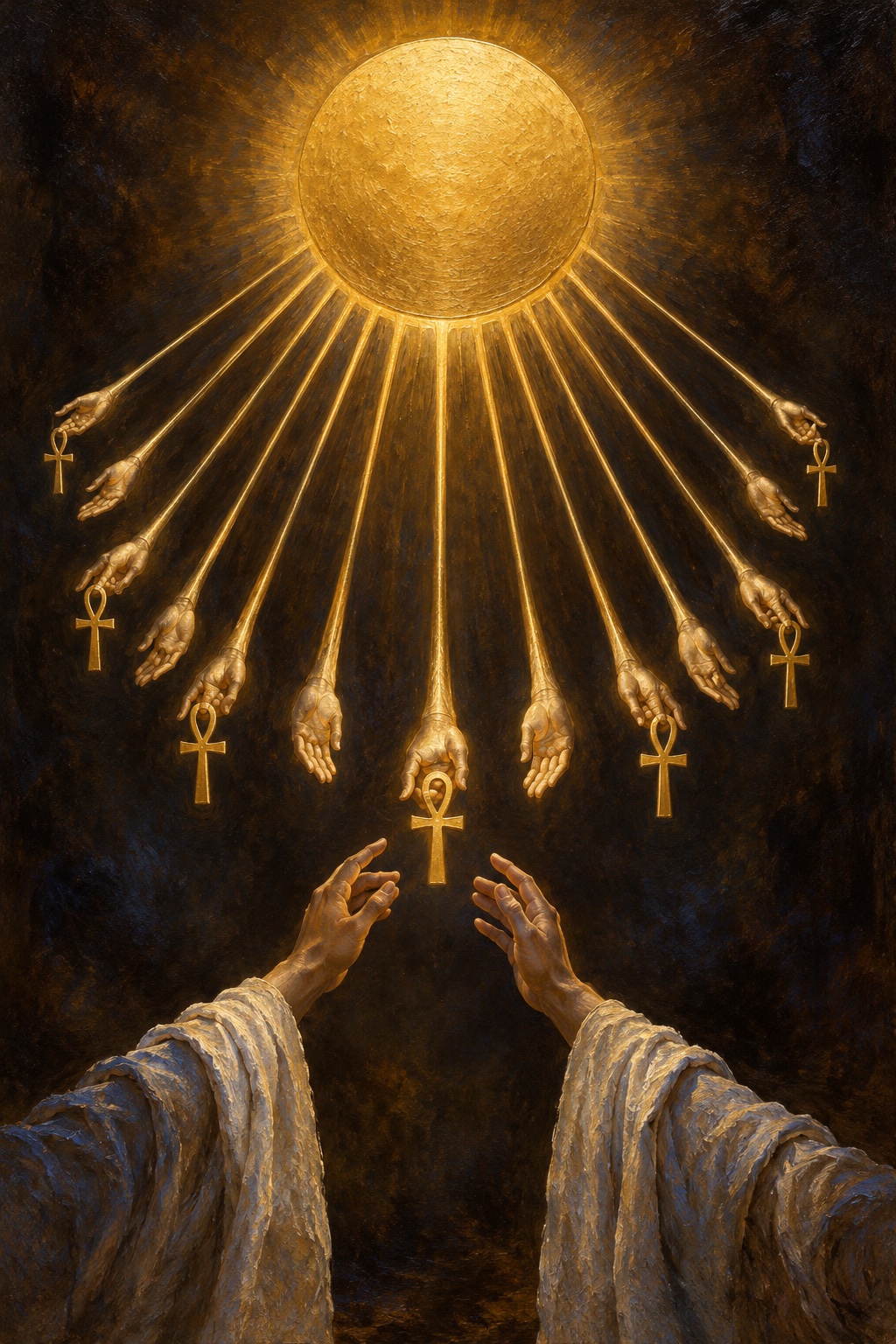
The disk whose rays end in hands
Aten is the disk of the sun. Budge gives him a chapter of his own, and its title names him twice, as a god and as the disk. His first sentence keeps both senses: Aten, he writes, appears to have stood for the god or spirit of the sun and also for the solar disk itself. Of the god’s early history Budge knows almost nothing. Under the Middle Empire, he says, Aten was a small provincial form of the sun-god, worshipped in one of the little towns near Heliopolis, and perhaps with a temple in Heliopolis itself. The texts written before the Eighteenth Dynasty do not say what powers he was first given.
The name is older than the cult. In the Theban Recension of the Book of the Dead the dead speak to Ra, and Aten comes into their words as a part of him: Ra shines from the horizon of heaven, and Aten is adored when he sets; Ra renews himself and grows young again under the form of Aten. From such lines Budge concludes that Aten was then the material body of the sun in which Ra lived, the visible sign of the great sun-god. That is the sense in which this atlas records Aten as identified with Ra. Under the Eighteenth Dynasty the god found royal protectors, first Amen-hetep III. and then his son Amen-hetep IV., and in their reigns, Budge says, Aten was made to take over all the titles and powers of the old sun-gods, Ra-Heru-khuti and Horus among them. Budge warns that it does not follow that these were ever Aten’s own.
The cult of that new god used one image, and Wiedemann describes it.
The god was always represented under the form of the solar disk, with rays downspread towards earth and severally terminating in hands. These hands are often depicted as presenting to the king, or shedding abroad upon the world, the symbols of life, power, or other blessings — Alfred Wiedemann, Religion of the Ancient Egyptians (1897), p. 39
Wiedemann adds in his next sentence that the Aten is never shown in human form. The god has no body and no face. It has the disk, the rays, and the hands at the ends of the rays. Budge describes the same figure and names two signs that the hands hold, the emblems of life and of sovereignty. In the reliefs and the paintings, he says, the rays shine on the king, on his queen and their family, and on the cartouches that hold the names of the king and the queen. Budge thinks that the heresy, as it was called, may have rested in some way on what its followers believed about this way of showing the god, and he notes that Amen-hetep IV. loved to be shown with the rays and their hands falling on him. A figure in Wiedemann, from the tomb of Ai at Tell el Amarna, shows the king, whom Wiedemann calls Khuenaten, on a balcony with his family, giving out rewards, while the Aten stretches its rays over them all.
The hymn
Wiedemann says that the worship of the Aten was mostly solemn processions, in which the king and his family took part, and the singing of a hymn. He prints one version, with a few small omissions, from the tomb of Ai, a high official of the time, at El Amarna. Budge prints another version, which he numbers line by line, and in his version the hymn is the king’s own speech to the god. Its morning is a coming of light.
Light is the earth when thou risest on the horizon and shinest as Aten by day ; darkness flees ; Thou sendest forth thy rays and the world is full of joy day by day — Alfred Wiedemann, Religion of the Ancient Egyptians (1897), p. 40, “Hymn to the Aten”
The hymn speaks to the god directly, and the name it gives him is the name of the disk: he shines as Aten by day. The rays come into the hymn as they come into the reliefs. They are what the god sends out, and the world receives them as joy. The hymn then turns from the day to the beginning of things.
Thou createdst the earth according to thy will when thou wast alone : Men, herds, all flocks, All that is upon earth and goeth upon feet, All that is on high and flieth with wings, The lands of Syria, of Kush, and of Egypt — Alfred Wiedemann, Religion of the Ancient Egyptians (1897), p. 41, “Hymn to the Aten”
Two things in this passage carry the cult. The first is the clause “when thou wast alone”. The god made the earth by itself, and no other god does any work in this hymn. The second is the list of lands. Syria and Kush come before Egypt, and Egypt comes last. The next lines say that the god set each land in its place and gave each what belongs to it, and that he gave the peoples speech and forms that follow the colours of their skins. Budge’s version gives the foreign lands their own water. In his version the god makes the lives of the foreign peoples too, and “Thou makest Hapi in heaven to come down to them”: the Nile of the other countries falls from the sky, while the Nile of Egypt comes up from the Underworld. The god of this hymn is not a god of Egypt alone.
Budge also notes what the hymn leaves out. It names no enemies of the sun. Apep and the other fiends whom Ra overcame at his rising are absent. There is no Khepri, whom Budge calls Khepera, and no Thoth or Ma’at, who served the sun-god each day, and there are no boats in which Ra crossed the sky. The old myths of Ra are ignored. The hymn keeps one other figure. Near its end the speaker says that none knows the god except his son, and the son is the king. Wiedemann’s version closes the same way, on the son who came forth from the god’s body, the king Khuenaten, and on his great royal wife. Wiedemann then notes that the Aten, as king of the world, was even given a cartouche, as the king and the queen were. In the inscription the god is called Ra Harmakhis, who rejoices on the horizon in his name of Shu, who is in the Aten.
A god with no other beside him
The new cult kept many of the old forms. Budge says that the temple of Aten in the king’s new city had the same name as the temple at Heliopolis, and that the high-priest of Aten took the title of the high-priest of Ra at Heliopolis. On fixed occasions the king himself led the worship. But the old worship of Aten had been tolerant, and the new one was not. The reliefs show Aten as the giver of all life on earth, with the heat and the light of the sun as his signs, and Budge then states what was new.
Aten was also the one physical body of the Sun, and the creed of Aten ascribed to the god a monotheistic character or oneness, of which it denied the existence in any other god — E. A. Wallis Budge, The Gods of the Egyptians (1904), vol. 2, p. 73
The sentence makes two claims, and only the second is new. Egypt had many gods of the sun, as the titles that Aten took over show. What the creed of Aten added was a denial: the oneness that it gave to Aten, it refused to every other god. Budge draws the consequence: Aten could not absorb another god and could not be absorbed by one, because he had nothing in common with the other gods of Egypt. That set him apart from the other gods of the sun. Wiedemann notes that from the start of the New Kingdom the sun-gods seldom appeared alone: they were generally fused with other gods, as in Amen Ra and Khnemu Ra. Aten could not be joined in this way. Budge also limits the word monotheism. He rejects two comparisons that others had made, with the worship of the Hebrews and with the Phoenician god Adon. The religion was monotheistic, he says, in so far as it rejected all other gods. But its texts hold no teaching on the unity of the god of the kind found in the hymns to Ra, and none of the ideas about the life after death that the Book of the Dead holds.
Budge then sums up what the followers of the cult said about their god.
Aten had existed for ever, they said, he was beautiful, glorious, and self-existent, he had created the sun and his path, and heaven, and earth, and every living being and thing therein, and he maintained the life in man and beast, and fed all creatures according to his plans, and he determined the duration of their life. Everything came from Aten, and everything depended upon him ; he was, moreover, everlasting — E. A. Wallis Budge, The Gods of the Egyptians (1904), vol. 2, p. 79
The words “they said” mark this as a report of the cult’s doctrine, not Budge’s own view. The list is a creator’s list: the god exists for ever and by himself, he makes heaven and earth and every living thing, he keeps them alive and feeds them, and he sets the length of their lives. One item stands out. Aten, the disk of the sun, is said to have created the sun and its path. In this creed the disk is no longer a part of the sun. It is the god who made it. Budge adds that the priests of Aten proclaimed the unity of their god in words that made the priests of Amun angry.
A capital for the god
Thebes was the city of Amun. Since the expulsion of the Hyksos, Budge says, the local god of Thebes had been the head of the gods of Egypt, because he was the god of the princes who had won. Budge ties the oneness of Aten to the move that followed.
it is evident that they wished to give a monotheistic character to the worship of Aten, and it was, manifestly, this characteristic of it which made the king and his god detested at Thebes ; it accounts for the fact that Amen-hetep IV. felt it to be necessary to build a new capital for himself and his god — E. A. Wallis Budge, The Gods of the Egyptians (1904), vol. 2, p. 79
Budge argues the point from the place the king did not choose. Amen-hetep IV. called himself the high-priest of Heru-khuti, a god greatly honoured at Memphis and Heliopolis, so he could have lived in either of those old religious centres. He went to neither. Budge concludes that the worship of Aten could not bear the presence of another god, and still less of many gods, and that this was monotheism. Wiedemann tells the same move from Thebes. At first, he writes, the king lived at Thebes, and he meant to build there a great temple to Ra Harmakhis Aten, with an obelisk and its sacred buildings.
But the opposition of the Theban priesthood prevailed ; the king forsook the city, accompanied by all his court, and on the site of Tell el Amarna in Middle Egypt he founded a new capital wholly dedicated to the worship of the Sun — Alfred Wiedemann, Religion of the Ancient Egyptians (1897), p. 39
The two writers give the move two causes. In Budge, the cause is the creed: the oneness of Aten made the king and his god hated at Thebes. In Wiedemann, the cause is the priesthood of Thebes, who opposed the king and won. The two causes fit together, because the priests who opposed the king were the priests of Amun. Wiedemann adds that the king seems at first to have tried to carry out his reform in a friendly spirit, and that the opposition made him a fanatic.
Budge calls the new city Khut-Aten. The national archives went there with the court, Wiedemann says, and the tombs of the king’s followers, with the ruins of the temple and the palaces, give almost all that is known about the worship of the Aten. Budge describes that worship as joyful. Incense was burnt several times a day, harps and other instruments played with the hymns, and the people brought fruit, flowers and the produce of their gardens to the altars. No animal was killed on those altars. The painters of the city worked in bright colours and in new forms, and Budge says that only in this reign did an Egyptian artist show that he understood light and shade.
The return of Amun
The new cult did not only raise Aten. It also struck at the god it had replaced.
The name of Amen, in whom he recognized the chief rival of the Aten, was erased from the monuments — Alfred Wiedemann, Religion of the Ancient Egyptians (1897), p. 43
Amen is Wiedemann’s spelling of Amun, and the “he” of the sentence is the king. The rivalry in this atlas’s relations comes from this sentence. Wiedemann goes on to say that the name was cut out even in the tombs, that it was looked for on small objects such as funerary stelae, and that it was removed even where it formed part of a person’s name. Budge adds that the king cut out the figure of Amun as well as the name.
The cult of Aten did not last long after the king who made it. Budge follows its end through the kings who came after Amen-hetep IV. The first was Tut-ankh-Amen, who married a daughter of the dead king. Her name was Ankh-s-en-pa-Aten, and she changed it to Ankh-s-en-Amen. Tut-ankh-Amen began to restore the name and the figure of Amun where his father-in-law had cut them out, made terms with the priests of Amun, and moved his court back to Thebes. The next king, Ai, had been a follower of Aten and had built a tomb for himself in the new city, but as king he built another tomb at Thebes, and its sarcophagus shows that he had rejected the cult. After Ai came rival claimants and a time of disorder, and then Heru-em-heb, whom the priests of Amun had put forward. Budge says that Heru-em-heb used all his power to stamp out every trace of the worship of Aten, and that he succeeded.
Thus Amen-Ra conquered Aten, Thebes once more became the capital of Egypt, the priests of Amen regained their ascendancy — E. A. Wallis Budge, The Gods of the Egyptians (1904), vol. 2, p. 84
Budge tells the end as a war won. Amun, joined with Ra as Amen-Ra, conquered the disk. His city was the capital again, and his priests were back in power. Budge adds that in less than twenty-five years after the king’s death his city was deserted. Wiedemann describes the same reversal. The capital was abandoned and never lived in again, the temples of the Aten were destroyed, and the names of the god and of the king were cut out in their turn, as the king had cut out the name of Amun. After that, the god is seldom named. Wiedemann says that Heliopolis seems to have been the one place where a sanctuary of the Aten survived, so the god ended near the place where, by Budge’s account, he had begun.