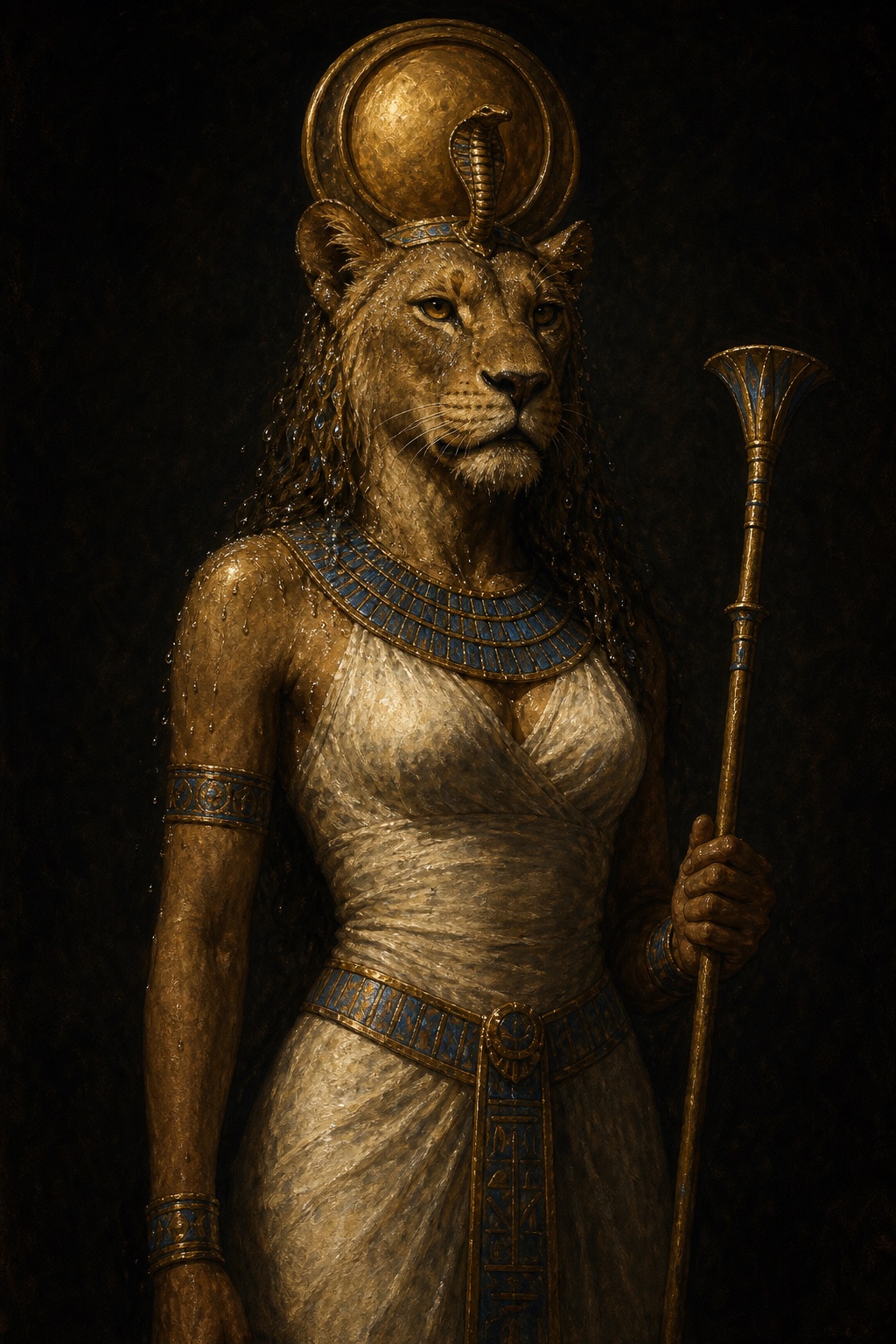
Tefnut is Shu’s twin and counterpart, produced with him from Atum’s own body at the beginning, and where he is dryness and air she is what is wet. Budge connects her name to a root meaning to spit or to be moist.
“and Tefnut was a personification of the moisture of the sky” — E. A. Wallis Budge, The Gods of the Egyptians (1904), vol. 2, p. 87
That is a smaller portfolio than it sounds in a country where rain is rare. Egypt is watered by the Nile, not the sky, so the moisture Tefnut governs is the marginal kind — dew, mist, the damp of early morning, the occasional soft rain of the Delta. Budge notes that she was originally a goddess of gentle rain and soft wind, and that in the Book of the Dead she does little for the deceased beyond providing breath, which she does jointly with her brother: the two of them together are simply the atmosphere.
Her striking story is the one where she leaves. In the myth of the Distant Goddess, Tefnut — identified here with the Eye of Ra — quarrels with her father and goes south into Nubia, where she takes the form of a raging lioness and kills whatever comes near. Egypt without her dries out. Ra sends Thoth after her, and Thoth, unable to compel a goddess in that state, does the only thing available: he tells her stories, flatters her, argues, and gradually talks her into coming home. Her return is celebrated as a festival, and the raging lioness becomes the gentle cat again at the border. It is a myth about the annual arrival of the inundation and about the necessity of appeasement, and it is unusual in giving the decisive role to persuasion rather than to force.
She is depicted as a woman with a lioness’s head under the solar disk, or simply as a lioness, and she blurs readily into the other dangerous feline goddesses — Sekhmet, Menhit, Bastet — whom Budge lists her as being identified with in various cities. Together with Shu she completes the first generation: from Atum come air and moisture, from air and moisture come earth and sky, and from earth and sky come Osiris, Isis, Set and Nephthys, which is the whole of the Ennead in three steps.