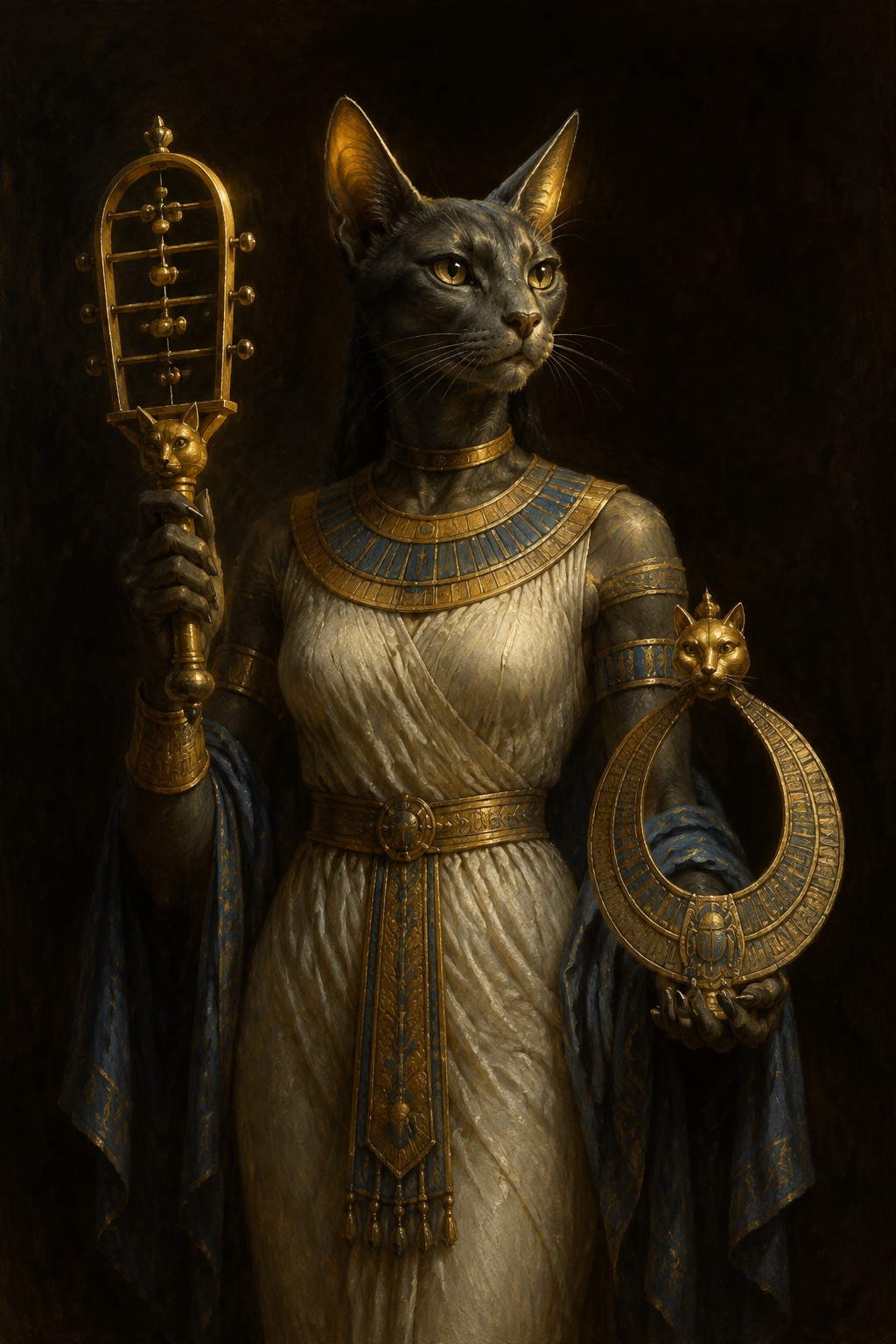
A cat’s head, and a lioness’s
Budge gives her two bodies in one sentence, and the difference between them is the whole of her character.
“The goddess Bast is usually represented in the form of a woman with the head of a cat, but she also has, at times, the head of a lioness surmounted by a snake” — E. A. Wallis Budge, The Gods of the Egyptians, vol. 1
The cat is the form the cult is remembered by, and Budge says it is the older one: the goddess was worshipped as a cat first, and the identification with the lioness came comparatively late. Her hands are furnished in the same passage — a sistrum held up in the right, an aegis with a small cat’s or lioness’s head on it in the left. The sistrum is a rattle used in temple music, not a weapon. Nothing she carries is for fighting.
The name is Budge’s spelling of hers: he writes Bast throughout, and Bastet is the form the wiki’s other entries already use.
Old in the Delta
Her city is Per-Bast, the House of Bast, which Greek writers called Bubastis and Ezekiel called Pibeseth. Budge’s argument for her antiquity does not rest on the city, though; it rests on a line in a pyramid.
“This fact shows that the worship of Bast was already very old in Egypt, at all events in the Delta, and that a definite position was assigned to her in the theological system of the priests of Heliopolis” — E. A. Wallis Budge, The Gods of the Egyptians, vol. 1
The fact in question is that Pepi I’s funerary inscription says the king’s heart is the heart of Bastet. A goddess who is already a figure of speech in a Sixth Dynasty royal text was not invented for the Delta cult that later made her famous; she was there to be borrowed. Her festivals were kept in the spring, and by the Stele of Canopus the great ones at Bubastis fell in April and May.
The other cat goddess
The wiki already has her opposite number. Sekhmet is the lion-headed daughter of Ra sent to destroy mankind, and Budge sets the two of them out as a matched pair rather than as duplicates: Sekhet personifies the burning, destructive heat of the sun, and Bast the milder heat that at certain seasons brings on the growth of vegetation and the germination of seed. Same sun, two temperatures. The green-painted lioness head is Bast as sunlight; the cat head, Budge argues after Brugsch, is Bast as the moon, because the pupil of a cat’s eye widens as the moon fills.
That pairing is also why she turns up in the Memphite family. Introducing Nefertum, Budge offers three possible mothers in a single sentence — Ptah and Sekhet, or Ptah and Pakht, or Ptah and Bast — and this wiki’s Nefertum entry keeps that sentence’s uncertainty rather than resolving it. Bastet is one of the three, and the entry here says so without claiming the other two are wrong.
The soul of Isis, and a silence
Two of Budge’s remarks about her point in opposite directions and are worth keeping side by side. The first makes her enormous:
“According to one legend Bast was the personification of the soul of Isis” — E. A. Wallis Budge, The Gods of the Egyptians, vol. 1
The second makes her nearly absent:
“Bast and her city are very rarely mentioned, and her name is entirely omitted from the list of the gods mentioned in connexion with the deification of members” — E. A. Wallis Budge, The Gods of the Egyptians, vol. 1
The second is about the Theban recension of the Book of the Dead — the funerary text this wiki quotes constantly for Anubis, Thoth, Maat and Nefertum. In the book that matters most for the Egyptian dead, the goddess of Bubastis is barely there, and she is missing entirely from the chapter that assigns a god to every part of the body.
Both things are true at once, and the reason is geography. Bastet is a Delta goddess whose cult ran on a different circuit from the Theban funerary industry: enormous at Bubastis, absorbed into Mut at Thebes and into Iusaaset at Heliopolis, and thin in the papyri because those were written by other priesthoods. Her survival into the modern imagination has nothing to do with the Book of the Dead. It has to do with the cats.