Rising like the lotus at the nostrils of Ra
Budge places Nefertum inside a single recurring act rather than a longer myth: he is what a person becomes at the exact moment the sun returns. In the Theban Recension of the Book of the Dead, the deceased claims that transformation in the first person, taking on the god’s own defining moment as their own.
I rise like Nefer-Tem, who is the lotus at the nostrils of Ra, when he cometh forth from the horizon each day — E. A. Wallis Budge, The Gods of the Egyptians, vol. 1 (1904), p. 521 (quoting the Book of the Dead, Theban Recension, Ch. clxxiv.19)
To rise “like Nefer-Tem” is to become the lotus itself, opening at Ra’s face as he climbs clear of the horizon — the sun’s own daily return, borrowed as the shape of the dead’s own rebirth. Nefertum carries both halves of that image at once, named for the sunrise and pictured as the flower that makes it visible, which is why this wiki tracks him under both sun and rebirth rather than either alone.
The thirty-fourth Assessor in the Hall of Maati
The same volume gives Nefertum a second appearance, and a very different one: not cosmic repetition but a fixed seat in a tribunal, one of the forty-two named Assessors the dead must address one by one in the Hall of Maati. Budge’s translation preserves the deceased’s address to him directly, naming his cult city in the same breath as the denial of wrongdoing:
Hail, Nefer-Tem, who comest forth from Het-ka- Ptah (Memphis), I have not acted with deceit, and I have not worked wickedness — E. A. Wallis Budge, The Gods of the Egyptians, vol. 1 (1904), p. 521
Budge’s own parenthetical glosses Het-ka-Ptah as Memphis in the same line — the city this wiki’s own Ptah entry already names as his cult seat — so the address ties Nefertum to his father’s city even in a scene built around the deceased’s own conduct, not around genealogy. The seat is real and specific, the thirty-fourth of forty-two, but it is one place in a hall Ma’at’s own feather already governs elsewhere in the same trial; the text gives Nefertum a place in the tribunal, not authority over it.
A son of Ptah, and a mother Budge will not settle on
This wiki’s own Ptah and Sekhmet entries already agree on Nefertum’s parentage: both list him as their child, and each names the other as consort. Budge’s account of the Memphite triad, in the same volume that supplies both passages above, does not close the question so neatly.
Ptah as father is the one point every version agrees on; only the mother moves. Sekhmet is the option this wiki follows elsewhere, both because it is Budge’s first-listed choice and because it is the pairing the Memphite triad is best known by, but the disagreement itself is Budge’s own, sitting inside a single sentence rather than between competing sources.
Sceptre, lotus, and the lion he stands upon
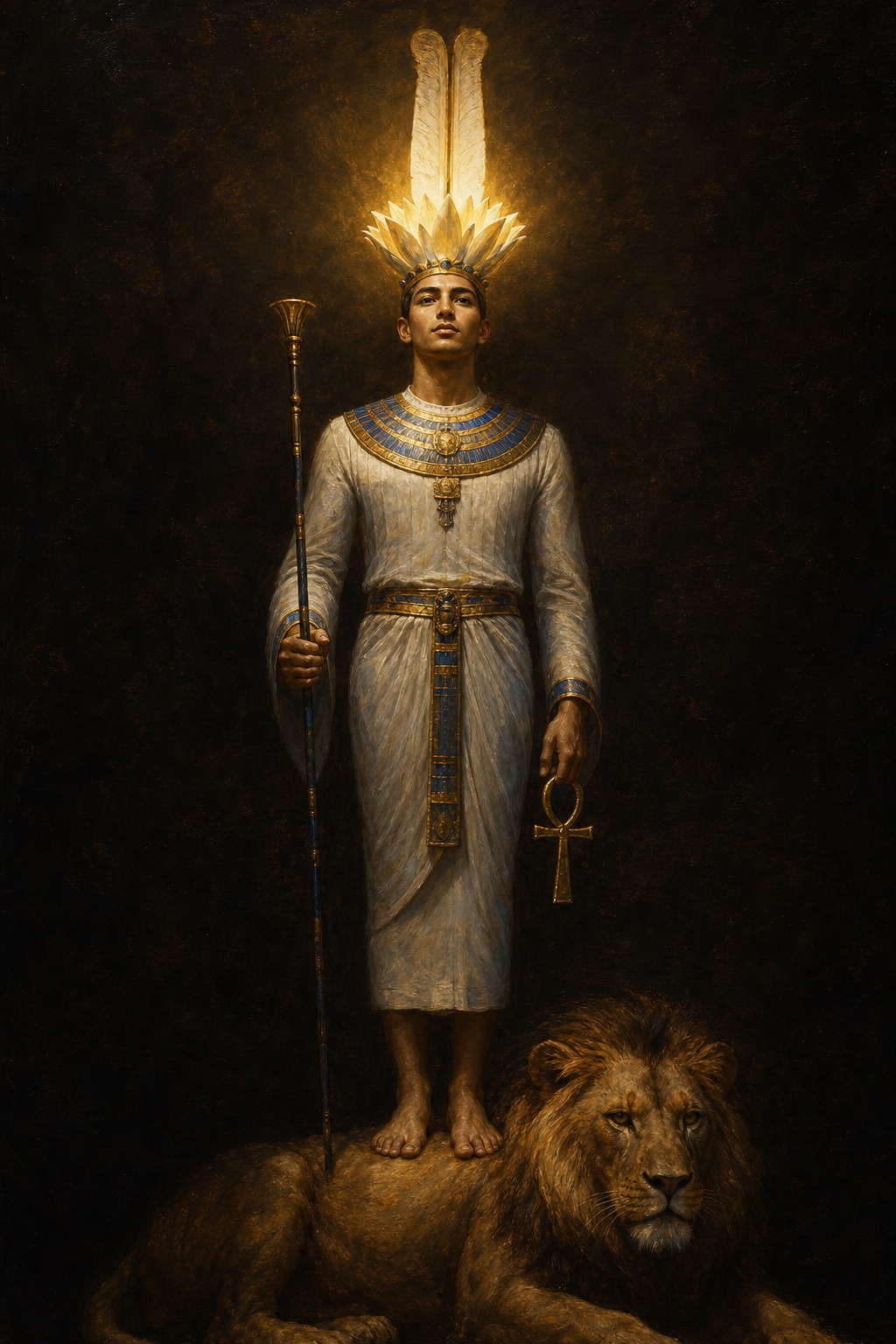
Where the sunrise passage gives Nefertum an act and the Hall of Maati passage gives him a seat, Budge’s fuller description of his cult image gives him a body. He is shown as a man, holding in his hands either the tcham sceptre together with the ankh, the sign of life, or a lotus sceptre topped with plumes; in some depictions he wears the lotus flower itself on his head, alone or crowned with the same plumes. Blue-and-green glazed porcelain statues of the god go a step further and give him a perch: they stand him upon a lion.
A second, stranger form exists alongside the standing man. In some images Nefertum takes a lion’s head instead of a human one, set on a mummiform body wrapped close enough that only his hands project from the garment, holding the tcham sceptre again, now paired with a flail rather than the ankh. Between the two forms he shares an emblem with each side of his family: the sceptre and ankh he holds recall the sceptre and ankh Ptah himself carries, and the lion’s head recalls the lioness who, in Budge’s own account, may or may not be his mother.