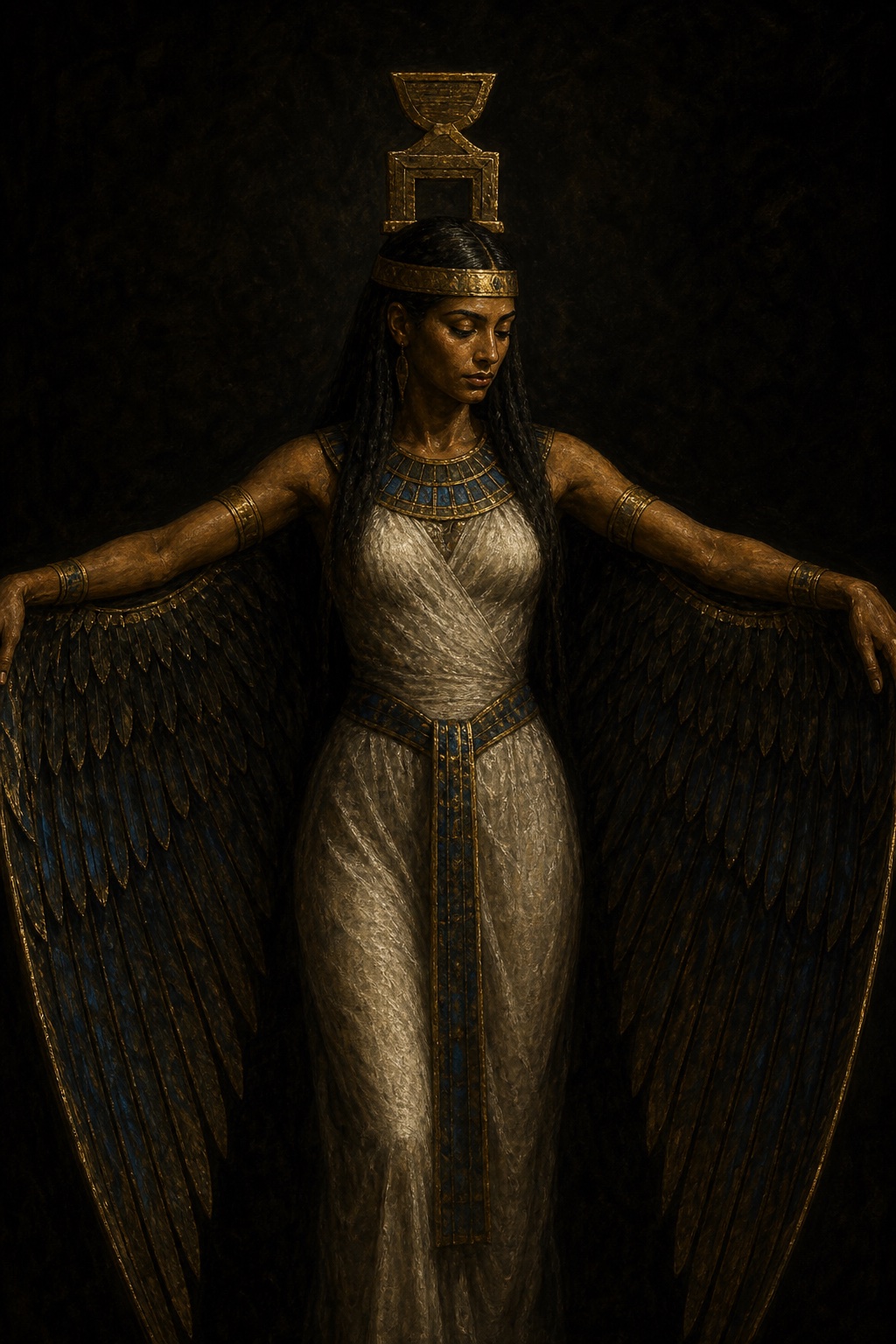
Nephthys is the fourth child of Geb and Nut, and the one who is almost never alone. Her name — Nebet-hut, “lady of the house” — is written with a basket above the sign for an enclosure, and she wears those two hieroglyphs on her head as a crown, so that her image is her name. She is married to Set, the murderer of Osiris, and yet at every point in the story that follows she stands with Isis against him: it is Nephthys who searches the Delta beside her sister, Nephthys who helps assemble the scattered body, Nephthys who takes the kite’s form and keens over the corpse until the words of power take hold.
That doubling is the whole of her. Egyptian art almost always shows the two sisters as a matched pair, one at the head of the bier and one at the foot, wings spread over the dead — Isis mourning at the head, Nephthys at the feet. Where Isis is the mother who acts, Nephthys is the one who accompanies; where Isis is the visible world, later commentators put Nephthys on the side of what is hidden. She bears Anubis, in most tellings by Osiris rather than by her own husband, and the jackal who guides the dead through the weighing of the heart is thus her son.
She was the opposite of Isis in every respect; Isis symbolized birth, growth, development and vigour, but Nephthys was the type of death, decay, diminution and immobility. — E. A. Wallis Budge, The Gods of the Egyptians (1904), vol. 2
That reading is Budge’s own, and it flattens her a little: the Egyptians did not treat her as a goddess of endings so much as of the interval before a return. She is present at the death and present at the raising, and the funerary texts pair her name with her sister’s so consistently that to invoke one is very nearly to invoke both. Her protection is quiet, structural, and assumed — the kind you notice only in its absence.