The vulture of the South
Before Egypt had one king, on Budge’s account, it had two sacred animals, one for each half of the country. In predynastic times the uraeus was worshipped in the Delta, at the place the Egyptians later called Per-Uatchet and the Greeks called Buto. In Upper Egypt at the same period the chief object of adoration was the vulture, and its principal sanctuary was the city of Nekheb. The vulture goddess is Nekhebet, or Nekhebit, the second spelling Budge gives beside the first and the one his translation of the Edfu legend uses in its later chapters. The uraeus goddess is Uatchet, whom modern writing calls Wadjet. The Greeks called the southern city Eileithyiaspolis and the Latins Civitas Lucinae; its site is the modern village of El-Kab. Those are names for the town. Budge never says in his own voice that the Greeks equated the goddess herself with any goddess of theirs, and this entry records no equivalent for her.
The two goddesses are almost never apart. Budge calls Uatchet her twin sister, and the twinship is geographical rather than genealogical: one of them is the South and the other is the North. The plainest statement of it comes from his description of the Metternich Stele, a late protective slab cut with nearly three hundred figures of gods, where the pair appear on its face.
On the left and right are the goddesses Nekhebet and Uatchet, who guard the South of Egypt and the North respectively. — E. A. Wallis Budge, Legends of the Gods (1912), introduction
The stele, Budge says, formed a barrier to every spirit of evil and every venomous reptile, whichever way it stood. The two goddesses are on it for the same reason they are on everything else in this entry: between them they cover the whole country, and nothing gets past both halves.
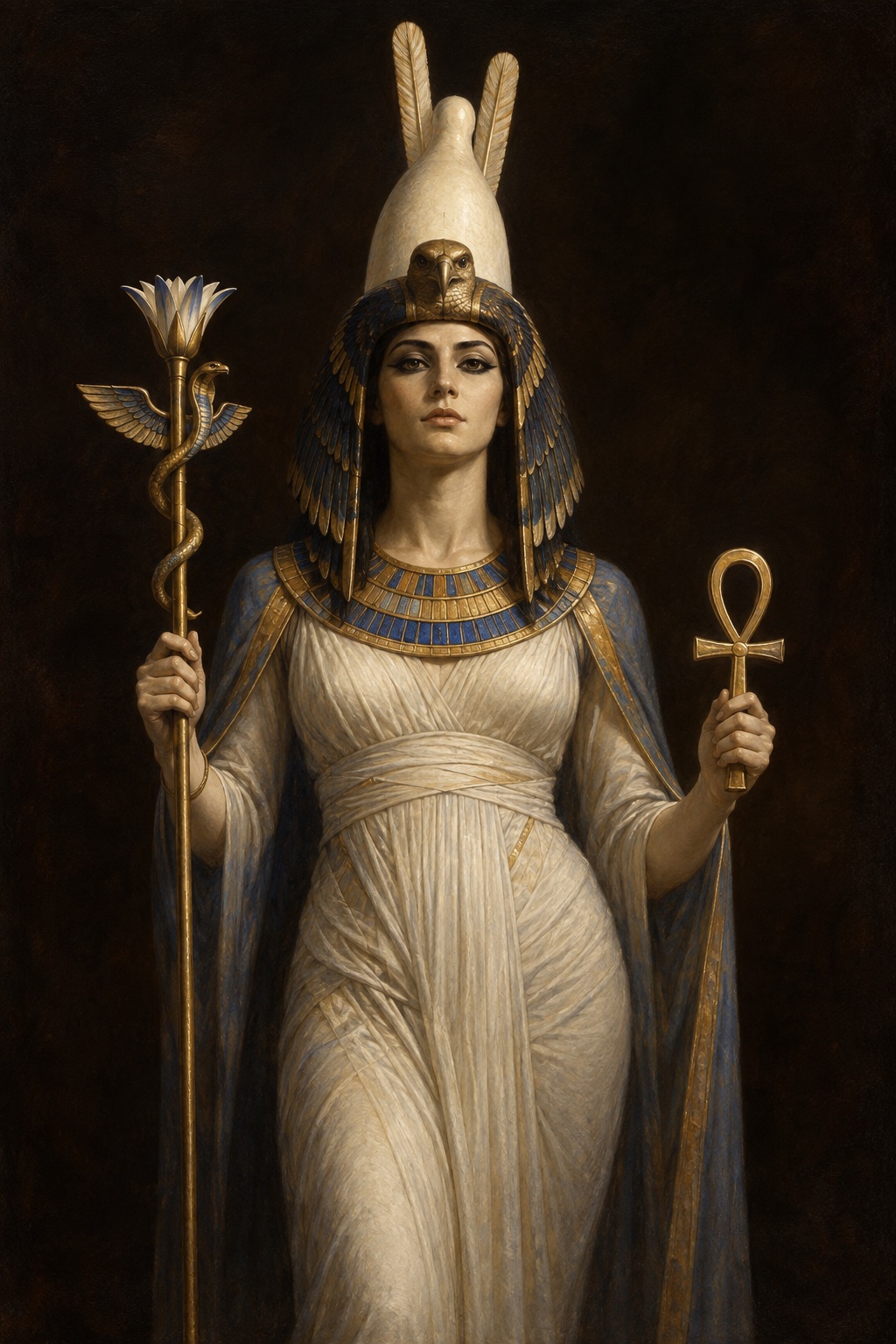
Budge’s description of her image is short. She is a woman wearing the vulture head-dress, and above it the white crown, which he calls the sign of sovereignty over Upper Egypt, with two plumes attached to it. In one hand she holds a sceptre and in the other the symbol of life. Sometimes the sceptre is a long-stemmed flower with a serpent twined round it; Budge thinks the flower is probably a water-lily but does not commit to it. The serpent is the winged serpent wearing the crown of the South, and he says it is as much her symbol as the vulture. She is also drawn as a woman with the head of a vulture, holding a bow and an arrow in her left hand, in a picture Budge cites from Lanzone. In coloured pictures of one of her forms she is painted light yellow or almost white, which he reads as the colour of the southern desert or of the light of the newly risen sun or moon.
What is not in Budge is the image a modern reader most expects: the vulture with spread wings hovering over the king, a shen ring in each talon. That picture is convention. No sentence in the texts this entry draws on describes it, and the symbols listed here are only the ones he names.
A serpent on the Winged Disk
Her one episode is not her own. It belongs to Horus in the form Budge calls Heru-Behutet, Horus of Behutet, the god of Edfu, and it comes from the long legend cut in hieroglyphs on the walls of his temple there, which Budge translates. Ra sails on the Nile, his enemies take the forms of crocodiles and hippopotami to wreck his boat, and Horus hunts them with his followers, the workers in metal, from Edfu down to the Delta and back up into Nubia. Twice in the translation he takes the form of the Winged Disk on the Boat of Ra and sets the two goddesses beside him as serpents. The first time, the serpents are there to make the enemies quake in every place he comes to, in the Land of the South and the Land of the North. The second time, at a town in northern Nubia where the ablest of the enemies are uttering treason against him, the text says what they actually did.
And he made the goddess Nekhebit — E. A. Wallis Budge, Legends of the Gods (1912), “The Legend of Horus of Behutet and the Winged Disk”
The sentence goes on with the goddess Uatchit, and Budge hangs a footnote on each name, the goddess of the South and the goddess of the North, before the sentence reaches what the two were made to do.
to be with him in the form of serpents, so that they might make the Sebau fiends to quake in [all] their limbs (or, bodies). Their boldness (i.e., that of the fiends) subsided through the fear of him, they made no resistance whatsoever, and they died straightway. — E. A. Wallis Budge, Legends of the Gods (1912), “The Legend of Horus of Behutet and the Winged Disk”
Nobody is struck. Elsewhere in the legend the enemies die on lances, in chains and under the knife; here they die of fear, and the gods who follow the boat say so at once: Horus has overthrown the enemy by means of the two serpent goddesses and the fear of him they carry. Ra then decrees a name, Ur-Uatchti, which Budge’s note renders as great one of the two uraei-goddesses, and the same note places the pair above the brow of the god, or at the right and the left of the solar disk. His summary, below, gives that name to the double snake diadem of Heru-Behutet.
Budge tells the same episode a second time in his own words, in The Gods of the Egyptians, and his summary is not the same story.
When this was done Horus changed himself once more into the form of the winged sun-disk with uraei, and took with him the goddesses Nekhebet and Uatchit in the form of two serpents, that they might consume with fire any rebels who still remained. — E. A. Wallis Budge, The Gods of the Egyptians (1904), vol. 1, p. 483
In the translation the serpents frighten, and the fiends die of their own terror. In the summary the serpents burn. Both are Budge, both describe the same scene at the same Nubian town, and this entry keeps them apart. The retelling keeps a trace of the other version, because the gods in the boat still praise Horus for smiting an enemy who were afraid of him.
The legend ends by explaining something every visitor to an Egyptian temple saw. Thoth set the Winged Disk in every sanctuary, to drive away evil from it. Budge closes his summary by saying that this is the meaning of the winged disks with uraei over the entrances of temple courts, and that the snake goddess on the right-hand side of the disk is Nekhebet. The closing section of the translation says the same in its own terms: the Heru-Behutet on the right hand, president of the southern half of heaven, is the one on whom Nekhebit is placed as a serpent. Budge’s own section on her, earlier in the same volume, adds that the right-hand side is the south side, and that the two goddesses sat as uraei on the brow of Ra and gave themselves to destroying his enemies. That is why her relations record Horus as an ally and not as family. In this legend she is the weapon on his forehead, and the praise goes to him.
Crowning the king
The vulture and the uraeus were never only cult animals. In the early dynastic period, Budge says, a king who wanted to proclaim his sovereignty over all Egypt put a pair of signs before his name, a title he renders freely as lord of the shrines of the Vulture and Uraeus; the equivalents of those signs are already on the plaque of Aha. How the signs were read is uncertain, he adds, but there is no doubt about what they meant. Down to very late dynastic times the kings of Egypt declared that they ruled the country by the favour of the two goddesses whose emblems were the vulture and the uraeus. His second volume gives one of the oldest titles of the Pharaohs as lord of the city of the Vulture and lord of the city of the Uraeus: her city, and Uatchet’s.
The goddesses did not only lend the king a title. They put the crown on him.
she is usually represented with her twin sister Uatchet, and also in coronation scenes, for it was most important for a king to be crowned with the double crown, by these deities. — E. A. Wallis Budge, The Gods of the Egyptians (1904), vol. 1, p. 440
The sentence begins before the quoted start: in the bas-reliefs of the temples she is usually shown with her twin. The double crown is the South and the North worn at once, and each of the two goddesses answers for one half of it. Budge then takes a step past the reliefs and guesses at the ceremony they record.
And it is very probable that at the time of the coronation of a king priestesses dressed themselves in the character of the two goddesses, and that the one declared the South had been given to him whilst the other asserted the same concerning the North. — E. A. Wallis Budge, The Gods of the Egyptians (1904), vol. 1, p. 440
The hedge is his, and it should stay attached. Budge offers the priestesses as very probable, not as something a text describes. In his text the guess follows directly on the scenes and on the special chambers that, following Brugsch, he says were set apart for the two goddesses near the sanctuaries of the temples. Uatchet’s chamber lay on the west side and was called the house of fire; Nekhebet’s lay on the east and was called the great house. The fire, in this arrangement, belongs to the other goddess.
Budge also gives the king a mother and a nurse from this pair, and the order matters. From one aspect, he says, Nekhebet was identified with Isis, the fertile goddess of nature, while Uatchet was identified with Nephthys, who plays the nurse to the child Isis bears. On that reading Nekhebet was mother to the Sun-god and so to the king, who is the Sun-god’s son, and Uatchet was the king’s nurse. The vulture of the South is the one who bears him, not the one who rears him.
Protector of the king and of the dead
If the king is the son of Ra and she is his mother, protecting him is simply her part. The words addressed to her that Budge quotes in her own section come from the Pyramid Texts, from line 762 of the text of the Sixth Dynasty king Mer-en-Ra, and they say exactly that.
Thou protectest Mer-en-Ra — E. A. Wallis Budge, The Gods of the Egyptians (1904), vol. 1, p. 441
The line runs on past the quoted end. It calls on her by name, says it again in the perfect tense, and places the protection in the House of the Prince in Annu, which is Heliopolis. Budge says the line seems to connect her with Annu, and suggests that if so she was probably identified there with one of the local goddesses, Iusaaset or Nebt-hetep. His second volume reports another passage from the same king’s text in which Nekhebet of the Temple of Sar, in Heliopolis, is said to protect him. Both passages are about a dead king. The protection this entry credits her with is care for a ruler in the next world as much as in this one.
It did not stop at kings. Budge cites a text published by Maspero that mentions the natron of the city of Nekheb, apparently much used in embalming the dead. Because of that natron, the goddess was believed to watch over the dead in the Underworld, and to give them beautiful faces with two shining eyes. To make sure of it, a bandage of Nekheb was laid on the forehead of every carefully prepared mummy.
That is guardianship in the plainest sense: watching rather than fighting. It is why this entry lists both protection and guardianship among her domains. She protects the king in the Pyramid Texts, she guards the South on the Metternich Stele, and she keeps watch over the embalmed in the Underworld. The destroying serpent of the Winged Disk is the same goddess seen from the other side, turned outward against whatever threatens what she keeps.
Absorbed by Mut, Isis and Hathor
Budge’s account of her is largely an account of other goddesses taking her over, and it runs in more than one direction at once.
Mut’s entry quotes the sentence in which Budge reads the vulture heads at Mut’s shoulders as proof that Mut’s cult was grafted on to that of Nekhebet. That is the identification this entry records in its relations, from Nekhebet’s side: the Theban mother took the vulture from the South, and the vulture came with its meaning attached. Budge’s list of sacred animals says the same thing more widely. The vulture, he writes there, was the symbol of Nekhebet, of Mut, of Neith, and of other goddesses who were identified with Nekhebet.
Isis came in from another side. The aspect that makes Nekhebet the king’s mother is, in Budge’s first volume, the aspect in which she is identified with Isis. His second volume goes further and says that she was only a form of Isis in dynastic times, whatever she may have been before. It takes the identification back to the Pyramid Text of Unas, where in one passage the king is united to Mut, breathes the breath of Isis and is joined to Nekhebet; from that Budge concludes that even when the text of Unas was written, Mut and Nekhebet were already identified with Isis. Later in the same volume he lists her among the local goddesses whose attributes Isis had absorbed at a comparatively early period.
Hathor is the identification Budge distrusts. In later texts, he says, the vulture goddess of the South is distinctly identified with Hathor, and he files her whole section under Hathor’s in his first volume. But he explains the filing in the same breath. The identification of Hathor with Nekhebet, Uatchet, Bastet and Neith is the product of a late period, when the earliest attributes of those goddesses had been forgotten; he treats them under Hathor for convenience and because there is something to be said for it, not because he regards the Ptolemaic identification as the correct one. This entry therefore narrates the Isis and Hathor identifications and records only Mut in its relations.
One more claim needs its limits stated. In his chapter on the Nile, Budge is certain that Nekhebet was the female counterpart of Hapi of the South, one of the goddesses assigned to the river as wives or sisters in very early dynastic times; Isis held that place later, because Osiris was identified with Hapi. Hapi’s entry reports that chain and records no consort for him, and this entry records none for her.