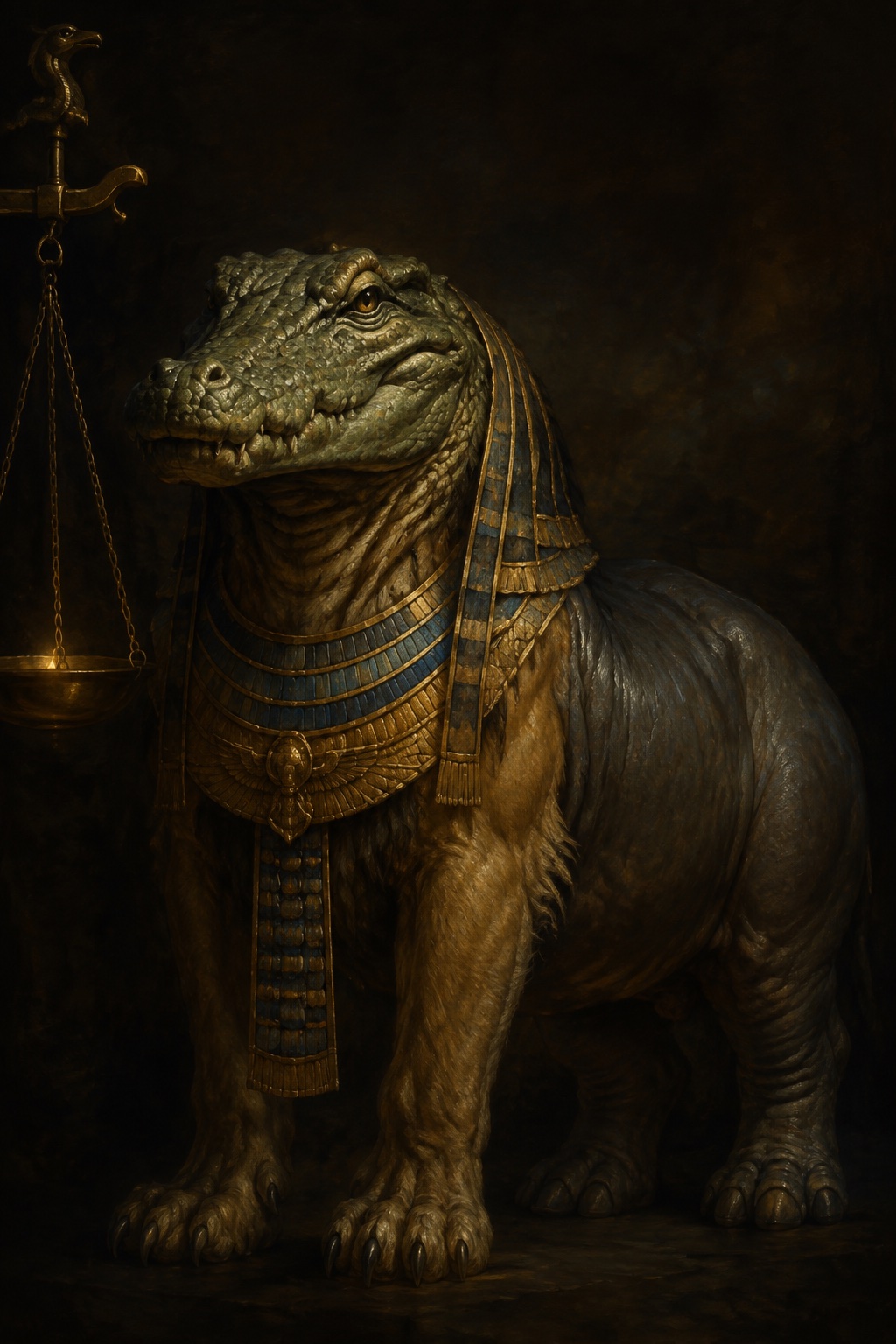
The monster behind Anpu
Budge’s account of the Papyrus of Ani vignette walks down the line of figures at the Great Balance, naming who stands where. Budge’s Anpu is the god this wiki calls Anubis, and the scribe at his shoulder is Thoth; she comes last in the row, behind them both.
Behind Anpu are Thoth the scribe of the gods, and the monster Amemit, with the head of a crocodile, the forepaws and shoulders of a lion, and the hindquarters of a hippopotamus; the duty of the last-named was to eat up the hearts that were light in the balance. — E. A. Wallis Budge, The Book of the Dead (1901), “The Judgment of Osiris”
Two things in that sentence need saying plainly. The first is the name. Budge writes Amemit here, Am-mit in The Gods of the Egyptians, and Amemet elsewhere in the same work — but never Ammit, which is the modern spelling this entry takes as its title, and the spelling this wiki’s Anubis page has used since it was written. So every quotation on this page keeps Budge’s own form while the page around it keeps the modern one. That is the split this wiki already runs wherever Budge’s romanisation and the modern one part company — between Seshat and his Sefkhet-aabut, between Sekhmet and his Sekhet, between Khonsu and his Khensu.
The second is the body. Three animals in three places — crocodile at the front, lion in the middle, hippopotamus behind — and one duty attached to them, stated as flatly as a job description. Budge offers no symbolism to decode here. He is describing what is painted in the vignette. The reason to read it closely is that his own second description of the same creature does not agree with it.
The hearts Anubis casts her
She does not hunt, and Budge never shows her choosing. The weighing is watched by somebody else, and what fails it is handed to her.
The act of weighing was carefully watched by Anubis the god of the dead, whose duty was to cast to the Eater of the Dead the hearts which failed to balance the feather exactly — E. A. Wallis Budge, The Gods of the Egyptians (1904), vol. 1, p. 20
Budge uses the same word for both parties: duty. Anubis’s duty is to cast; hers is to eat. Between the two of them there is no pleading, no reprieve and no appetite — a heart that does not balance the feather exactly is simply passed from one office to the next. Whose feather it is goes unsaid in both of these passages, and Ma’at’s own entry on this wiki makes the same point about Budge at greater length: in his telling the feather is truth and righteousness itself, not a goddess’s property.
Budge adds one detail in his second volume that says a great deal about how the Egyptians imagined the risk. Part of what Anubis takes care of, he writes, is that a body committed to his charge should not be handed over to the Eater of the Dead by accident. The thing being guarded against is not only a heart found wanting. It is a clerical slip.
The verdict that denies her Ani
Once Thoth has read the result aloud, the Great Company of the Gods answer him, and her name arrives in the middle of their answer.
The Osiris, the scribe Ani, true of voice, hath testified. He hath not sinned and [his name] doth not stink before us; Amemit (i.e., the Eater of the Dead) shall not have the mastery over him. Let there be given unto him offerings of food and an appearance before Osiris, and an abiding homestead in the Field of Offerings as unto the Followers of Horus. — E. A. Wallis Budge, The Book of the Dead (1901), “The Judgment of Osiris”
She is named here in order to be refused. That is the shape of almost every appearance she makes in these texts: the gods speak of her only to say what she will not be given, and then go on to list what the acquitted man will be given instead — food offerings, an appearance before Osiris, a homestead in the Field of Offerings. It is worth remembering what kind of document this is. A funerary papyrus is a commissioned argument for its owner’s innocence, made for the man whose name it carries, so of course she goes hungry in it. What she actually receives, when a heart does weigh light, is described nowhere in these pages.
Not a torment but an ending
Budge states the theology behind her plainly in his second volume, in the middle of a discussion of Osiris as judge: the souls of all those condemned in the Judgment Hall of Osiris were supposed to be devoured straightway, and from one point of view the punishment of the wicked consisted of annihilation. That is not a hell, and it is not a sentence to be served. It is the removal of the thing that was to have gone on living — the offerings, the homestead, the appearance before the god, the whole future the verdict above grants Ani, simply not happening.
Two honest notes on a figure this thinly attested. Budge is not consistent about what she is. He calls her “the monster” throughout, writes “which” of her in one place in his second volume, and “him” and “he” of her in another. This entry says “she”, and that is this wiki’s convention rather than anything Budge settles. It is not settled elsewhere in the corpus either: the Anubis page has named her Ammit in all six locales since it was written, but it never needs a pronoun for her, so it takes no position. No quotation on this page contains one. And she is given nothing else — no parents, no cult, no speech, no episode of her own. She never acts anywhere in the three volumes behind this entry. What she has instead is a station and a duty, and both of them are described from behind somebody else’s shoulder.