The one the writing came down from
The oldest datable notice of Cangjie is not a story about inventing anything. It is a single clause in the Xunzi, in the third century BC, inside a chapter on the mind that has been shut in by attending to one thing only — and there the clause stands as that fault turned to advantage.
好書者眾矣,而倉頡獨傳者,壹也
“Lovers of writing have been many; that Cangjie alone is the one it came down from is a matter of singleness.” — Xunzi, “Jiebi” 解蔽篇; tr. Mythos Atlas
Read what it actually claims. Writing is already in the world, and 好書者眾矣 — the people devoted to it are many. What is said of Cangjie is 獨傳, that he alone is the one through whom it was handed on, and the reason given is 壹, undividedness of attention. No master. No four eyes. No act of making. In the earliest witness he is not the inventor of writing at all; he is the one man who did not look away from it.
Heaven rained millet
A century and a half later the Huainanzi, presented to the throne in 139 BC, gives him the act — and gives the world its answer, in thirteen characters.
昔者蒼頡作書,而天雨粟,鬼夜哭
“In ancient times, when Cangjie made writing, heaven rained down millet and the ghosts wept in the night.” — Huainanzi, “Benjing” 本經訓; tr. Mythos Atlas
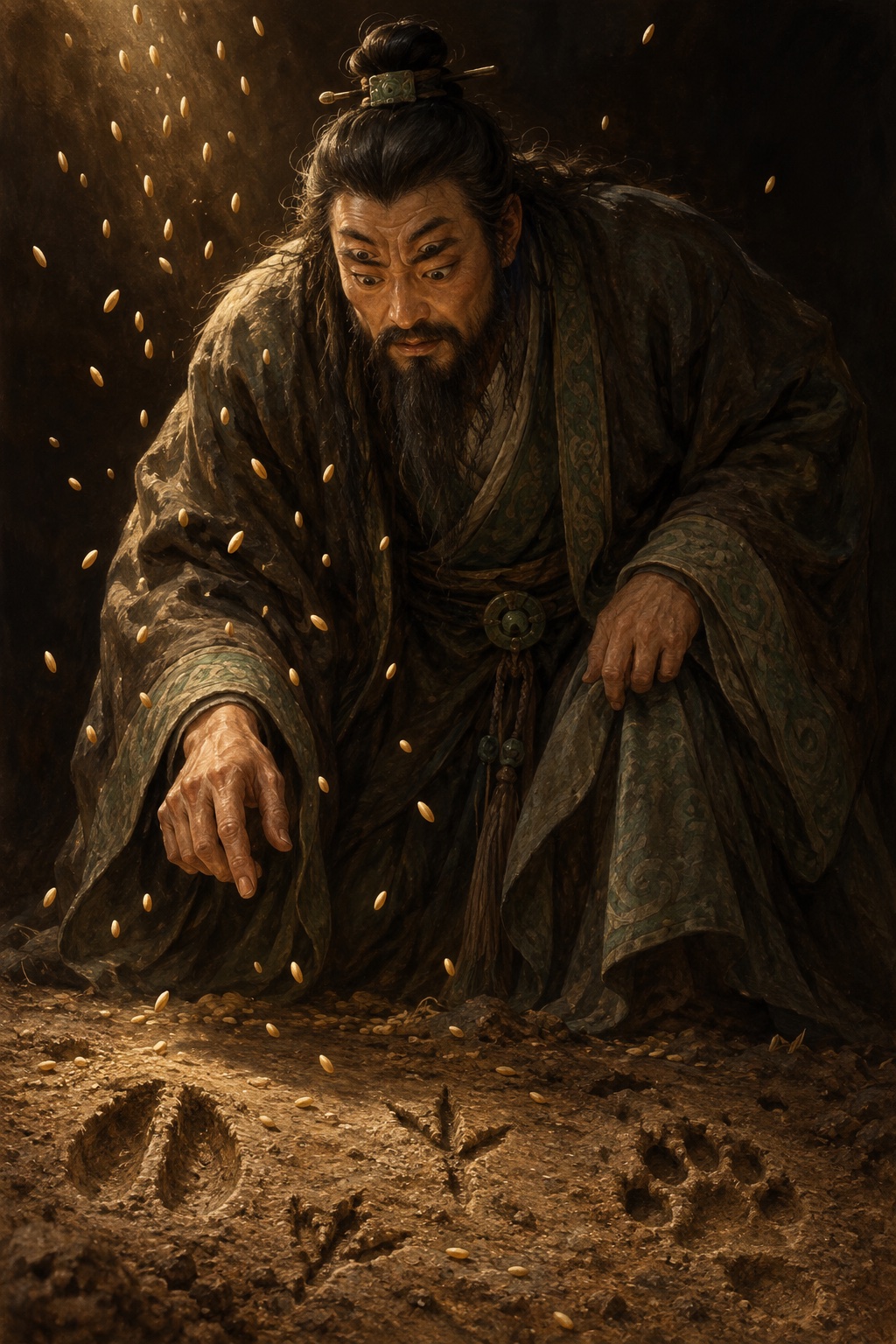
作書, he made writing: this is the first surviving text to say so. What follows it is not explanation but portent. The sky opens and drops grain, 天雨粟; the dark fills with weeping, 鬼夜哭; and the sentence declines to say why either happens. The surrounding argument is that human capability rises as human virtue thins, so the two signs read as the price of the gain rather than as a reward for it. Nothing here mentions a court, a commission or a sovereign. The invention stands by itself, and it costs.
The name is written 蒼頡 in this passage and 倉頡 in the Xunzi and the Shuowen Jiezi. It is one man; early Chinese texts are simply not fixed about which graph carries the sound.
The tracks of birds and beasts
Around AD 100 Xu Shen closed his dictionary of graphs with an account of how graphs came to exist, and it is his sentence that every later telling repeats.
黃帝史官倉頡,見鳥獸蹄迒之跡,知分理之可相別異也,初造書契
“Cangjie, scribe-official to the Yellow Emperor, saw the hoof- and claw-prints of birds and beasts, understood that their patterns could be told apart one from another, and first made the incised graphs.” — Xu Shen, Shuowen Jiezi, postface 敘; tr. Mythos Atlas
The verb that carries the passage is 知, not 造. What it credits is a piece of seeing: 鳥獸蹄迒之跡, the marks animals leave on the ground, and then the recognition 知分理之可相別異也, that the lines of a pattern can be distinguished from one another, and so that one mark can stand apart from another and mean a different thing. Writing follows from a discrimination, not from a craftsman’s trick — which is why the discernment, and not the handiwork, is the thing the postface praises.
Xu Shen also sets the invention inside a sequence of devices rather than a quarrel between persons. Fu Xi had drawn the trigrams; Shennong had kept the records of government in knotted cords; then Cangjie made 書契. That word is worth holding onto. 契 is a tally cut into a surface, and 書契 are graphs that are incised. No brush appears in this sentence, no ink, no bamboo and no silk. Those belong to the later picture of a scribe, not to the text that made him one. The Yellow Emperor’s name opens the clause, and it is the newest thing in it.
Four eyes, and a master arriving late
The four eyes are not a folk embellishment added by illustrators. They are in Wang Chong, around AD 80, in a chapter arguing that extraordinary men can be known by extraordinary bodies.
蒼頡四目,為黃帝史
“Cangjie had four eyes, and was scribe to the Yellow Emperor.” — Wang Chong, Lunheng, “Guxiang” 骨相篇; tr. Mythos Atlas
Eight characters carry both halves of the popular image, and they arrive together, and they arrive late. The Yellow Emperor is in both of the Eastern Han witnesses and in neither of the earlier ones: Wang Chong writes 為黃帝史 here, Xu Shen writes 黃帝史官 twenty years later, and between them they attach the maker of writing to a sovereign about three centuries after the Huainanzi had described the making without him. The Xunzi, earlier still, gives him no master whatever.
So the figure was assembled in three layers. First a man singled out for concentration, through whom writing was transmitted. Then a maker whose making the sky and the dead answered. Then, in the Eastern Han, a body with 四目 in it and a place at a sovereign’s court — 史官, an office, which is all that either text gives him. Neither supplies robes, a beard or a desk. The conventional portrait is not so much wrong as it is the most recent thing about him, and the oldest sentence on record still says only that many people loved writing and one of them stayed with it.