Huangdi stands exactly where Chinese myth and Chinese history were deliberately welded together, and you can watch the weld being made. Sima Qian opens the Shiji — the founding work of Chinese historiography, the model for two thousand years of dynastic writing — not with a god, not with a creation, but with him, and narrates his reign as fact:
軒轅之時,神農氏世衰。諸侯相侵伐,暴虐百姓,而神農氏弗能征。於是軒轅乃習用干戈,以征不享。⋯⋯蚩尤作亂,不用帝命。於是黃帝乃徵師諸侯,與蚩尤戰於涿鹿之野,遂禽殺蚩尤。而諸侯咸尊軒轅為天子,代神農氏,是為黃帝。
“In Xuanyuan’s time the house of Shennong had declined for generations. The lords raided one another and brutalised the people, and Shennong could not punish them. So Xuanyuan trained in the use of shield and spear, and campaigned against those who would not pay tribute. … Chiyou made disorder and would not obey the sovereign’s command. Then the Yellow Emperor levied troops from the lords and fought Chiyou in the field of Zhuolu, and captured and killed him. The lords all honoured Xuanyuan as Son of Heaven in place of the house of Shennong: this is the Yellow Emperor.” — Sima Qian, Shiji, “Annals of the Five Emperors”; tr. Mythos Atlas
Read it as prose and the machinery shows. There is no fog, no bronze-headed brothers, no south-pointing chariot — Sima Qian has stripped the supernatural out and left a sequence any Han official would recognise: a failing dynasty, a competent general, a rebel who refuses a summons, a punitive expedition, a transfer of the mandate. The myth has been filed as an administrative precedent. This is where 是為黃帝, “this is the Yellow Emperor,” does its work: not a birth but a job title, conferred by the lords at the end of a campaign.
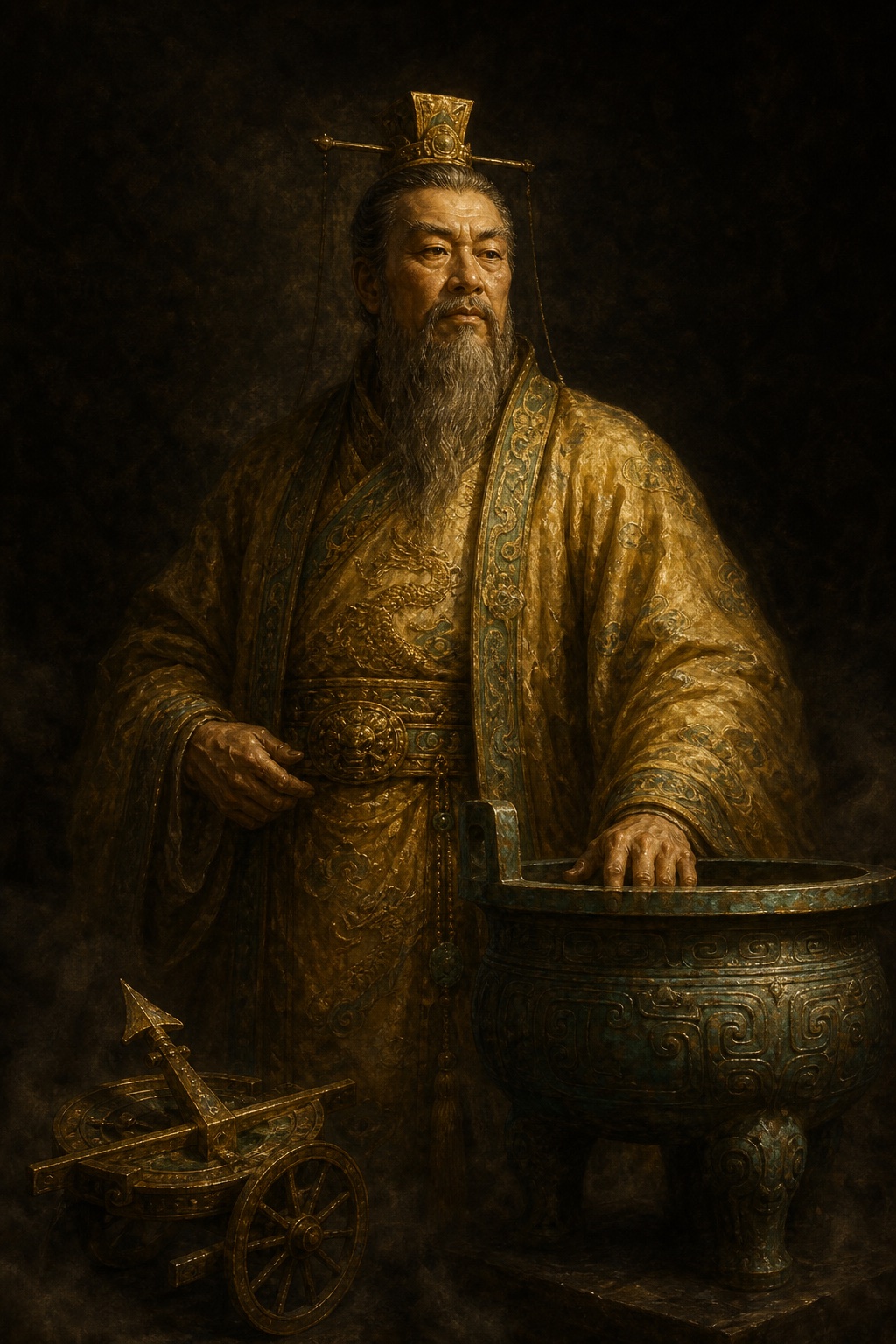
Everything that makes civilisation gets attributed to him or his court — the calendar, the cyclical signs, boats, carts, writing, the potter’s wheel, coinage, music, silk through his wife Leizu, and medicine through the Huangdi Neijing, cast as a dialogue between the Emperor and his physician. He is less a personality than an origin story for the arts of order.
Which is why the Daoists, who claimed him too, preferred a version where he gives all that up. In the Liezi he exhausts himself governing, dreams of the country of Hua-hsu — a land with no leaders, no desires, and nothing to administer — and wakes understanding that the Way cannot be reached by effort or through the senses:
“For twenty-eight years after this, there was great orderliness in the Empire, nearly equalling that in the kingdom of Hua-hsu. And when the Emperor ascended on high, the people bewailed him for two hundred years without intermission.” — Liezi, tr. Lionel Giles
The Zhuangzi is blunter still, listing him among those who simply got the Way: 黃帝得之,以登雲天 — “Huang-di got It, and by It ascended the cloudy sky,” in Legge’s rendering. Note that even in the mystical version, the ascent is an achievement recorded in a list, alongside other holders.
He does not die so much as depart. A dragon descends to a place where he has cast a great bronze tripod, and he mounts it and rises. Some of his ministers catch hold and are carried up with him; those who grab only the dragon’s whiskers fall back to earth — which is one way of describing the difference between an emperor and everyone who works for him.