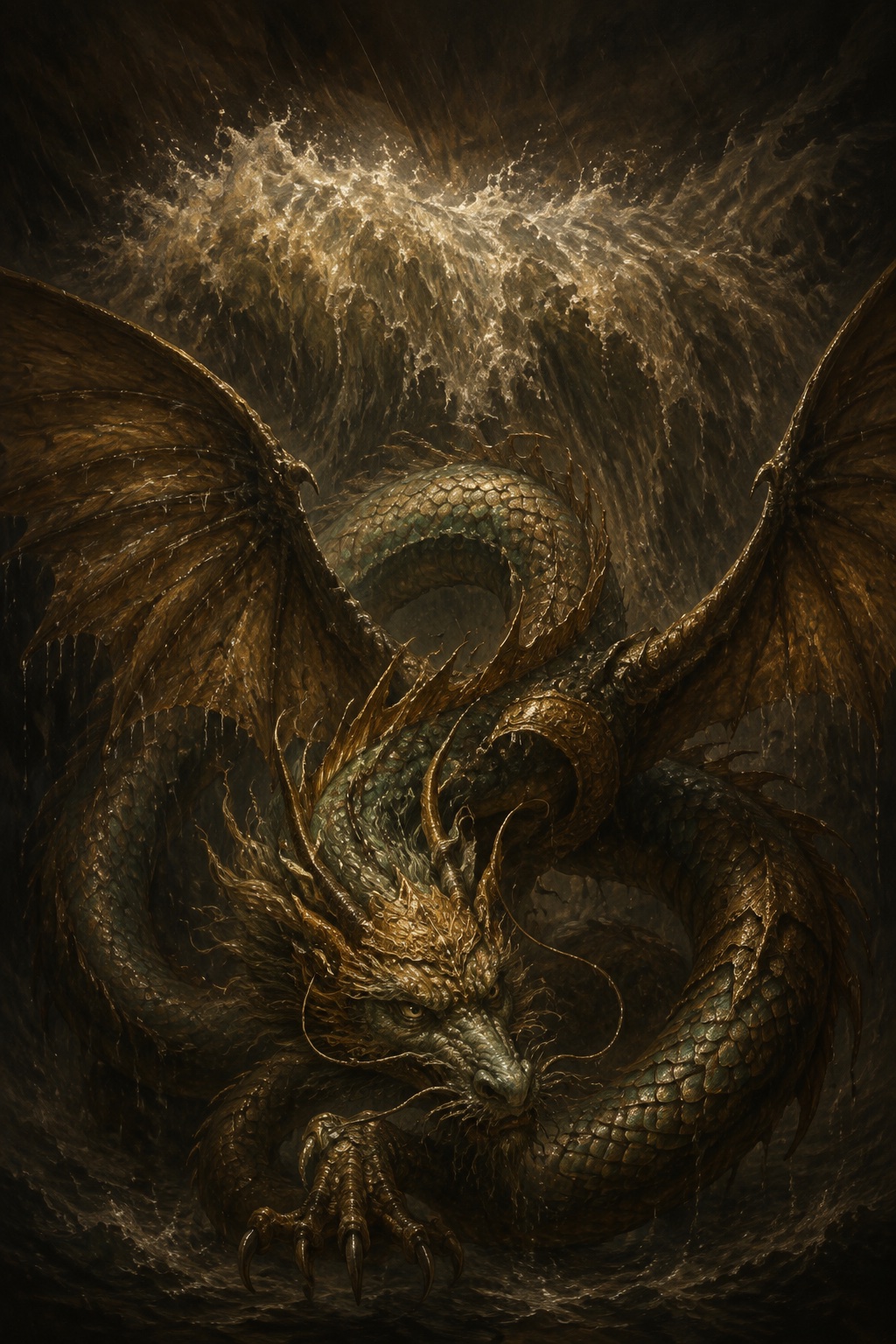
The order at the field of Jizhou
Yinglong is never introduced. The Shanhaijing’s book of the great wilderness of the north tells the war between Chiyou and the Yellow Emperor in a handful of clauses, and the dragon simply appears inside the second of them, as the object of a command.
蚩尤作兵伐黄帝,黄帝乃令應龍攻之冀州之野。應龍畜水。蚩尤請風伯雨師,縱大風雨。黄帝乃下天女曰魃,雨止,遂殺蚩尤。魃不得復上,所居不雨
“Chiyou made weapons and attacked the Yellow Emperor, and the Yellow Emperor then ordered the Responding Dragon to attack him at the field of Jizhou. The Responding Dragon dammed up the waters. Chiyou called on the Earl of Wind and the Master of Rain, and loosed a great wind and rain. The Yellow Emperor then sent down the sky-woman called Ba; the rain stopped, and he killed Chiyou. Ba could not go back up, and where she dwells it does not rain.” — Shanhaijing, “Great Wilderness: North”; tr. Mythos Atlas
令 is the verb that governs him: he is ordered out. This is the only sentence in any of the material behind this entry that gives him a commander, a battlefield and an act of his own, and the act gets one four-character clause. 應龍畜水 — the dragon hoards the water, holds it back, keeps it. Chiyou’s answer is weather: he calls in Fengbo, the Earl of Wind, and the Master of Rain and turns a storm loose, which is exactly what a dam is for. Two ways of handling water are set against each other, and neither of them settles anything.
The battlefield is 冀州之野, the field of Jizhou. It is not Zhuolu. Zhuolu is the Shiji’s name for this war, and the Shiji tells it as a punitive campaign with no dragon in it at all; the two names belong to two traditions rather than to two spellings of one.
Then the war ends without him. The Emperor sends down the drought-woman Ba, the rain stops, and 遂殺蚩尤 — and thereupon killed Chiyou. Whose hand it is, the clause does not say. The last agent named is the Yellow Emperor, and that is how it is ordinarily read: the dragon opens the battle, and somebody else closes it.
The last two clauses of the passage are not about the dragon either. 魃不得復上,所居不雨 — Ba could not go back up, and where she settles it does not rain. It is worth holding on to which figure that sentence belongs to, because a different chapter hands the same two ideas to Yinglong.
Two killers in one chapter
Several hundred characters before it narrates that war, the same chapter has already settled it, and settled it the other way.
應龍已殺蚩尤,又殺夸父,乃去南方處之,故南方多雨。
“The Responding Dragon, having killed Chiyou, killed Kuafu too, and then went away to dwell in the south. That is why the south has so much rain.” — Shanhaijing, “Great Wilderness: North”; tr. Mythos Atlas
已 is the character that does the damage. The line does not say the dragon kills Chiyou; it says he had killed him already — a finished act, mentioned in passing as the background to a notice about Kuafu. So the chapter records the outcome of the war as settled fact on one page and then, further down the same page, narrates that same war to a different end.
Both halves are quoted elsewhere in this atlas, and neither is quoted for the dragon’s sake. Chiyou’s entry takes the last clause, the rainfall of the south; Kuafu’s takes the middle one, the second name on the list. Read from Yinglong’s side it is neither an aetiology nor an obituary but a tally: two names, in order, with no reason given for either and nothing at all in between.
Nothing here reconciles the two accounts, because the chapter does not. The Shanhaijing is a compilation and not an author, and this is the same seam Kuafu’s entry describes for his own two deaths — independent notices about one war, copied onto one page and left to disagree. What is worth noticing is which reading the tradition kept. Chiyou is remembered as the Yellow Emperor’s kill at Zhuolu, on the Shiji’s authority; the dragon’s version of the same war survives as the strange thing the Shanhaijing says.
Not able to go back up
The eastern book of the great wilderness gives him the same two killings by name, and then adds what the northern book never does: a consequence that does not end, and a rite that answers it.
殺蚩尤與夸父,不得復上。故下數旱,旱而為應龍之狀,乃得大雨
“He killed Chiyou and Kuafu, and could not go back up. So below there are frequent droughts, and in a drought they make the shape of the Responding Dragon, and then they get great rain.” — Shanhaijing, “Great Wilderness: East”; tr. Mythos Atlas
不得復上 — cannot go back up. The northern chapter spent those four characters on the drought-woman Ba and paired them with 所居不雨, no rain where she stays; the eastern chapter attaches them to the dragon and pairs them with 故下數旱, frequent droughts below. Two agents are sent down into one war and neither of them gets home, and in both cases the weather afterwards is the record of it. The northern chapter also has the other ending, where he goes off to live in the south and leaves the south with too much rain; this one leaves everywhere else with too little. The two endings cannot both be true of the same dragon, and both are in the same book.
Then comes the only thing in any of it that somebody does to him rather than with him. 旱而為應龍之狀,乃得大雨 — in a drought they make his shape, and then they get great rain. Not a prayer and not an offering: an image, made on the ground, of the figure whose absence the drought is understood to be. The Song encyclopaedia Taiping yulan files the sentence under “drought”, among procedures for asking rain, next to the Huainanzi’s earthen dragon that brings it. That is why this atlas files a commanded war-beast as a god rather than as a creature or a servant: of everything the sources do with him, this is the one act that treats him as somebody who can answer.
No introduction, and a pair of wings
The chapter that sends him out is generous with labels and gives him none of them. 大荒北經 introduces the bird-bodied Yuqiang, the nine-headed Jiufeng and the tiger-headed Qiangliang each with 有神, there is a god; it introduces Kuafu with 有人, there is a man. Yinglong gets neither formula. On these pages he has no parents, no rank, no country and no mountain — he arrives inside somebody else’s sentence, already available to be sent.
What the name does carry is a shape. 應龍 works less like a personal name than like a class: Wang Yi’s gloss on the Tianwen, preserved in Hong Xingzu’s commentary, sets 有鱗曰蛟龍 against 有翼曰應龍 — the scaled kind is called a jiaolong, the winged kind a yinglong. The wings are not decoration, they are the definition, and they are the only thing about his body that more than one early witness agrees on. Nothing gathered here gives him a colour, a number of claws or antlers, and neither does this entry.
So the register the sources use for him never quite settles. He is commanded, he is harnessed, and he is defined as a species of animal. He is also the one whose shape people scratch into the ground when the rain fails, and that is the only one of those that expects an answer.