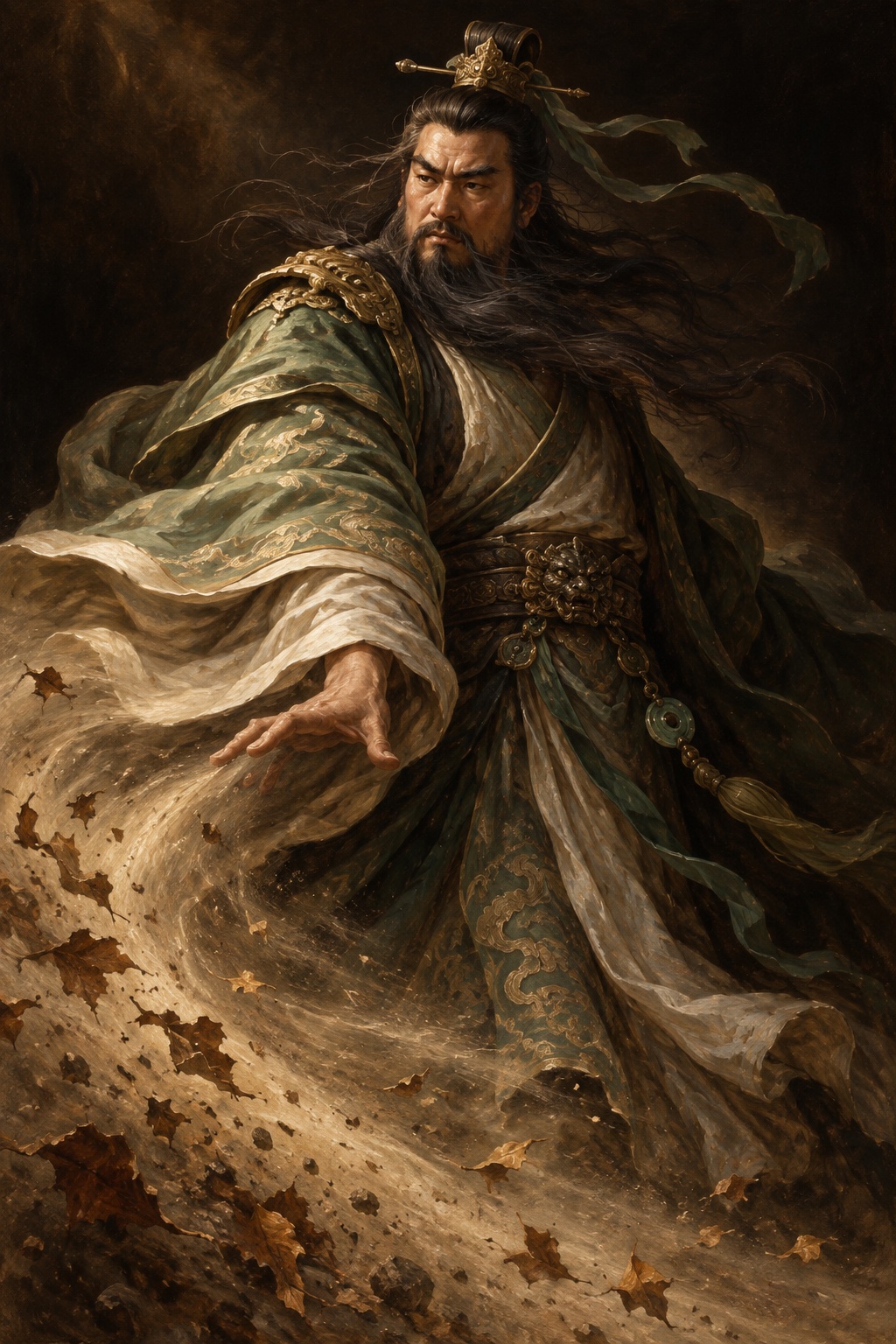
Called in against the dam
In the Shanhaijing, Fengbo is named once, as half of a pair, and the pair gets one clause. The book of the great wilderness of the north tells the war between Chiyou and the Yellow Emperor in a handful of clauses, and the wind enters it as Chiyou’s answer to a dam.
蚩尤作兵伐黄帝,黄帝乃令應龍攻之冀州之野。應龍畜水。蚩尤請風伯雨師,縱大風雨。黄帝乃下天女曰魃,雨止,遂殺蚩尤。魃不得復上,所居不雨
“Chiyou made weapons and attacked the Yellow Emperor, and the Yellow Emperor then ordered the Responding Dragon to attack him at the field of Jizhou. The Responding Dragon dammed up the waters. Chiyou called on the Earl of Wind and the Master of Rain, and loosed a great wind and rain. The Yellow Emperor then sent down the sky-woman called Ba; the rain stopped, and he killed Chiyou. Ba could not go back up, and where she dwells it does not rain.” — Shanhaijing, “Great Wilderness: North”; tr. Mythos Atlas
The Yellow Emperor orders Yinglong out, and the dragon holds the water back. Then 蚩尤請風伯雨師 — Chiyou calls on the Earl of Wind and the Rain Master. The verb is 請, to invite or to ask for, and not the 令 that sends the dragon. The Emperor gives an order to his own dragon; Chiyou asks for help from two powers who are not his to command. That is why this atlas records Chiyou as Fengbo’s ally and not as his master.
The next clause, 縱大風雨, has no subject of its own. The translation carries Chiyou’s through, as the grammar allows, but the only figures in the sentence who have wind and rain to let go are the two he has just called on. 縱 means to release, to let loose, and it is as close as the Shanhaijing comes to saying what Fengbo does. He is not described. On this page he has no body, no parents, no mountain and no country, only a title, 風伯, and a partner.
Then the storm is undone, and only half of it is mentioned. The Emperor sends down the sky-woman the passage calls Ba, whose own entry is Nüba, and 雨止: the rain stops. The wind is not said to stop. It simply leaves the text, and Chiyou is killed in the next clause. Nothing is said of what becomes of the Earl of Wind. He is on the losing side of the war, and the war ends without him.
Sweeping the road on Mount Tai
The Hanfeizi puts the same title in a procession. In the chapter “Ten Faults” 十過, Music-Master Kuang tells Duke Ping of Jin where a piece of music came from, and his answer is an assembly of spirits that the Yellow Emperor once held on top of Mount Tai.
昔者黄帝合鬼神於泰山之上,駕象車而六蛟龍,畢方並鎋,蚩尤居前,風伯進掃,雨師洒道,虎狼在前,鬼神在後,騰蛇伏地,鳯皇覆上,大合鬼神,作爲清角
“Long ago the Yellow Emperor assembled ghosts and spirits atop Mount Tai. He rode an ivory chariot drawn by six flood-dragons, with Bifang running beside the yoke. Chiyou went in front; the Earl of Wind advanced, sweeping the way; the Master of Rain sprinkled the road. Tigers and wolves went before, ghosts and spirits followed behind, a flying serpent lay flat on the ground, and phoenixes covered the sky above. In that great assembly of ghosts and spirits, he composed [the music] ‘Clear Horn.’” — Hanfeizi, “Ten Faults”; tr. Mythos Atlas
The sentence is a list of stations. Six flood-dragons draw the ivory chariot and Bifang runs beside it. 蚩尤居前 — Chiyou goes in front. 風伯進掃 — the Earl of Wind advances and sweeps. 雨師洒道 — the Rain Master sprinkles the road. Tigers and wolves go ahead, ghosts and spirits behind, a flying serpent lies flat on the ground and phoenixes cover the sky. Most of the list says where a figure stands. Fengbo’s clause says what he does.
進掃 is his alone. In the Shanhaijing his verb was shared with the Rain Master, if it was his at all. Here the two of them have separate clauses and separate tasks, and the tasks fit together as one piece of work: the wind goes first and clears the road, and the rain follows and wets it. It is the only act in the material behind this entry that belongs to Fengbo alone, and it is the reason this atlas records him as serving the Yellow Emperor. In this procession he works ahead of the Emperor’s chariot, as one of the Emperor’s retinue.
One war, two places
Put the two passages side by side and the Earl of Wind stands on opposite sides of the same emperor. In the Shanhaijing, Chiyou makes weapons and attacks the Yellow Emperor, and Fengbo is one of the two powers Chiyou calls in against the Emperor’s dragon. In the Hanfeizi, Fengbo sweeps the road ahead of the Yellow Emperor’s chariot, and Chiyou is in the same procession, one clause before him, going in front.
Neither text refers to the other. The Hanfeizi mentions no war; it lists the retinue of an assembly, and both names are on the list. The Shanhaijing mentions no procession and no service before the battle. Neither book tells of Fengbo changing sides, and this entry does not supply a story that joins them. The two texts simply place him differently.
What the two passages do share is narrower. The wind and the rain come as a pair, 風伯 and 雨師, with the wind named first each time. And in both they belong to the Yellow Emperor’s story: in one they are the weapon raised against him, in the other the road crew that goes before him.
The tune from Mount Tai
The procession is not told for its own sake. In “Ten Faults” it is the history of a tune, and the story around it illustrates one of the chapter’s ten faults of rulers. The chapter lists them at the start, and the fourth is to neglect government for love of music, which the chapter says leads a ruler to ruin himself.
Duke Ping of Jin has been asking which music is the saddest. Music-Master Kuang plays him one tune, and sixteen black cranes fly in from the south, form ranks, stretch their necks to call and spread their wings to dance. The Duke asks whether any music is sadder, and Kuang names Clear Horn, 清角. He will not play it. He says that it was made at the Yellow Emperor’s assembly on Mount Tai, that the Duke’s virtue is too thin to hear it, and that hearing it may bring ruin. The Duke answers that he is old and that music is what he loves, and he insists.
Kuang plays. At the first playing a dark cloud rises in the northwest. At the second a great wind arrives and a great rain follows it; it tears the curtains, breaks the ritual vessels and throws down the tiles of the galleries. The guests scatter and the Duke, afraid, lies flat among the gallery rooms. Afterwards the state of Jin has a great drought, with the land left red for three years, and the Duke himself is struck with a crippling illness.
The text does not name Fengbo in this storm. It says only that a great wind came, and it gives no agent for it. But the order of events is the one the Shanhaijing also follows: a great wind and rain let loose, and then a drought. In the Shanhaijing the drought comes because the Emperor sends Nüba down to stop the storm. In the Hanfeizi it comes because a ruler with too little virtue has heard the music of the Mount Tai assembly, where the Earl of Wind swept the road.
Office, gloss and a second name
Two other kinds of text know a wind lord, and neither of them tells a story about him.
The Zhouli sets out the state sacrifices under the duties of the minister of rites. A Wind Master stands in the third group of its list. The supreme god comes first, then the sun, moon, stars and constellations, and then Si Zhong, Siming, the Wind Master and the Rain Master, who receive a burnt offering of firewood. The blood sacrifices at the altars of the soil and the grain come after them. This is a place in a ritual order, not a character. The title is also different: the Zhouli says Wind Master, not Earl of Wind, and it gives him no act.
So the sources give him two registers. As an office he is a title in a list of sacrifices, and to a commentator he is a figure for the ruler’s command. In the two narratives he acts: he lets a storm loose for Chiyou, and he sweeps a road for the Yellow Emperor. This atlas files him as a god on the strength of those two verbs.