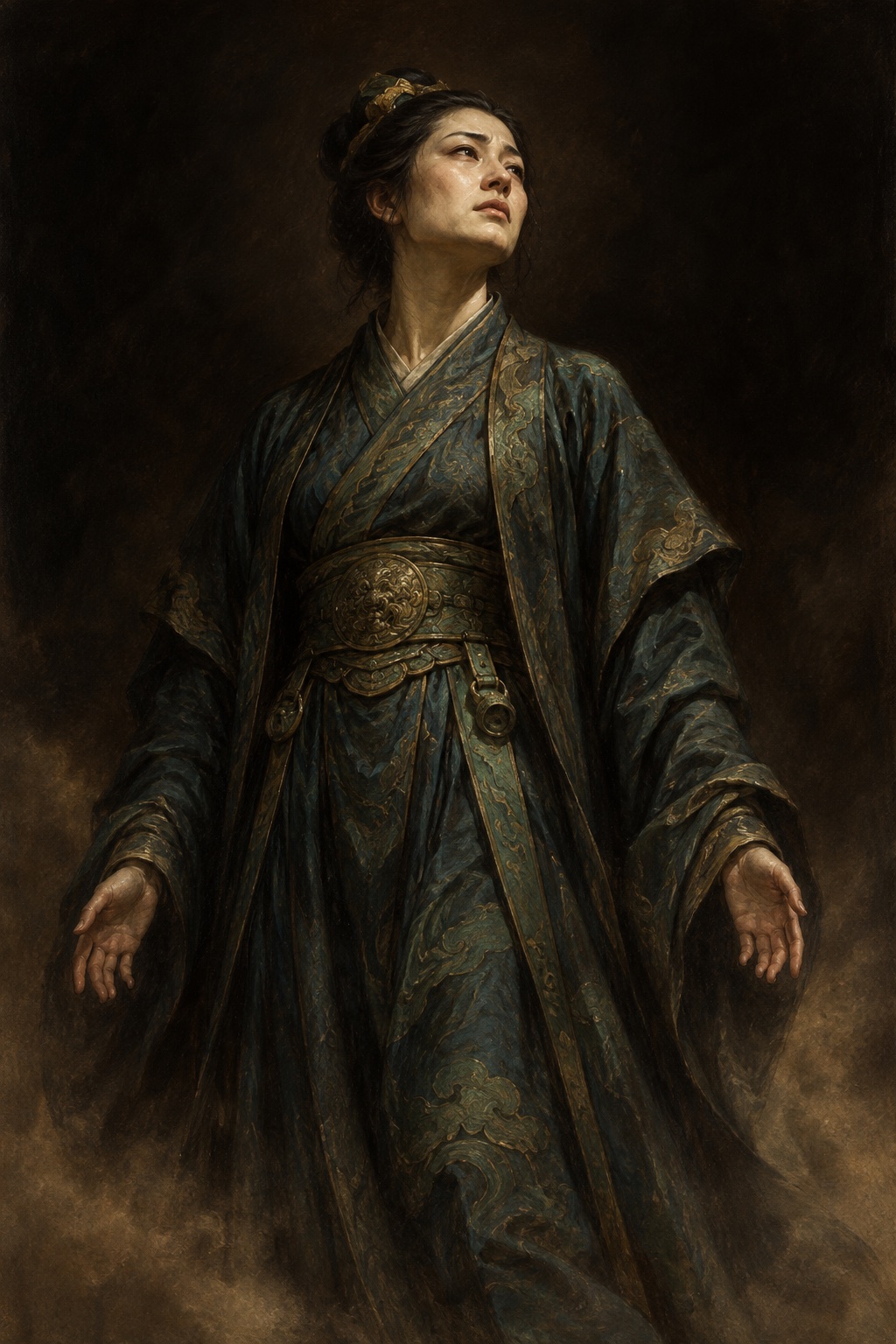
A person clothed in blue-green
The Shanhaijing’s book of the great wilderness of the north introduces nearly everything on its pages with one of two formulas. 有神, there is a god, for the bird-bodied Yuqiang and the nine-headed Jiufeng; 有人, there is a person, for Kuafu. She gets the second one, and then a single detail of dress.
有人衣青衣,名曰黄帝女魃
“There is a person clothed in blue-green, called the Yellow Emperor’s daughter Ba.” — Shanhaijing, “Great Wilderness: North”; tr. Mythos Atlas
衣青衣 — she wears a robe of 青, the classical colour word that spans blue and green together and is never made to choose between them. It is the word the northern books also put on Xiangliu’s snake body, 蛇身而青, and this entry leaves it as wide as the text does. It is also the only thing the classic says about her body. No height, no face, no hair: a person, dressed, standing in the north.
The rest of the clause is a genealogy and a name at the same time. 黄帝女魃 — the Yellow Emperor’s daughter Ba. Both of the other texts quoted below take those last two characters, 女魃, as her name outright, and this entry follows them, because bare 魃 drifted into a common noun for the thing that brings drought and stopped being anybody in particular. The war passage a few clauses on gives her one more title, 天女, sky-woman. A daughter of the Yellow Emperor and a woman of heaven is what the classic has; that is why this atlas files her as a goddess. It is not what the later tradition made of her, and the last section of this entry says so rather than quietly choosing.
The rain stopped
Her one act sits inside somebody else’s war, in the sentence the corpus already quotes for Yinglong.
蚩尤作兵伐黄帝,黄帝乃令應龍攻之冀州之野。應龍畜水。蚩尤請風伯雨師,縱大風雨。黄帝乃下天女曰魃,雨止,遂殺蚩尤。魃不得復上,所居不雨
“Chiyou made weapons and attacked the Yellow Emperor, and the Yellow Emperor then ordered the Responding Dragon to attack him at the field of Jizhou. The Responding Dragon dammed up the waters. Chiyou called on the Earl of Wind and the Master of Rain, and loosed a great wind and rain. The Yellow Emperor then sent down the sky-woman called Ba; the rain stopped, and he killed Chiyou. Ba could not go back up, and where she dwells it does not rain.” — Shanhaijing, “Great Wilderness: North”; tr. Mythos Atlas
She is not a fighter in it. She is the counter-weather. The dragon’s dam has been answered by a storm, and 黄帝乃下天女曰魃 — the Emperor then sent down the sky-woman called Ba. 下 is transitive here and she is its object, exactly as 令 was the verb that governed the dragon. What she does on landing is not described at all. The text spends two characters on it: 雨止, the rain stopped. Then 遂殺蚩尤, and thereupon killed Chiyou, and the war is finished.
The clause after that is hers alone, and it is the whole of her afterwards. 魃不得復上,所居不雨 — she could not go back up, and where she dwells it does not rain. Eight characters, phrased as a fact about the weather rather than as a sentence passed on her. Nothing in any source says she failed, or refused, or overreached. She did what she was sent to do, and the drought is not a punishment for anything; it is what she is, left where the war put her.
The Bamboo Annals tells the same war in one line, and it is the one text that puts her in a clause with an active verb.
應龍攻蚩尤戰虎豹熊羆四獸之力以女魃止淫雨
“The Responding Dragon attacked Chiyou, fighting with the strength of the four beasts — tiger, leopard, bear and brown bear — and Nüba was used to stop the excessive rain.” — Zhushu Jinian, juan 1; tr. Mythos Atlas
以女魃止淫雨 — used Nüba to stop the excessive rain. It is the plainest statement of what she is for anywhere behind this entry, and it is still 以, using: an instrument in a sentence whose subject is somebody else. The caveat travels with it. This is the received text of the Bamboo Annals, the recension carrying a commentary attributed to Shen Yue of the Liang, and its relation to the manuscript recovered from a tomb in 279 has been argued over since the Qing. It is a genuine transmitted text and not a modern fabrication, but it is a weaker witness than the Shanhaijing, and this entry leans on it for one clause.
North of the Red Water
The northern chapter does not stop where the war does. The next sentence is her own episode, and it opens with somebody telling on her.
叔均言之帝,後置之赤水之北。叔均乃為田祖。魃時亡之,所欲逐之者,令曰:「神北行!」先除水道,决通溝瀆
“Shujun reported it to the Emperor, and she was afterwards placed north of the Red Water. Shujun then became Field Ancestor. Ba would from time to time slip away from it; and those who wanted to drive her off would give the order: ‘Spirit, go north!’ — clearing the watercourses first, and opening the channels and ditches.” — Shanhaijing, “Great Wilderness: North”; tr. Mythos Atlas
叔均言之帝 — Shujun spoke of it to the Emperor. Her episode begins as a report about her, with her as its object, and it never quite hands her the subject position after that. 後置之赤水之北, afterwards placed her north of the Red Water: 置 has no stated agent at all. The ordinary reading takes it from the last man named with authority, which is why this entry records the banishment against the Yellow Emperor and not against the informer — but the classic leaves the hand out, and it is worth saying so.
The two clauses that follow hand out opposite fates in the same breath. 叔均乃為田祖 — Shujun then became Field Ancestor, the spirit of the farmed ground. The man who reported the drought is given the fields; the drought is given the far side of a river. Then 魃時亡之: from time to time she gets loose from it. That is the only verb in this entry she performs on her own initiative, and it is escape.
What answers the escape is not a prayer. 所欲逐之者,令曰:「神北行!」 — those who want to drive her off give the order, Spirit, go north. Four characters, and the word they use for her is 神, spirit, the same respectful designation the chapter gives its gods, spent on an eviction notice. And the order is only half of it: 先除水道,决通溝瀆, first clear the watercourses, open the channels and the ditches. The rite against the drought-woman is drainage work, done before anyone shouts.
Drowned in the sacred pool
In a Han poem about a city she turns up again, in a tradition that owes the Shanhaijing nothing, as game.
囚耕父於清泠,溺女魃於神潢
“They shut Gengfu up in Qingling, and drowned Nüba in the Sacred Pool.” — Zhang Heng, Dongjing fu, in the Wen Xuan; tr. Mythos Atlas
Zhang Heng, who died in 139, wrote the Rhapsody on the Eastern Capital as a description of the Han capital’s year, and this couplet belongs to its account of the 大儺, the great exorcism at the year’s end. The passage is a hunt: a procession that runs down named demons, one to a clause, and disposes of each in its own place. Gengfu is imprisoned; she is drowned. Her name there is flat 女魃, with no father attached to it and no robe.
溺 is less a killing than a procedure, because the exorcism comes round every year and every year she is drowned again. A story ends. A rite repeats. And the register has changed completely: the sky-woman the Emperor sent down is now something the state removes from the calendar each winter, alongside whatever else the year has accumulated.
The commentaries went further than Zhang Heng did, and this entry quotes none of it, because none of it is in a classic. The chain of texts the Qing editor assembles around her clause describes a naked thing two or three chi tall, bald, with its eyes set on the top of its head, that moves as fast as wind, and leaves a country scorched for a thousand li wherever it is seen. That is a demon, and it is what the word 魃 came to mean on its own. It is also, flatly, not the figure in the classic, which gives her a father, a robe of blue-green, one obedient act and a river she is kept behind. This entry keeps the classic’s words and lets the later ones stand beside them, unreconciled, in the order they were written.