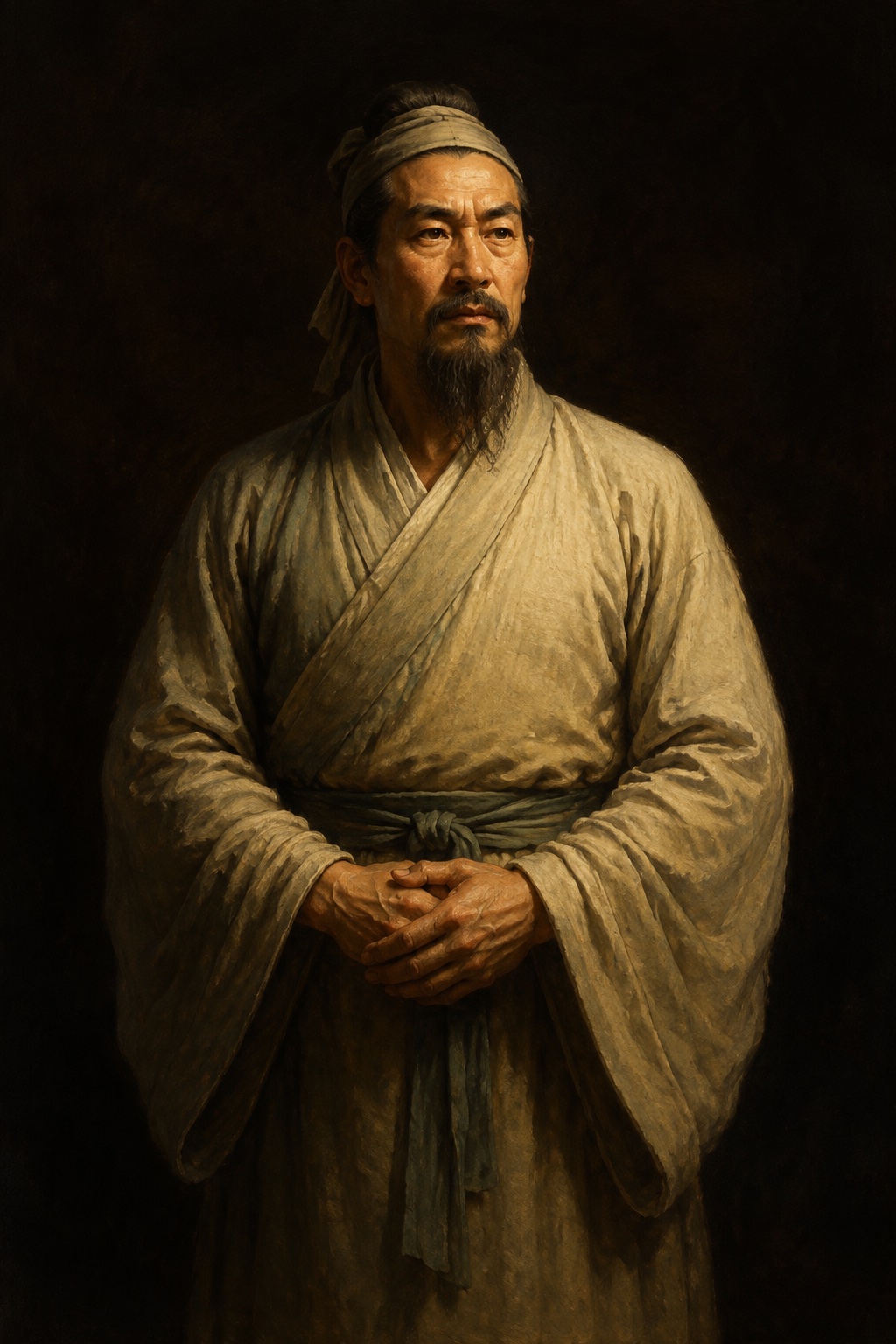
Found among the poor and mean
Shun does not arrive in the record as a prince, a god or a hero. He arrives as the answer to a personnel problem. Yao has been on the throne seventy years, wants to hand it over, and is refused by the President of the Four Mountains on grounds of insufficient virtue; he then asks for a name from anywhere at all — among the illustrious, or from among the poor and mean. The court produces one.
師錫帝曰:「有鰥在下,曰虞舜。」帝曰:「俞?予聞,如何?」岳曰:「瞽子,父頑,母嚚,象傲;克諧以孝,烝烝乂,不格姦。」
“All (then) said to the Di, ‘There is an unmarried man among the lower people, called Shun of Yu’. The Di said, ‘Yes, I have heard of him. What have you to say about him?’ The Chief said,’ He is the son of a blind man. His father was obstinately unprincipled; his (step-)mother was insincere; his (half-) brother Xiang was arrogant. He has been able (however), by his filial piety to live in harmony with them, and to lead them gradually to self-government, so that they (no longer) proceed to great wickedness.’” — Shangshu, “Canon of Yao” 堯典, tr. James Legge
有鰥在下 is the phrase that files him: a man without a wife, down below. In a document otherwise composed entirely of titles, that is an absence of every marker of status the text knows how to record.
Then comes the résumé, and it is a list of other people’s faults. 父頑, 母嚚, 象傲 — the father obdurate, the mother a liar, the brother Xiang arrogant. The recommendation says nothing whatever about Shun’s abilities. Its entire content is 克諧以孝: he was able to harmonise them by filial conduct. What is being certified is that he survived his household without becoming like it, and the Chinese political tradition takes that as the qualifying test for governing the world.
The two daughters
Yao does not appoint him. He tests him, and the test is domestic too.
帝曰:「我其試哉!女于時,觀厥刑于二女。」釐降二女于媯汭,嬪于虞。
“The Di said, ‘I will try him; I will wive him, and thereby see his behaviour with my two daughters.’ (Accordingly) he arranged and sent down his two daughters to the north of the Gui, to be wives in (the family of) Yu.” — Shangshu, “Canon of Yao” 堯典, tr. James Legge
觀厥刑于二女 — observe his pattern with the two daughters. 刑 here is model, form, the shape a man’s conduct takes; the emperor proposes to read a candidate for the throne by watching him be a husband. And the direction of travel matters: 釐降, he sent them down, from the palace to the bend of the Gui river. The imperial daughters go to the commoner’s household, not the reverse. Everything about the procedure assumes that the way a man runs a house is the same faculty, at smaller scale, as the way he would run the empire — which is the assumption the previous passage already made about his father, mother and brother.
The four criminals
What the throne looked like once he had it is recorded, characteristically, as a list of removals. The corpus already holds this sentence from Gun’s side; it is Shun’s only unambiguous act as sovereign in the two canons.
流共工于幽洲,放驩兜于崇山,竄三苗于三危,殛鯀于羽山,四罪而天下咸服
“He banished the Minister of Works to You island; confined Huan-dou on mount Chong; drove (the chief of) San-miao (and his people) into San-wei, and kept them there; and held Gun a prisoner till death on mount Yu. These four criminals being thus dealt with, all under heaven acknowledged the justice (of Shun’s administration).” — Shangshu, “Canon of Shun” 舜典, tr. James Legge
Four men, four places, four different verbs — 流, 放, 竄, 殛, graded from banishment to death. The Minister of Works is Gong-gong, who elsewhere in the tradition is the being who cracked the pillar of heaven; here he is a civil servant sent to an island. Gun is the father of Yu, killed for failing against the flood. The tradition never reconciles the two registers, and this passage is the flattest of them: the sage-king’s justice consists of getting four specific people out of the government.
The closing clause is the one the later canon quotes: 四罪而天下咸服, and all under heaven submitted. Not “was saved,” not “was pacified” — 服, acknowledged, went along with it. Shun’s legitimacy in the Shangshu is manufactured out of exactly two things, a household he did not let ruin him and four officials he did ruin, and it holds up well enough that the Xici lists him at the end of the sequence that begins with Fuxi and Shennong, as the last of the sages under whom things simply worked.