He is born from a rock, and the novel is careful to make the birth an event with no parents and therefore no place in any lineage:
內育仙胞,一日迸裂,產一石卵,似圓毬樣大。因見風,化作一個石猴,五官俱備,四肢皆全。便就學爬學走,拜了四方。目運兩道金光,射沖斗府。
“Within, it nursed an immortal embryo. One day it split open and delivered a stone egg, about the size of a ball. Meeting the wind, it changed into a stone monkey, complete in all five senses and all four limbs. At once it learned to crawl and to walk, and bowed to the four quarters. From its eyes shot two beams of golden light, piercing all the way to the Palace of the Dipper.” — Journey to the West, ch. 1; tr. Mythos Atlas
The last clause aims the whole novel. The Dipper’s palace is heaven’s astral bureau; the first thing this creature does, involuntarily, is set off an alarm in the filing system. He is a problem for the register from the moment he opens his eyes.
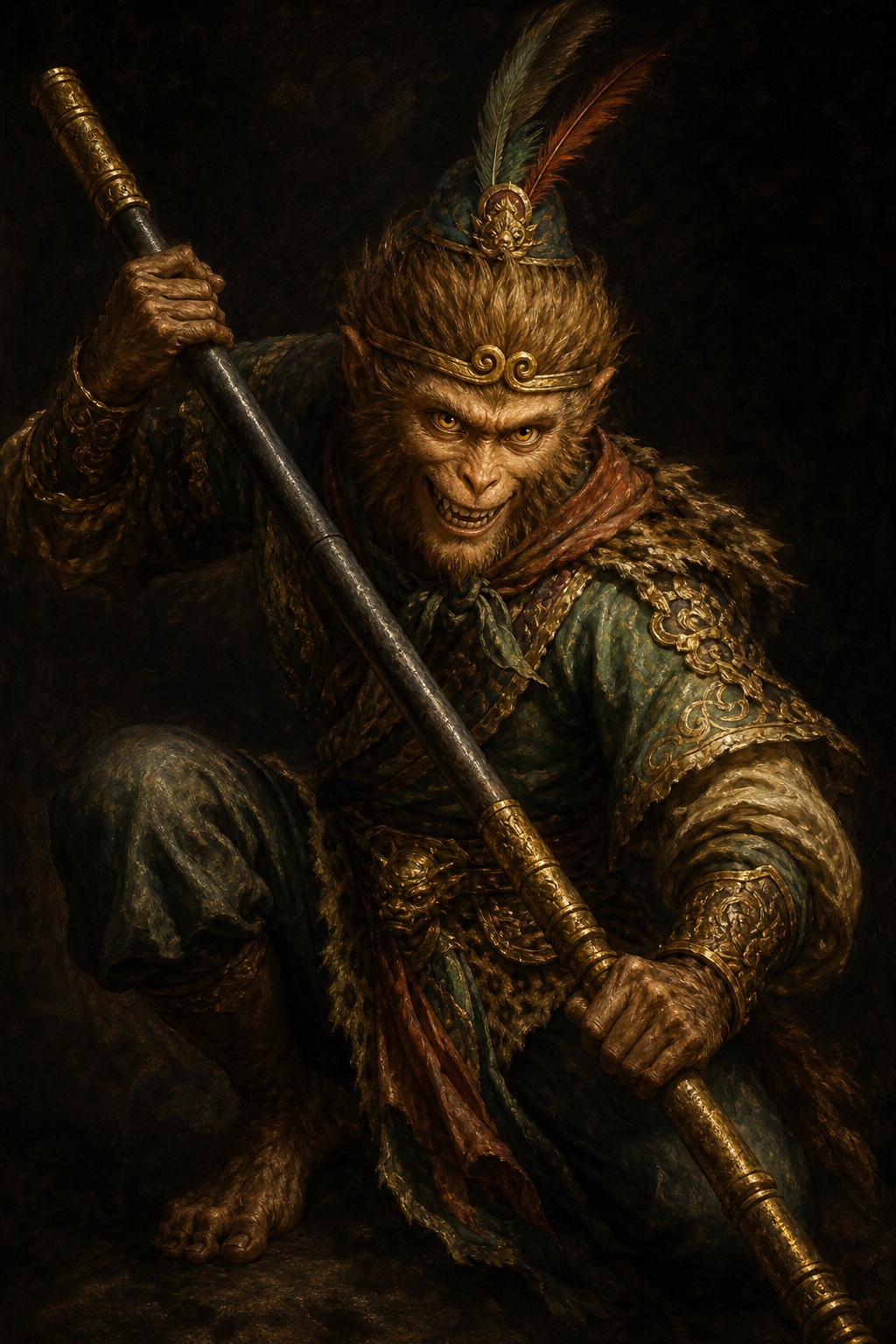
Then he learns the seventy-two transformations and a somersault covering thirty-six thousand miles, bullies the Dragon King of the Eastern Sea out of an iron rod that once measured the depth of the flood, and commits the perfect crime against a bureaucratic heaven. Dragged below by the officials of death, he does not plead — he calls for the Register of the Living and the Dead, finds the page with his name and his monkeys’ names on it, and strikes them out. He does not defeat death. He amends the record.
Heaven’s response is bureaucratic in turn: co-opt him with a job. He is summoned up and appointed Bimawen, Keeper of the Horses, and is delighted until somebody explains where that sits in the table of ranks:
玉帝輕賢,封我做個甚麼『弼馬溫』。
“The Jade Emperor slights the worthy — he appointed me some sort of ‘Bimawen’!” — Journey to the West, ch. 4; tr. Mythos Atlas
What he does next is the sharpest joke in Chinese literature, because he does not reject the system, he escalates within it. A demon king suggests a better title, and Monkey takes it up on the spot:
就做個齊天大聖,有何不可?」猴王聞說,歡喜不勝,連道幾個「好!好!好!」教四健將:「就替我快置個旌旗,旗上寫『齊天大聖』四大字,立竿張掛。自此以後,只稱我為齊天大聖,不許再稱大王。
“‘Why not simply be Great Sage Equal to Heaven?’ The Monkey King, hearing this, was overjoyed and cried out several times, ‘Good! Good! Good!’ He ordered his four generals: ‘Quickly get me a banner made, and write on it the four great characters GREAT SAGE EQUAL TO HEAVEN, then set it on a pole and fly it. From now on address me only as Great Sage Equal to Heaven; no one is to call me Great King again.’” — Journey to the West, ch. 4; tr. Mythos Atlas
He promotes himself by ordering a sign. And heaven — this is the detail that gives the satire its edge — eventually ratifies the title, because a rank granted is easier to manage than a rebel at large. They give him the office and no duties, then park him in charge of Xiwangmu’s peach garden, which is like handing an arsonist the matches. He eats the peaches of immortality, drinks Laozi’s elixir, and wrecks the banquet he was not invited to. He also discovers, on getting home, how heaven’s time relates to everyone else’s: 在天一日,即在下方一年也 — “one day in heaven is one year in the world below.”
No god can hold him. Only the Buddha can, and only by a trick of scale: Monkey somersaults to the end of the universe, signs his name on what he takes for the pillars at the edge of the world, and finds he has been standing in the Buddha’s palm the whole time. Five hundred years under the Mountain of Five Elements later, he is released to escort the monk Tripitaka to India, and the novel spends a hundred chapters turning the most ungovernable being in the cosmos into something like a disciple.
He remains the most beloved figure in Chinese myth, and the reason is not subtle. In a heaven organised as a civil service, he is the one who edited his own file.