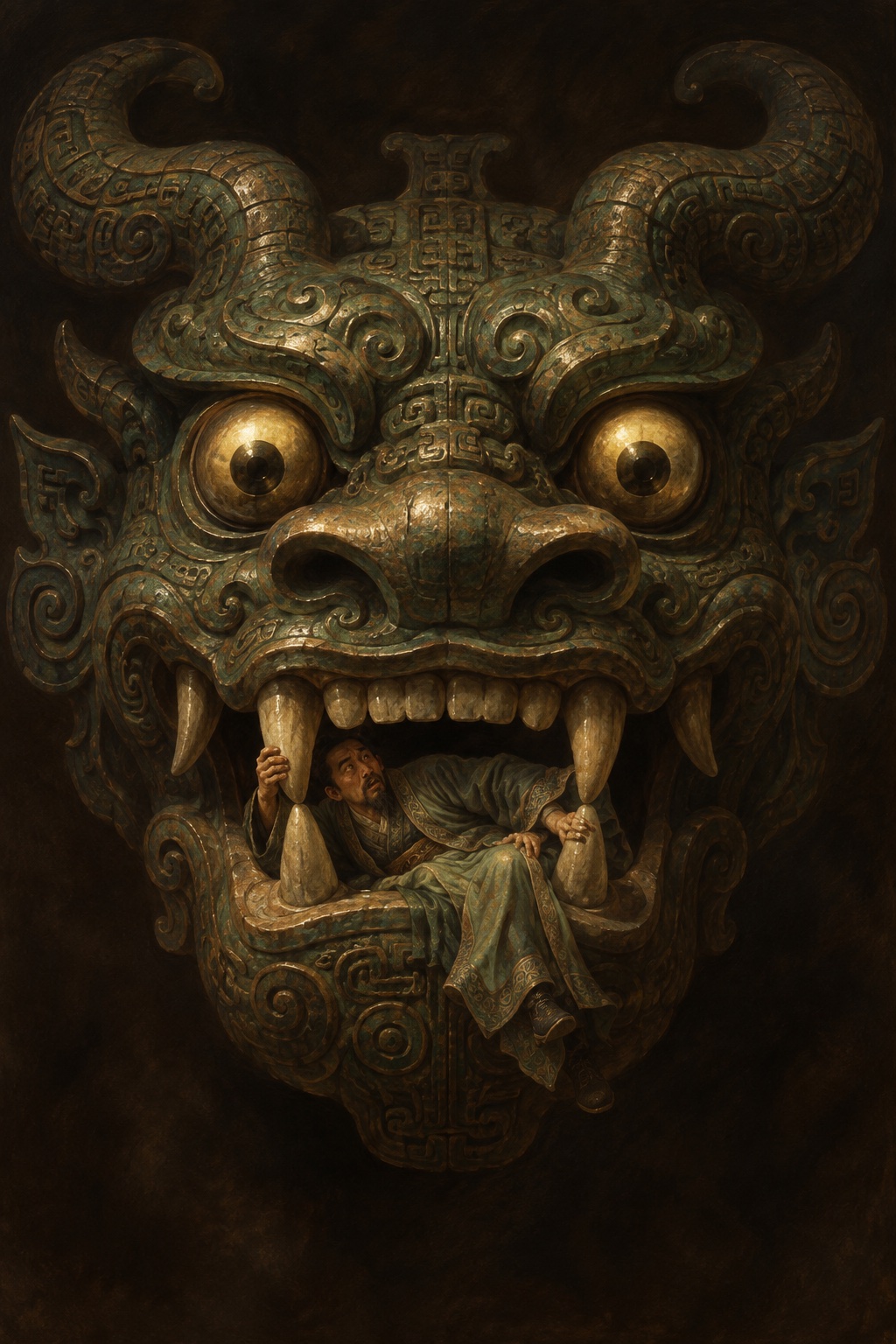
A nickname at the court of Lu
The Zuozhuan does not bring Taotie on as a beast. It brings him on in a speech, and the speech is about a man who has just been driven out of Lu. Under Duke Wen’s eighteenth year, a prince of Ju kills his father, the lord of Ju, and flees to Lu with the state’s jewels, which he presents to the new ruler, Duke Xuan. The duke orders that the fugitive be given a town, today. Ji Wenzi has the minister of crime put him over the border instead, also today, and when the duke asks why, Ji Wenzi has the grand historian Ke answer for him.
Ke answers with the reigns of Yao and Shun. First come sixteen worthy sons of two ancient clans, whom Yao could not raise to office and whom Shun, serving as Yao’s minister, did raise. Then come the worthless ones. The Dihong clan had a worthless son, and the people under heaven called him 渾敦, Hundun. The Shaohao clan had one, and they called him 窮奇, Qiongqi. Zhuanxu had one, and they called him 檮杌, Taowu. Each line, Ke says, carried its wickedness down the generations until Yao’s time, and Yao could not get rid of them. Then he adds a fourth:
縉雲氏有不才子,貪于飲食,冒于貨賄,侵欲崇侈,不可盈厭,聚斂積實,不知紀極,不分孤寡,不恤窮匱,天下之民,以比三凶,謂之饕餮,舜臣堯,賓于四門,流四凶族,渾敦,窮奇,檮杌,饕餮,投諸四裔,以禦螭魅
“Tsin-yun [In the time of Hwang-te] had a descendant who was devoid of ability and virtue. He was greedy of eating and drinking, craving for money and property. Ever gratifying his lusts, and making a grand display, he was insatiable, rapacious in his exactions, and accumulating stores of wealth. He had no idea of calculating where he should stop, and made no exceptions in favour of the orphan and the widow, felt no compassion for the poor and exhausted. All the people under heaven likened him to the three other wicked ones, and called him Glutton. When Shun became Yaou’s minister, he received the nobles from the four quarters of the empire, and banished these four wicked ones, Chaos, Monster, Block, and Glutton, casting them out into the four distant regions, to meet the spite of the sprites and evil things” — Chunqiu Zuozhuan 春秋左傳, “Duke Wen, Year 18” 文公十八年, tr. James Legge (The Chinese Classics, vol. 5, 1872; Hong Kong University Press reprint, 1960)
In this passage Taotie is a name that people give to a man. 謂之饕餮: the people under heaven called him that, as they had called the other three by theirs, and the text says how they arrived at it, 以比三凶, by comparing him with the three already named. What earns him the name is a list of appetites. He is greedy for food and drink, grasping for goods, never to be filled, heaping up stores with no idea of a limit, and he spares neither orphans nor widows. The passage gives him no body, no face and no mouth. The son of the Jinyun clan is a man, and Taotie is what the people call him. Legge does not romanise the four names. He translates them as Chaos, Monster, Block and Glutton, and so reads them as descriptions, which is how the speech uses them.
Legge’s bracket places Tsin-yun, his spelling of Jinyun, in the time of Hwang-te, his spelling of the Yellow Emperor. That is a date, not a line of descent. Du Yu’s note on the passage makes Jinyun the name of an office in the Yellow Emperor’s time, and Kong Yingda’s subcommentary explains it from a later year of the Zuozhuan, which says that the Yellow Emperor named his offices after clouds.
The banishment follows in one breath. Shun, as Yao’s minister, receives the lords at the four gates and banishes the four, the Four Perils, 四凶, sending them out to the four borders, 投諸四裔, to hold off the demons of the wilds. Then the speech draws its moral. When Yao died, all under heaven took Shun as Son of Heaven with one mind, because he had raised the sixteen and removed the four. And Ke applies it to the case in hand. Ji Wenzi has not yet found one good man, he concludes, but he has removed one peril, the prince from Ju, where Shun removed four.
Four Perils and Four Malefactors
The Zuozhuan does not match its four to anyone else’s list. The Shangshu has a set of four of its own. In its “Canon of Shun”, Shun punishes 共工, 驩兜, the 三苗 and 鯀, and the chapter calls them 四罪, the Four Malefactors. Both sets are Shun’s work and both have four members, and Du Yu and Kong Yingda set out to make them one set. Kong Yingda’s subcommentary keeps the two labels apart even as it does so. It calls the Shangshu’s set 四罪 and the Zuozhuan’s set 四凶, and it says that the way to know who is who is to examine their deeds and so identify the men.
Du Yu’s notes do three of the four. Hundun, he says, is Huandou; Qiongqi is Gong Gong; Taowu is Gun. On that reading Gong Gong and Gun are Taotie’s fellow Perils in the Zuozhuan, and Malefactors in their own right in the Shangshu: the same men, banished in two books under two sets of names. For Taotie himself Du Yu gives no counterpart. He divides the name instead, and reads its first character as greed for wealth and its second as greed for food. He also explains why the text compares the son of Jinyun with the three rather than simply listing him with them: this son was not of the line of emperors and kings.
Kong Yingda supplies the fourth by elimination. The Shangshu, he notes, gives no account of the Sanmiao’s crimes, so once the other three have been matched, Taotie must be the Sanmiao. He adds that the earlier scholars all held this and that none said otherwise. It is an identification by what is left over. Nothing in the Zuozhuan’s portrait of a greedy son points to the Sanmiao, and nothing in the Shangshu line says that the Sanmiao were greedy. In their own books the Four Perils and the Four Malefactors stay two sets. They become one set only in the commentary.
A head with no body
The beast comes from another book. The Lüshi Chunqiu has a chapter on foreknowledge, told through men who saw the fall of states before it came. The Jin grand historian Tu Shu, seeing the disorder in Jin, carries his charts and laws to Zhou. When Duke Wei of Zhou asks him which state will fall first, he names Jin, and within three years Jin has fallen. Asked again, he names Zhongshan, and then the duke himself. After him comes Bai Gui, who leaves Zhongshan and then Qi because both are going to perish. Between those two stories, after the remark that the words of those who have the Way must be taken seriously, the chapter sets down a single image:
周鼎著饕餮,有首無身,食人未咽,害及其身,以言報更也。為不善亦然
“On the Zhou tripods is set Taotie, a head with no body. It eats a man, and before it can swallow, the harm reaches its own person. This is to speak of retribution. Doing what is not good is the same.” — Lüshi Chunqiu, “Xian shi” 先識; tr. Mythos Atlas
Nothing in the line recalls the Zuozhuan. There is no clan, no Shun, no banishment and no man with a nickname. There is an image on the Zhou tripods, 周鼎, and the line describes it first by what it lacks: 有首無身, a head and no body. Then it gives the image an act. It eats a man, and before it can swallow him the harm comes back upon it. The words for that, 害及其身, say that the harm reaches its own 身, its person or its body, which is the thing the head has just been said to lack. The Lüshi Chunqiu does not stop on the point. It states its moral in a clause of its own, that the image speaks of retribution and that anyone who does wrong fares the same, and then it moves on to Bai Gui.
Appetite is the one thread between the two books. The Zuozhuan’s man can never be filled, and the Lüshi Chunqiu’s head never finishes its meal. But the Lüshi Chunqiu does not draw that thread itself, and it says nothing of Shun, of the Jinyun clan or of any banishment. The greedy man comes from the Zuozhuan; the man-eating head on the tripods comes from the Lüshi Chunqiu. Art historians now give the name to the frontal animal mask on Shang and Zhou ritual bronzes; that use is a convention, and no text quoted in this entry makes it.
Guo Pu’s bridge
The Shanhaijing’s “Classic of the Northern Mountains” has a man-eater of its own, on Mount Gouwu, and the classic never calls it Taotie:
曰鈎吾之山,其上多玉,其下多銅。有獸焉,其狀如羊身人面,其目在腋下,虎齒人爪,其音如嬰兒,名曰狍鴞,是食人
“It is called Mount Gouwu. On its heights is much jade, and below, much copper. There is a beast there, shaped like a sheep’s body with a human face. Its eyes are under its armpits; it has a tiger’s teeth and human nails; its voice is like an infant’s. It is called the Paoxiao. It eats people.” — Shanhaijing, “Classic of the Northern Mountains” 北山經; tr. Mythos Atlas
That is a whole body, which neither of the other books supplies. The Zuozhuan does not describe its man at all, and the Lüshi Chunqiu’s head has no body. The name that joins this body to them comes from Guo Pu, whose notes are printed with the classic’s text. His note on the Paoxiao calls it a greedy creature. It says that the Paoxiao eats men and that, before it has finished, the harm turns back on its own body, which is almost the Lüshi Chunqiu’s account of the image on the tripods. Then the note names the Zuozhuan: this, Guo Pu says, is what the Zuozhuan calls Taotie.
The identification is Guo Pu’s, not the classic’s. The Shanhaijing gives the 狍鴞 no name but its own and says nothing of tripods, greed or retribution. Guo Pu’s note is the one place where the three strands meet: the body from the Shanhaijing, the retribution from the Lüshi Chunqiu and the name from the Zuozhuan. The Zuozhuan’s own subcommentary reached for a body as well. Kong Yingda records Fu Qian citing the Shenyijing for a beast named Taotie that eats men and has its face and eyes under its armpits, close to the eyes under the armpits that the Shanhaijing gives the Paoxiao.