The granary and the well
The Book of Documents spends one word on him, inside a character reference written about somebody else, and gives him nothing to do. The acts behind that word were being argued over in Mencius’s school three centuries before the Shiji was written; Sima Qian is the later and tidier teller, and his is the version that runs as a narrative rather than as evidence in somebody’s argument. It is worth starting there for the shape of the thing, and going back to the older text for what it means.
The wish to kill Shun is older than any of them. Sima Qian has already said that the father, the stepmother and the son all wanted him dead, and the passage that finally shows them trying opens on 尚復, still, once more: this is a household returning to something it has been at for years. What is new is that there is now an estate. Yao had tested Shun by marrying his two daughters into the family, and had sent down fine clothes, a lute, oxen and sheep, and had granaries built on the property. The murders are not new. The motive for a division of the spoils is.
The first attempt is the father’s alone. Gusou sends Shun up to plaster the granary roof and fires the building from underneath him; Shun comes down holding two large straw hats spread out as shields — 兩笠自扞而下 — and walks away unburnt. The second is the one the text puts Xiang inside. Gusou sends Shun to dig a well; Shun digs it with a concealed side-passage, 匿空旁出, and once he is deep in the shaft the two of them shovel earth in on top of him together, 與象共下土實井. They are burying him alive, and they believe they have managed it.
瞽叟、象喜,以舜爲已死。象曰:「本謀者象。」
“Gusou and Xiang were delighted, taking it that Shun was already dead. Xiang said, ‘The one who planned it from the start was Xiang.’” — Shiji, “Annals of the Five Emperors” 五帝本紀; tr. Mythos Atlas
本謀者象 is four characters and it is the most revealing thing he says. The narrative has just shown him as his father’s second pair of hands at the mouth of a well; it has not shown him devising anything, and the granary fire it attributes to Gusou by himself. The boast claims both attempts at once, and it is offered as a credential — the opening move in a negotiation about who gets what.
What follows immediately is that negotiation. 象與其父母分 — Xiang divides the estate with his father and mother, and he does the dividing, and he reads the shares out loud. Shun’s wives, who are Yao’s two daughters, and the lute: those he takes. The oxen, the sheep and the granary go to the parents. It is worth noticing what he values. The livestock and the grain store are the actual wealth of a farming household; he hands them to the old couple and keeps the two princesses and the instrument, which are the things that came down from the palace.
The lute, and the man who walked in
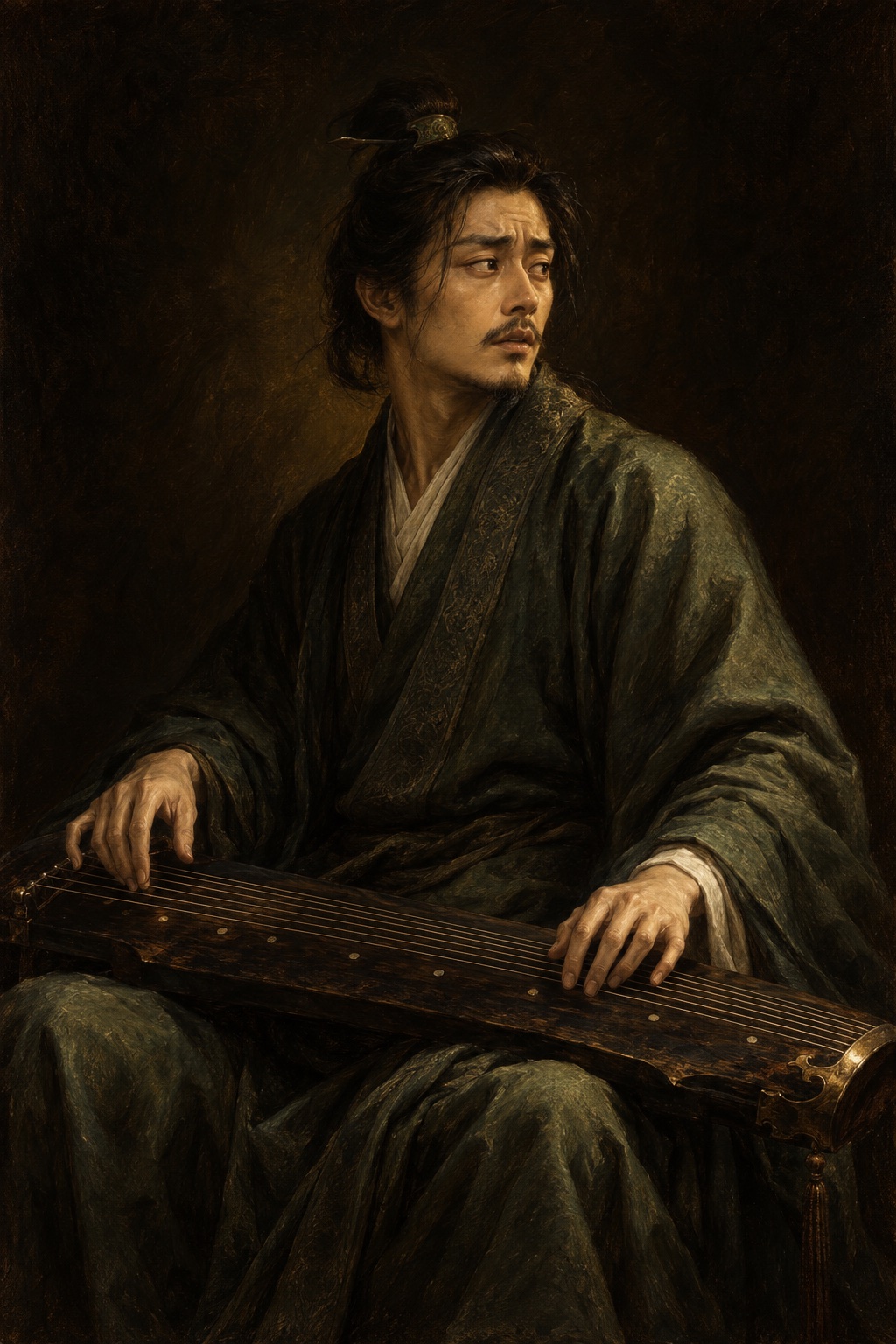
Then he moves house. 象乃止舜宮居 — Xiang goes and settles in Shun’s own rooms, and the next thing he does there is pick up the lute he has just assigned himself.
象乃止舜宮居,鼓其琴。舜往見之。象鄂不懌,曰:「我思舜正鬱陶!」舜曰:「然,爾其庶矣!」
“Xiang then settled into Shun’s house, and played his lute. Shun came in and saw him. Xiang, startled and put out, said, ‘I was thinking of Shun — and how heavy my heart was!’ Shun said, ‘Just so. You shall take charge of my many people for me.’” — Shiji, “Annals of the Five Emperors” 五帝本紀; tr. Mythos Atlas
Four beats, and each one is a whole characterisation. 鼓其琴 puts him mid-performance, which is the only time the sources ever show him enjoying anything. 舜往見之 is as flat as the language gets: Shun went and saw him. No confrontation is described, because none happens.
象鄂不懌 does the work. 鄂 stands for 愕, startled — the face of a man who has been caught — and 不懌 is displeased, put out, sour. He is both at once, and the second is the more damning: he is not frightened of the brother he tried to murder, he is annoyed that the murder did not take. Then comes the performance. 鬱陶 is grief that has built up with nowhere to go, the word for mourning that cannot be discharged, and he applies it to a man standing in the doorway watching him play his lute in his house.
Shun’s reply is two words of agreement and then a job. 然 — just so, quite right — accepts the lie at face value, and 爾其庶矣 hands him responsibility for Shun’s people. The four characters are Sima Qian’s compression of an older and plainer line the Mengzi preserves, 唯茲臣庶,汝其于予治: these my officers and people, you shall govern them for me. No accusation, no punishment, no mention of the well. That reply is the hinge of the entire figure, and the philosophers had already been arguing about it for three hundred years by the time the Shiji set it down; every question in the next two sections comes out of it.
Whether Shun knew
Wan Zhang, Mencius’s student, retells the whole business — the granary with the ladder taken away, the well stopped up from above, the inventory, the lute — and then asks the question the story invites, which is not about Xiang at all.
不識舜不知象之將殺己與?」曰:「奚而不知也?象憂亦憂,象喜亦喜
“‘I wonder — did Shun not know that Xiang meant to kill him?’ He said: ‘How could he not have known? When Xiang was sorrowful, he was sorrowful; when Xiang was glad, he was glad.’” — Mengzi, “Wan Zhang I” 萬章上; tr. Mythos Atlas
奚而不知也 — how could he not have known. Mencius does not defend Shun by making him an innocent, and the Shiji agrees with him on the point: a man who digs his well with an escape tunnel already in it has understood his family perfectly well. The knowledge is granted and the behaviour is left standing.
What the answer then offers is not an explanation but a mirror. 象憂亦憂,象喜亦喜, when Xiang grieved he grieved and when Xiang rejoiced he rejoiced — Shun’s face simply follows his brother’s, with no reference to what the brother has just tried to do. So Wan Zhang asks the obvious follow-up, which is whether the joy was a pretence, and Mencius says flatly that it was not. His parable is about Zi Chan of Zheng, who was given a live fish, told his pond-keeper to put it in the pond, and was lied to by the man, who had cooked and eaten it; Zi Chan believed the pleasant report and was glad, and was laughed at for it behind his back. A gentleman, Mencius says, can be imposed on by what comes at him in the shape of the right thing, and is hard to trap by what does not. Xiang arrived in the posture of a younger brother loving his elder, so Shun took it in good faith and was genuinely happy. The defence is that Shun was fooled, willingly, and that being fooled that way is not a fault.
The fief at Youbi
The harder question is what the sage-king did with him afterwards, and here Wan Zhang stops asking about feelings and starts asking about law.
象日以殺舜為事,立為天子,則放之,何也?」孟子曰:「封之也。或曰放焉。」萬章曰:「舜流共工于幽州,放驩兜于崇山,殺三苗于三危,殛鯀于羽山,四罪而天下咸服。誅不仁也。象至不仁,封之有庳。有庳之人奚罪焉
“‘Xiang made the killing of Shun his daily business. When Shun was set up as Son of Heaven he merely banished him. Why?’ Mencius said, ‘He enfeoffed him. Some say he banished him.’ Wan Zhang said, ‘Shun banished Gong Gong to Youzhou, drove Huan Dou out to Mount Chong, put the Sanmiao to death at Sanwei, and executed Gun at Mount Yu. Four punishments, and all under heaven submitted — because what he punished was the unrighteous. Yet Xiang was the most unrighteous of all, and he enfeoffed him at Youbi. What crime had the people of Youbi committed?’” — Mengzi, “Wan Zhang I” 萬章上; tr. Mythos Atlas
象日以殺舜為事 is the best short account of him anybody wrote: he made killing Shun his daily occupation, the way another man has a trade. And the list Wan Zhang sets beside him is the same four names the atlas already holds from the other end, in Shun’s own entry — Gong Gong sent to Youzhou, Huan Dou to Mount Chong, the Sanmiao dealt with at Sanwei, Gun killed at Yushan 羽山. The wording differs: the Book of Documents writes 竄三苗, drove the Sanmiao out, where the Mengzi writes 殺, put them to death. Those four are the whole content of Shun’s reputation as a judge. 四罪而天下咸服, four punishments and all under heaven submitted, is the sentence the tradition quotes to prove that his rule was just.
The argument is therefore airtight, and Wan Zhang builds it in one move. If the four banishments earned submission because 誅不仁也, because the unrighteous were punished, and if Xiang is 至不仁, the most unrighteous there is, then the one man who most deserved the sentence is the one man who got a fief. The last clause is the sharpest and it is not about Xiang: 有庳之人奚罪焉 — what had the people of Youbi done? A punishment withheld from a brother has to be paid for by somebody, and it is paid for by the inhabitants of a district who are handed a lord with a record.
Mencius answers on two fronts. First, on the affection: a humane man does not store up anger against his younger brother or keep a grudge overnight; being close to him means wanting him honoured, loving him means wanting him rich, and 封之有庳,富貴之也 — the fief is how you make a man honoured and rich. If Shun were Son of Heaven while his brother stayed a commoner, that would not be love. Second, and this is the part that answers Wan Zhang’s real objection, the fief is not what it sounds like. Xiang, Mencius says, got no power to act in his own state: the Son of Heaven sent officers to govern it and to remit its tribute and taxes to him, which is exactly why some people call the arrangement banishment. Xiang drew the revenues of Youbi and never ruled it, and its people were never left at his mercy.
Sima Qian records the same ending in six characters and makes no argument at all — 封弟象爲諸侯, he enfeoffed his younger brother Xiang as a feudal lord — set down among the closing facts of the reign, between Shun’s dutiful visits to his father and the succession of Yu. What is an ethical crisis for the philosophers is one more administrative act for the historian.
That gap is why the figure survives. Xiang does nothing of interest after the well is filled in; he is a man with two deeds, one boast and a title. But he is the single exception in the career of the most just king the tradition has, and every later argument about whether virtue may be partial, whether a ruler’s family is a private matter, and whether forgiveness is a luxury paid for by strangers, has to go through a younger brother sitting in a dead man’s room with a lute in his lap.