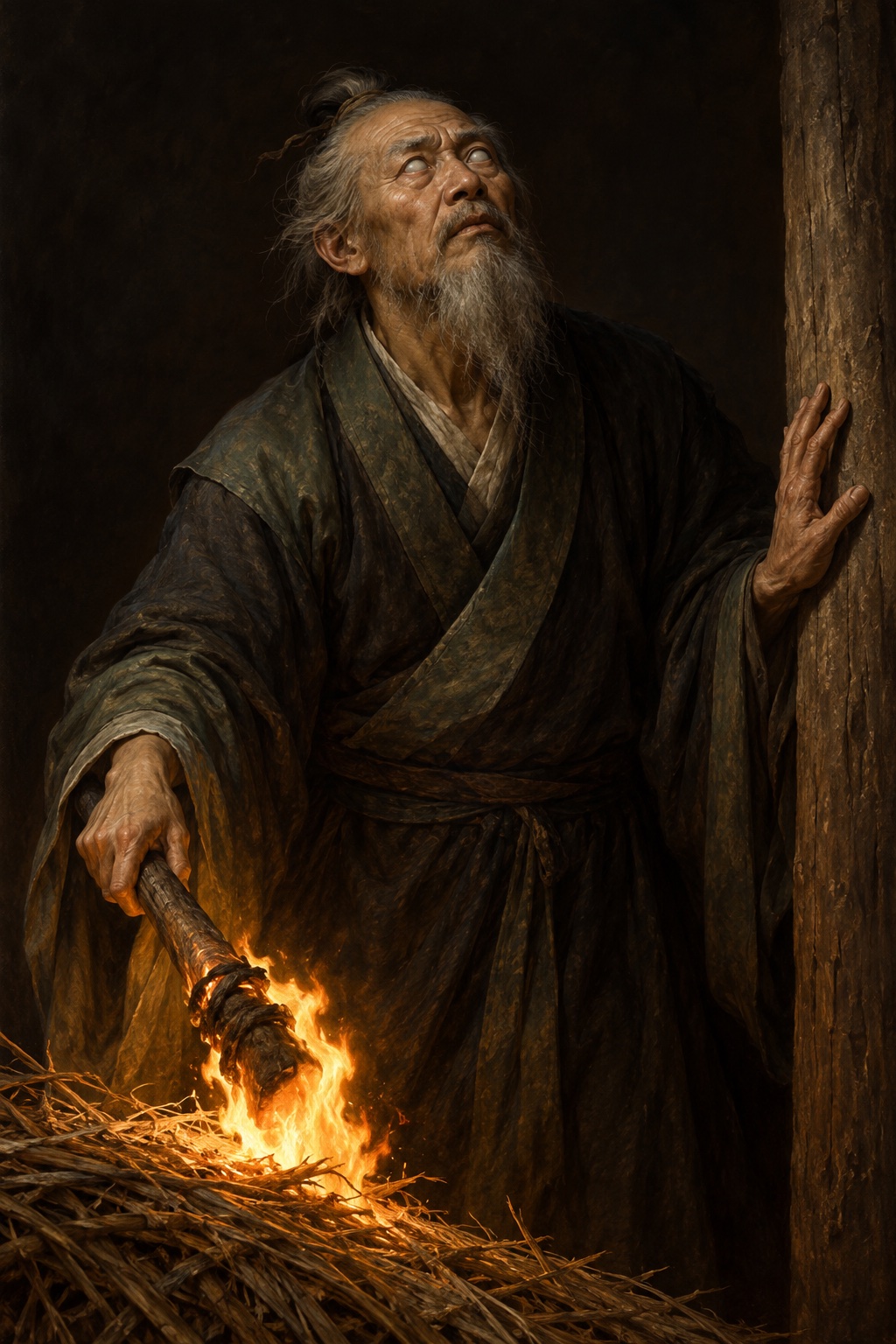
A blind man’s household
When Yao’s court recommends an unmarried commoner for the throne, the Book of Documents does not name the candidate’s father. The first thing it says about the candidate is that he is the son of a blind man, and the second is that the father is obstinate; the line is quoted in Shun’s own entry. The name the later texts use is hardly more than that description. 瞽 is the ordinary word for blind, and 瞽叟, as the Shiji writes it, is the blind old man. The Mengzi writes the second character differently, 瞽瞍, and means the same man.
Sima Qian gives him a pedigree before he gives him anything to do. The “Annals of the Five Emperors” traces Shun upward through his father: Gusou’s father was Qiaoniu, and the line runs on through Gouwang, Jingkang and Qiongchan to Zhuanxu, and Sima Qian counts seven generations down to Shun. Then comes the qualification that matters: 自從窮蟬以至帝舜,皆微爲庶人, from Qiongchan down to Shun, they were all humble commoners. Gusou descends from an emperor and lives as a commoner, and the throne will come back into the family through the son he least wants.
The same chapter states the fact that his name only implies. 舜父瞽叟盲 — Shun’s father Gusou was blind. Shun’s mother died, and Gusou took another wife and with her had Xiang. The motive for everything that follows is given in one plain clause and is never improved on: 瞽叟愛後妻子,常欲殺舜, Gusou loved the son of his second wife and was always wanting to kill Shun. Shun kept out of the way when he could, and when he committed some small fault he took the punishment. He served his father, his stepmother and his brother obediently, more earnestly every day, and never grew slack.
A few lines later Sima Qian sums up the household in a form that echoes the Book of Documents closely: 舜父瞽叟頑,母嚚,弟象傲,皆欲殺舜. The father was obstinate, the mother deceitful, the brother arrogant, and all of them wanted Shun dead. Here 頑, 嚚 and 傲 are the three words the court used when it recommended him, one for each member of the family. The next sentence describes how he survived them, and it describes Gusou as clearly as it describes the son: 欲殺,不可得;即求,嘗在側. When they wanted to kill him, he could not be found; when they needed him, he was always at their side.
The granary and the well
What turned the old wish into a plan was property. Yao tested Shun by marrying his two daughters to him, and then sent him fine linen and a lute, had granaries built for him and gave him oxen and sheep: 堯乃賜舜絺衣與琴,爲筑倉廩,予牛羊. The sentence after the gift opens 瞽叟尚復欲殺之. Gusou still wanted to kill him, once again; 尚復 marks the attempt as one more of many, not as a new idea.
The Shiji then tells two attempts, and it is exact about who does what. Gusou sends Shun up to plaster the granary roof, and Gusou himself sets the fire from below: 瞽叟從下縱火焚廩. No one else is named at the granary. Shun comes down holding two wide straw hats as shields, 兩笠自扞而下, and walks away unhurt. Afterwards Gusou sends him to dig a well. Shun digs it with a hidden passage that leads out at the side, 匿空旁出, and when he is deep in the shaft, Gusou and Xiang throw earth down together and fill the well: 瞽叟與象共下土實井. The fire is the father’s act alone; the burial is the act of the father and the younger son together. Shun comes out through his hidden passage and goes.
瞽叟、象喜,以舜爲已死。象曰:「本謀者象。」
“Gusou and Xiang were delighted, taking it that Shun was already dead. Xiang said, ‘The one who planned it from the start was Xiang.’” — Shiji, “Annals of the Five Emperors” 五帝本紀; tr. Mythos Atlas
The pleasure is shared and the claim is not. Xiang takes the credit for a plan the narrative has not shown him making, and Gusou lets it stand; in none of this does the father speak. In the division of the estate that Xiang then announces, Shun’s wives and his lute go to Xiang, and the oxen, the sheep and the granaries go to the parents: 牛羊倉廩,予父母. The grain stores that Yao had built for Shun pass to Gusou as his share of the son he believes he has buried.
The older telling, in the Mengzi, comes not as a story but as evidence in a question. Wan Zhang, Mencius’s student, sets out the facts before he asks his teacher what they meant for Shun, and his facts begin like this.
父母使舜完廩,捐階,瞽瞍焚廩。使浚井,出,從而掩之
“His parents set Shun to repair a granary, to which, the ladder having been removed, Gu Sou set fire. They also made him dig a well. He got out, but they, not knowing that, proceeded to cover him up.” — Mengzi, “Wan Zhang I” 萬章上, tr. James Legge
Legge’s text, as ctext.org serves it, spells the name Gu Sou. The two tellings differ in nearly every detail. In the Mengzi it is 父母, both parents, who set Shun his tasks. The ladder is taken away, 捐階, and the passage does not say how Shun escaped the fire. He is already out of the well when it is covered. The Chinese names no one for the burial: it says only 從而掩之, and then covered it over, and Legge supplies both the “they” and the “not knowing that”. On one point the two texts agree. Whoever set the tasks and whoever filled the well, the fire has a single name next to it: 瞽瞍焚廩 in the Mengzi, 瞽叟從下縱火焚廩 in the Shiji.
Served all the same
The Shiji’s account of the two attempts ends with the son, not the father. Shun walks in on Xiang playing the lute in his house, accepts his brother’s excuse, and then 舜復事瞽叟,愛弟彌謹: Shun went back to serving Gusou, and loved his younger brother with still greater care. Nothing is said to Gusou and nothing is done to him. The sentence records no reproach and no reconciliation, only the son’s return to his duties.
The throne did not change the order between them. In its closing summary of the reign the chapter records that once Shun had ascended the throne, he went, carrying the banners of the Son of Heaven, to pay court to his father: 往朝父瞽叟,夔夔唯謹,如子道. He came in awe and with great care, in the way of a son. 朝 is the word for an audience at court, the visit a subject pays to a ruler, and here the Son of Heaven pays it to a blind commoner.
Mencius makes the relation the measure of Shun’s virtue. In “Li Lou I” he says that Shun fulfilled the way of serving a parent, and Gusou came at last to be content: 舜盡事親之道,而瞽瞍厎豫. Then he says it twice more, and each time the consequence grows. 瞽瞍厎豫而天下化 — when Gusou was content, the world was transformed. 瞽瞍厎豫而天下之爲父子者定 — when Gusou was content, the relation of father and son was settled everywhere under heaven. Mencius calls this 大孝, great filial piety. In this argument the father’s hardness is what gives the son’s service its weight: an easy father would have proved nothing.
Tao Ying’s question
The Mengzi uses him once more, in a case that never happened. Tao Ying puts a hypothetical to Mencius, and he builds it so that two duties meet head-on.
桃應問曰:「舜為天子,皋陶為士,瞽瞍殺人,則如之何
“Tao Ying asked, saying, ‘Shun being sovereign, and Gao Yao chief minister of justice, if Gu Sou had murdered a man, what would have been done in the case?’” — Mengzi, “Jin Xin I” 盡心上, tr. James Legge
Mencius answers in stages, and his student pushes at each one. Gaoyao 皋陶, the minister of justice, would simply arrest him: 執之而已矣. Would Shun not forbid it? How could he, when what Gaoyao enforced had come to him from a proper authority? Then what would Shun do? He would think no more of giving up the empire than of throwing away a worn-out sandal. He would take his father on his back in secret and run, 竊負而逃, and live along the sea-coast, 遵海濱而處, glad to the end of his life, happy, and forgetting the empire: 樂而忘天下.
The question is about Shun, but it depends on Gusou. The Mengzi has already shown him setting fire to a granary with his son on the roof, so the murder in the hypothesis is not an absurd one. The answer gives up neither duty. The judge is not stopped, and the king does not stop him. The son simply stops being king and carries the prisoner away; 竊, secretly, is also the ordinary word for stealing. The brother who tried to kill Shun got a fief at Youbi, and the father who kills in this case would get a flight to the sea, with the empire thrown away to pay for it. The passage does not mention the dead man again.
In none of the passages quoted here does Gusou say a word. He is blind and obstinate, he tried twice to kill his own son, and in a thought experiment he kills a man. The tradition keeps him for one purpose. He is the fixed hardship against which Shun’s filial piety is measured: the father sets the granary on fire, and the son comes down, walks away, and goes back to serve him.