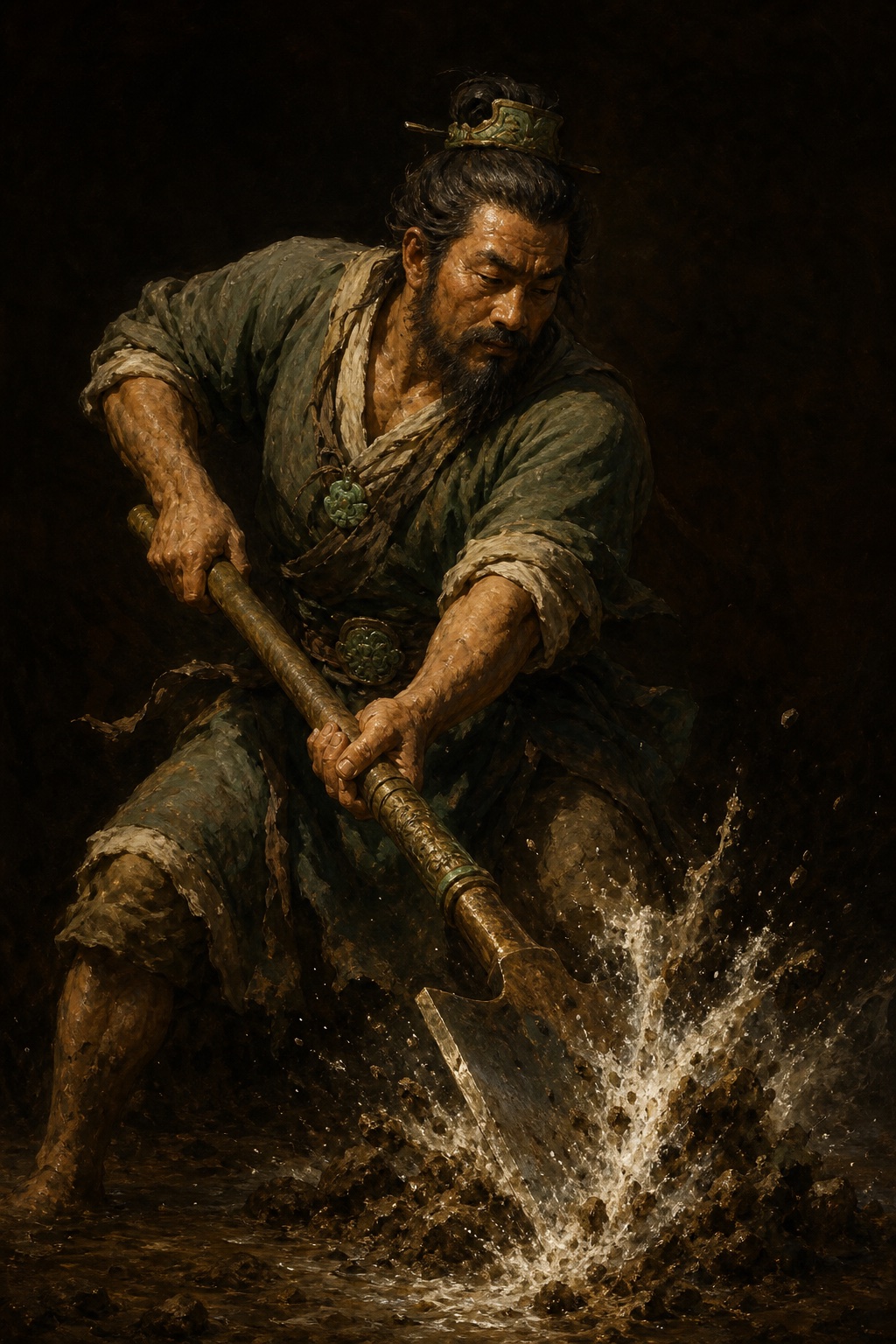
Finishing what Gun began
Zhurong’s own entry tells how the crisis started: the floodwaters rose to the sky, Gun stole the High God’s Growing Soil to dam them without leave, and the High God had Zhurong kill him for it at Yujiao. Yu was born from Gun’s body, and it was Yu the High God then ordered to finish the work his father had botched. The order did not repeat the method. Gun had tried to wall the water in; everything that follows is Yu’s own account of doing the opposite.
The four conveyances
In the Shangshu’s “Yi and Ji” 益稷, Yu tells the flood himself, reporting to Shun and the minister Gaoyao 皋陶 at court. It reads less like a myth about him than an official account of a finished public work, in his own voice:
洪水滔天,浩浩懷山襄陵,下民昏墊。予乘四載,隨山刊木,暨益奏庶鮮食。予決九川,距四海,濬畎澮距川;暨稷播,奏庶艱食鮮食。懋遷有無,化居。烝民乃粒,萬邦作乂
“The inundating waters seemed to assail the heavens, and in their vast extent embraced the hills and overtopped the great mounds, so that the people were bewildered and overwhelmed. I mounted my four conveyances, and all along the hills hewed down the trees, at the same time, along with Yi, showing the multitudes how to get flesh to eat. I (also) opened passages for the streams (throughout the) nine (provinces), and conducted them to the four seas. I deepened (moreover) the channels and canals, and conducted them to the streams, sowing (grain), at the same time, along with Ji, and showing the multitudes how to procure the food of toil, (in addition to) the flesh meat. I urged them (further) to exchange what they had for what they had not, and to dispose of their accumulated stores. (In this way) all the people got grain to eat, and the myriad regions began to come under good rule.” — Shangshu, “Yi and Ji” 益稷, tr. James Legge
The text names his “four conveyances” — 四載 — without ever saying what they are; two centuries later the Shiji glosses them as chariot, boat, sledge and mountain-spikes, one for each kind of ground, but that gloss is Sima Qian’s, not Yu’s own account. What Yu himself claims is labor, not equipment: hewing trees along the hillsides, opening the nine rivers, deepening channels and canals until they reach the streams, and only then — with the water finally going somewhere — teaching people to farm what the flood had left. Order, in this passage, is a route dug for the water, not a wall raised against it.
Eight years outside
Mencius, telling the same work from outside Yu’s own mouth two centuries later, keeps the geography and adds a number:
禹疏九河,瀹濟漯,而注諸海;決汝漢,排淮泗,而注之江,然後中國可得而食也。當是時也,禹八年於外,三過其門而不入
“Yu separated the nine streams, cleared the courses of the Ji and Ta, and led them all to the sea. He opened a vent also for the Ru and Han, and regulated the course of the Huai and Si, so that they all flowed into the Jiang. When this was done, it became possible for the people of the Middle Kingdom to cultivate the ground and get food for themselves. During that time, Yu was eight years away from his home, and though he thrice passed the door of it, he did not enter.” — Mengzi, “Teng Wen Gong I” 滕文公上, tr. James Legge
Mencius never explains why Yu stays away, or what three brief appearances at his own door are meant to prove; the absence is the whole point, the cost paid for water that goes where it is told to go instead of where it wants.
The throne of the Xia
Neither passage above says what Yu got for it. That part of the record is the Shiji’s: once the work is done, Yu takes the throne, faces south to receive the empire’s homage, and names the dynasty Xia. His son Qi succeeds him — not by the tested-merit selection that had put Yao’s throne into Shun’s hands and Shun’s into Yu’s, but simply by inheriting it, the first time the succession runs father to son rather than sage to sage. The digging is the part of the story every later telling repeats; the throne is what quietly changed shape while no one was watching the water.