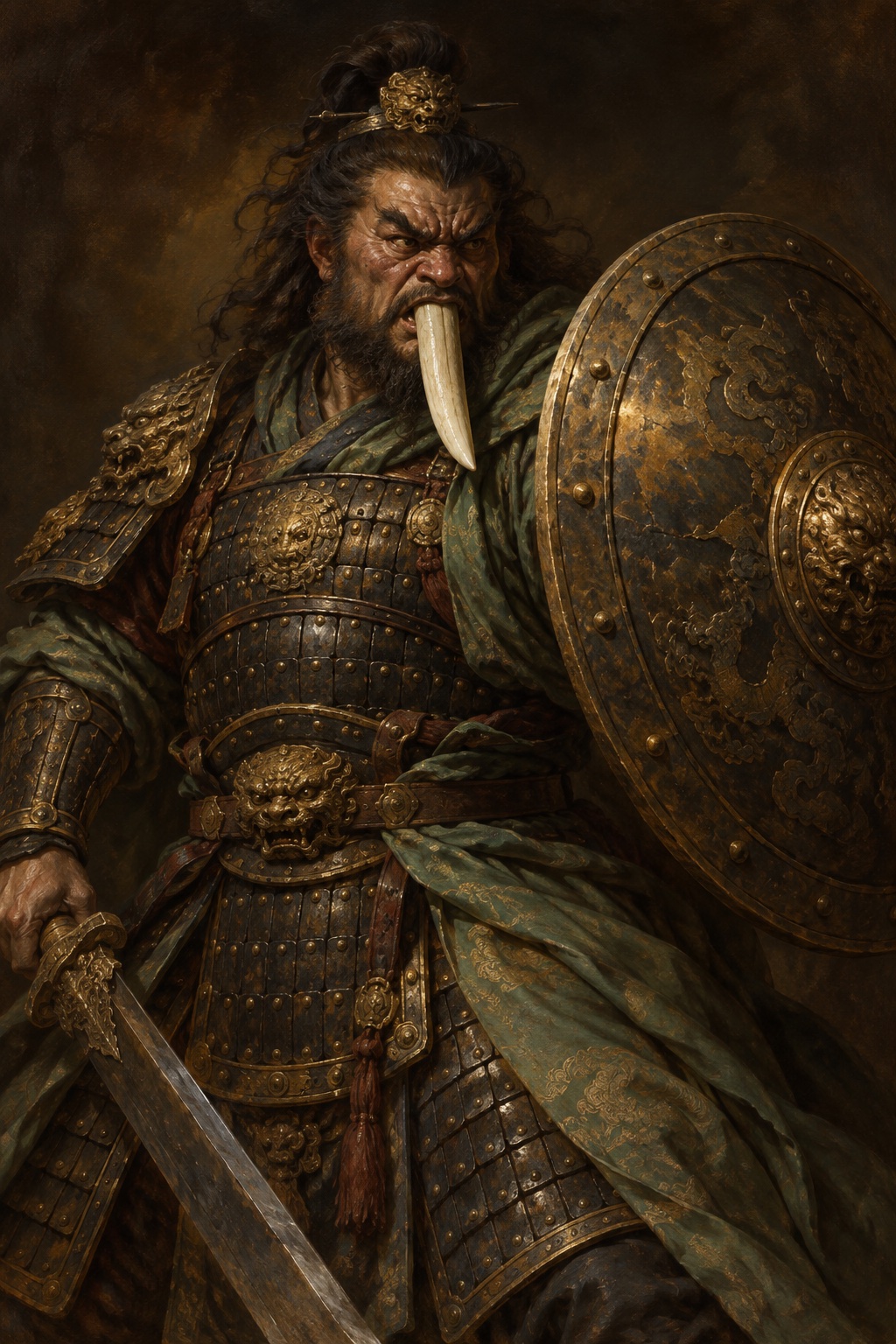
Shield against bow
The Shanhaijing gives Zaochi one scene, and it is a fight. It comes in the “Classic of Regions Beyond the Seas: South”, in a single notice of three sentences.
羿與鑿齒戰于壽華之野,羿射殺之。在昆侖虛東。羿持弓矢,鑿齒持盾
“Yi fought against Zaochi in the wilds of Shouhua, and Yi shot and killed him. It is east of Kunlun’s mound. Yi held a bow and arrows; Zaochi held a shield.” — Shanhaijing, “Classic of Regions Beyond the Seas: South”; tr. Mythos Atlas
The archer is 羿, Yi, the figure filed here as Hou Yi, and the notice gives him no title and no one to send him. The verb is 戰, to fight, and 與 makes the fight a meeting of two: Yi fought against Zaochi. The notice does not say who began it or why. It gives the outcome at once, 羿射殺之, Yi shot and killed him, and only after a clause of location does it say how the two were armed. Yi held a bow and arrows, 弓矢. Zaochi held a shield, 盾.
The two weapons stand in parallel clauses, one for each fighter, and the shield is the whole of what the notice says about Zaochi. It gives him no body, no face and no country, and it says nothing of what he did before the fight. The fight itself is not described either. The notice gives its end and its weapons, and nothing between them.
The wikisource edition quoted here prints a note straight after the shield: one version gives him a dagger-axe, 戈, where this one gives him a shield. The quotation stops before that note.
East of Kunlun’s mound
The notice sits in a chain. The “Classic of Regions Beyond the Seas: South” moves from one place to the next, and many of its notices open with a country and set it east of the one before. The notice before Zaochi’s is Kunlun’s mound, 昆侖虛, and the fight notice places itself against it: 在昆侖虛東, east of Kunlun’s mound. The clause has no subject. It may place the fight or the wilds of Shouhua, 壽華之野, and it does not say which. Beyond that clause the wilds get no description at all.
The notice after Zaochi’s is the Country of Three Heads, set east of it in turn. For that country the edition adds a placing from another version: east of Zaochi. In that reading Zaochi’s name marks a point on the chapter’s route, where the notices around it put the name of a country or a mound.
Yao appears in the same chapter, a few notices on, as the emperor buried on the sunny side of Mount Di. The chapter does not connect him with the fight. In its telling nobody sends Yi, and nobody gives a reason for killing Zaochi.
A man called Zaochi
The “Classic of the Great Wilderness: South” names him once more, in a single clause.
有人曰鑿齒,羿殺之
“There is a man called Zaochi. Yi killed him.” — Shanhaijing, “Classic of the Great Wilderness: South”; tr. Mythos Atlas
The clause opens with 有人, there is a man, the way the chapter brings on people elsewhere: earlier in the same chapter a man who eats beasts, named Jili, comes on with the same two characters. This chapter calls Zaochi a man and nothing else. It does not call him a beast, and neither chapter of the Shanhaijing gives him a body of any kind. This entry files him as a monster, as it files Yayu, because the Huainanzi counts him among the harms to the people.
The clause gives him no place of his own. It follows a notice about a mountain named Rongtian, where the sea flows in to the south, but it does not say that the killing happened there. The verb is 殺, to kill, without the arrow of the other chapter. There is no fight, no shield and no bow, only a name and a death. Hou Yi is again only 羿, Yi.
The name is the only place where teeth come in. 鑿 is a chisel and 齒 are teeth, so the two characters read as chisel teeth. That is a gloss of the name, and it is all the teeth there are: none of the passages quoted or cited in this entry describes his teeth, or any other part of him. The Shanhaijing gives him a shield in one chapter and calls him a man in another, and the Huainanzi gives him a place in a list.
One of six harms
The Huainanzi sets him in the reign of Yao. Ten suns have come out together, the crops are scorched, and the people have nothing to eat. Then it gives six names and brings one charge against all of them: 猰貐、鑿齒、九嬰、大風、封豨、修蛇皆為民害, Yayu, Zaochi, Jiuying, Dafeng, Fengxi and Xiushe were all a harm to the people. Zaochi stands second. The list gives none of the six a shape, and it does not say what harm any of them did. The charge is the whole of what the Huainanzi says against him.
Yao then sends Yi, 堯乃使羿, the archer filed here as Hou Yi, and the commission takes the six one clause at a time. Zaochi’s clause comes first, although Yayu heads the list; Yayu’s clause waits until after the ten suns. Each clause carries a verb. The others kill, 殺, net, 繳, shoot, 射, sever, 斷, and capture, 禽. Only Zaochi’s has 誅, to execute: a death dealt out as a punishment, which fits a commission in which Yao gives the order and Yi carries it out. When the six are dealt with and the suns are shot, 萬民皆喜, all the people rejoice, and they set up Yao as Son of Heaven.
Three passages, then, end Zaochi in three ways. The “Classic of Regions Beyond the Seas: South” has a fight, 戰, and an arrow: Yi shoots and kills him, 射殺. The “Classic of the Great Wilderness: South” says only that Yi killed him, 殺. The Huainanzi has Yao send Yi to execute him, 誅. Only the first gives either of them a weapon, and only the last gives a reason. None of the three mentions the others, and this entry sets them side by side, not in order.