One of six harms
The Huainanzi sets Jiuying in the reign of Yao. Ten suns have come out together, the crops are scorched, and the people have nothing to eat. Then the passage names six harms and brings one charge against all of them. Jiuying’s name stands third in the list.
猰貐、鑿齒、九嬰、大風、封豨、修蛇皆為民害。堯乃使羿誅鑿齒于疇華之野,殺九嬰于凶水之上
“Yayu, Zaochi, Jiuying, Dafeng, Fengxi and Xiushe all preyed upon the people. So Yao sent Yi to execute Zaochi in the wilds of Chouhua, and to kill Jiuying on the banks of the Xiong River.” — Huainanzi, “Benjing”; tr. Mythos Atlas
The charge is the same for all six, 皆為民害: each of them was a harm to the people. The list does not say what harm any of them did, and it gives none of them a shape. For Jiuying the name is all there is. 九 is nine and 嬰 is an infant, so the two characters read as nine infants, and that is a reading of the name only. The popular picture of Jiuying as a beast with nine heads has no support here: no text quoted or cited in this entry gives it heads, infants or a body of any kind.
Yao then sends Yi, 堯乃使羿, the archer filed here as Hou Yi, and the commission takes the six one clause at a time. Jiuying’s clause comes second, straight after Zaochi’s. The verb is 殺, to kill, and the clause names no weapon. In the same passage Yi shoots the ten suns, 射, but the passage does not say that he shot Jiuying, and this entry says only that he killed it. The place is 凶水, the Xiong River. 凶 means baleful or ill-omened, so the name reads as the baleful river, and that too is a reading of a name. The passage does not describe the river or say where it runs.
When the six are dealt with and the suns are shot, 萬民皆喜, all the people rejoice, and they set up Yao as Son of Heaven. The Huainanzi does not come back to Jiuying. In the base text it is a name in a list, a river and a single verb.
A prodigy of water and fire
The Huainanzi has come down with the commentary of the Han scholar Gao You, and the Siku quanshu edition of the Huainan honglie jie prints his notes inside the text. He glosses all six harms in a single note, set straight after the charge, and he gives each name a few words. These are Jiuying’s.
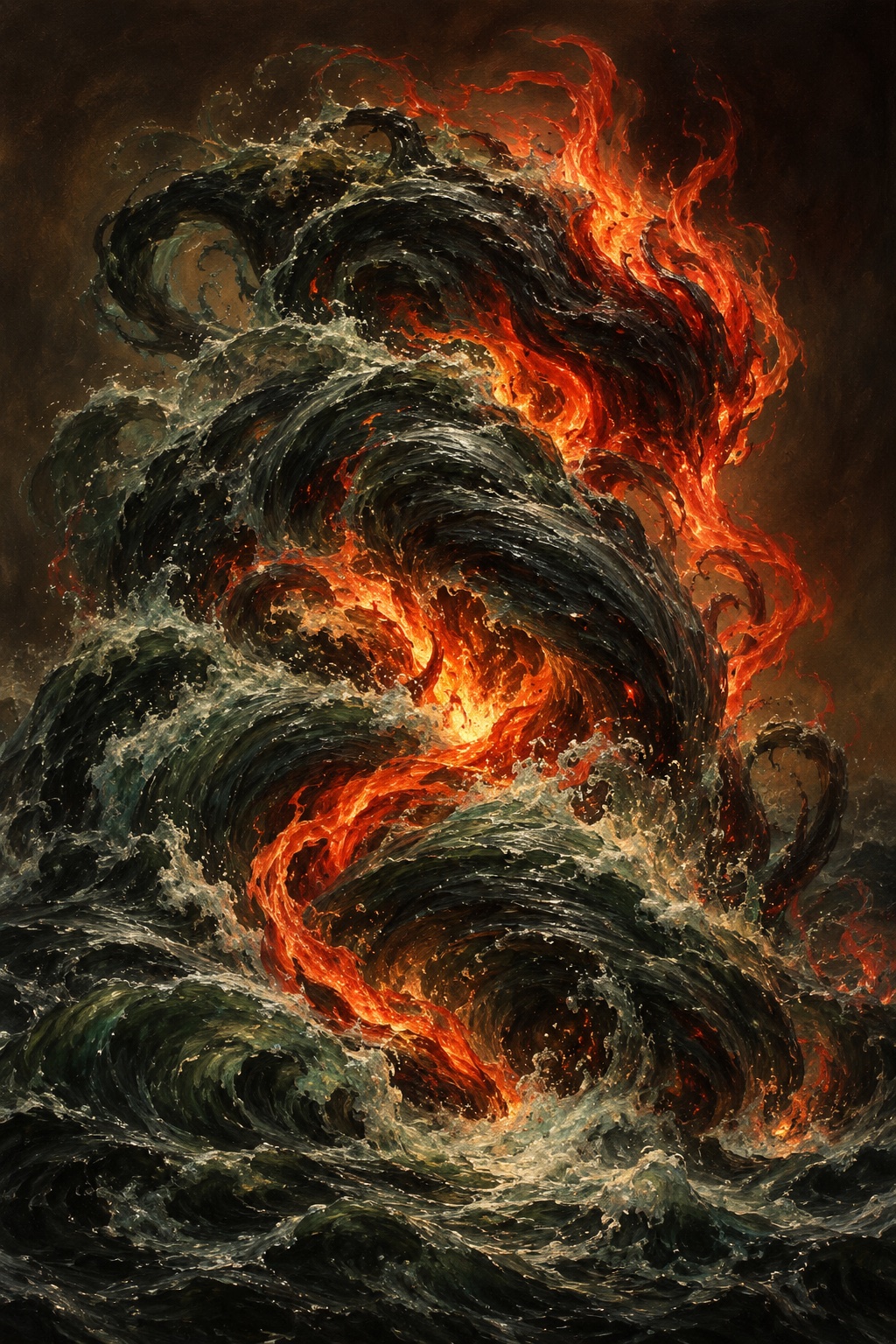
九嬰水火之怪為人害
“Jiuying is a prodigy of water and fire, which did harm to people.” — Gao You, Huainan honglie jie, “Benjing”; tr. Mythos Atlas
The note is unpunctuated in this edition. 怪 is a prodigy, an uncanny thing, and 水火 is water and fire. The gloss puts Jiuying in a class, but it does not give it a form. Gao You does not say whether Jiuying came out of the water or the fire, what it looked like, or what harm it did. 為人害 only says again what the base text has already said, that it did harm to people.
The rest of the same note shows what Gao You gives when he has something to give. Yayu is the name of a beast with a head like a dragon’s. Zaochi is a beast with teeth three chi long, shaped like a chisel. Dafeng is Fengbo, the Wind Earl, who can wreck people’s houses. Fengxi is a great pig, and Xiushe is a great snake. Of the six, Jiuying alone is not called a beast, a pig, a snake or the Wind Earl, and it alone gets no body part. Its gloss is a category and a charge.
The Xiong River
The Siku edition writes the river’s name in another form. Where the Huainanzi text quoted above has 凶水, the Huainan honglie jie prints 㐫水, and this entry quotes each as its own page prints it. Gao You’s note on the river comes straight after the clause.
殺九嬰於㐫水之上〈北狄之地有㐫水〉
“…to kill Jiuying on the banks of the Xiong River (in the land of the Northern Di there is a Xiong River).” — Huainanzi, “Benjing”, with Gao You’s note, Huainan honglie jie; tr. Mythos Atlas
The words in parentheses are Gao You’s; the edition sets them off in angle brackets after the clause. 北狄 are the Northern Di, the peoples of the north, and the gloss says only that their land has a river of this name. It does not describe the river. In the notes on the same commission, Gao You calls Chouhua a marsh of the south, Qingqiu a marsh of the east and Dongting a marsh of the south. The Xiong River is the only place in the commission that he puts in the north, and the only one that he places by the people who live there.
The Song writer Luo Mi tells the same campaign in his Lushi, and a note after his sentence places the river again. The Lushi labels the notes under its sentences as the work of Luo Mi’s son Luo Ping, but the Siku editors found them so like the main text that they suspected Luo Mi of writing them himself and putting his son’s name on them, 殆自著而嫁名於子歟.
凶水在北狄或曰臨濮西三十五清丘也
“The Xiong River is among the Northern Di. Some say it is Qingqiu, thirty-five li west of Linpu.” — note under Luo Ping’s name, in Luo Mi’s Lushi, juan 20; tr. Mythos Atlas
The note writes 凶水, not 㐫水. Its first clause agrees with Gao You. The second, after 或曰, some say, gives a second site: Qingqiu, west of Linpu. The note gives the number bare, and the translation supplies li, the measure that a distance needs. This Qingqiu is written 清丘, with 清, clear. It is not the 青丘 marsh where the Huainanzi has Yi net Dafeng, although the two names sound the same. The note gives both sites and does not choose between them.
Names for fierce men
Luo Mi tells the reign of Yao in his own words, and the harms come into that story too. The Lushi’s note on them then turns them into people.
盖大風九嬰等皆當時兇頑貪婪者之號如檮杌饕餮之類
“It would seem that Dafeng, Jiuying and the rest were all names for the violent, stubborn and greedy men of that time, of the same kind as Taowu and Taotie.” — note under Luo Ping’s name, in Luo Mi’s Lushi, juan 20; tr. Mythos Atlas
The note opens on 盖, it would seem, so it offers a guess, not a report. The guess is about names. Dafeng, Jiuying and the others were 之號, names given to men who were violent and stubborn, 兇頑, and greedy, 貪婪. On this reading there was never a prodigy at the Xiong River, only a bad man with a bad name. It is a Song rationalisation of a Han story, and the note reaches it by argument. Just before the guess, it recalls that the Shanhaijing calls Zaochi a man, and it cites texts in which great pig serves as a byname. Then it extends the pattern to the rest. Just after the guess, it runs through older glosses on the harms, and it calls it a mistake to take them for real snakes, pigs and strange beasts.
Its two models come from the Zuozhuan. Under Duke Wen’s eighteenth year, Taowu and Taotie are two of the four wicked clans that Shun banishes to the four borders while he serves Yao, and Taotie is the name that the people of the world give to a greedy son of the Jinyun clan, 謂之饕餮. In that passage Taowu is the name of a clan and Taotie is a byname given to a man, and both belong to the same reign as Jiuying. The Lushi’s note reads Jiuying in the same way, as a name for men.
Nine of the ten suns
The Qing scholar Wu Renchen wrote a commentary on the Shanhaijing, the Shanhaijing guangzhu. In juan 9 he comes to the ten suns, and after the notes of earlier commentators he adds a note of his own. In it he reports a third reading of the name.
羅長源陳一中諸子以十日為扶桑君十子九日為凶號曰九嬰羿所射者謂此十日也
“Luo Changyuan, Chen Yizhong and others take the ten suns to be the ten sons of the Lord of Fusang. Nine of the suns were baleful and were called Jiuying, and what Yi shot means these ten suns.” — Wu Renchen, Shanhaijing guangzhu, juan 9; tr. Mythos Atlas
Changyuan was Luo Mi’s courtesy name: the Siku editors’ summary of the Lushi names its author as Luo Mi, styled Changyuan. So the first name at the head of this reading is the author of the Lushi. Wu Renchen does not say where Luo Mi made the identification, and this entry does not name Chen Yizhong further. The reading makes the suns into men, ten sons of a lord of Fusang. Nine of them were baleful, 九日為凶, with the same 凶 that names the Xiong River, and 號曰九嬰, they were called Jiuying. On this reading the name means the nine baleful suns, and the suns that Yi shot are these ten.
The reading does not fit the Huainanzi. There Jiuying and the ten suns have separate clauses, with separate verbs and separate places: Jiuying is killed, 殺, on the Xiong River, and the ten suns are shot, 射, above. Luo Mi’s own narrative in the Lushi also lists Jiuying and the ten suns as two harms. Wu Renchen passes the reading on as the view of others.
So the texts read the name in turn. The Huainanzi gives Jiuying a place in a list, a river and a single verb. Gao You calls it a prodigy of water and fire and puts its river in the north. The Lushi’s note takes the name for a name of men, and the readers that Wu Renchen reports take it for nine of the ten suns. No text quoted or cited here gives Jiuying a body.