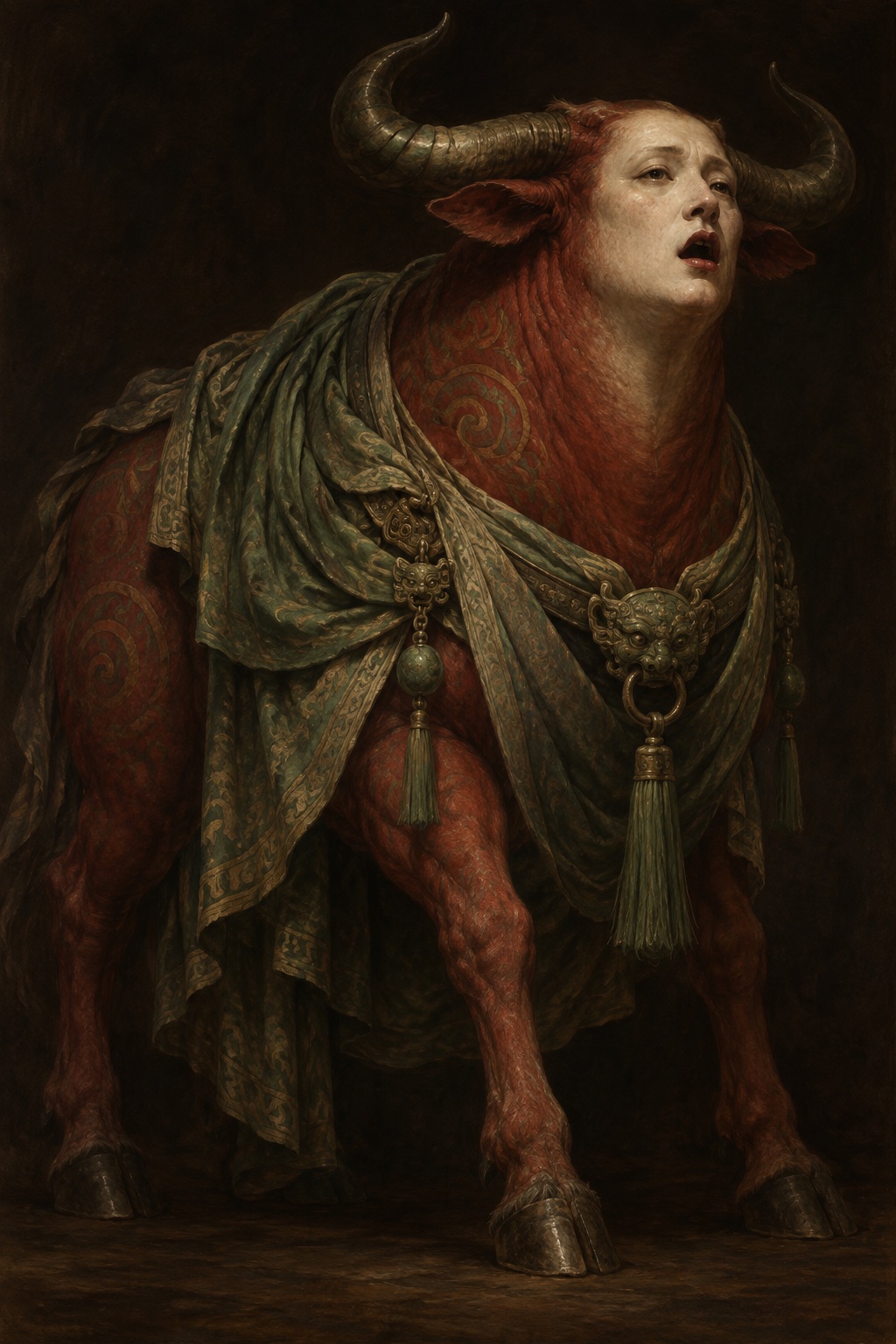
Killed by Erfu and his servant
The Shanhaijing writes the name 窫窳. The Huainanzi writes it 猰貐, and this entry takes its title from the Huainanzi’s graph, the one the entries on Hou Yi and Yao already quote; wherever it quotes the Shanhaijing, it keeps 窫窳. None of the passages quoted here mentions the other book. The first three sections follow the Shanhaijing, and the last follows the Huainanzi.
The Shanhaijing’s book of the regions within the seas to the west opens with a killing. Its first notice names a master and his servant, 貳負之臣曰危: Erfu had a servant, and his name was Wei. The deed follows in one clause, 危與貳負殺窫窳, Wei, together with Erfu, killed Yayu. Most of what follows in the notice concerns the punishment.
貳負之臣曰危,危與貳負殺窫窳。帝乃梏之疏屬之山,桎其右足,反縛兩手與髮,繫之山上木
“Erfu had a servant called Wei. Wei, together with Erfu, killed Yayu. The Emperor then shackled him on Mount Shushu, fettered his right foot, bound his two hands behind his back together with his hair, and tied him to a tree on the mountain.” — Shanhaijing, “Classic of Regions Within the Seas: West”; tr. Mythos Atlas
The killing gets a single verb, 殺, to kill, and nothing around it. The notice does not say why Erfu and Wei killed Yayu, where it happened, or how; there is no weapon, and there is no description of the victim. Yayu has no body in this notice at all, only a name.
The punishment gets four clauses. The Emperor, 帝, whom the text names no further, shackles him, 梏; fetters his right foot, 桎; binds his hands behind his back together with his hair; and ties him to a tree. The one shackled is Wei, the subject of the killing clause, in which Erfu stands only as the one Wei acted “together with”; the notice says nothing of what becomes of Erfu. Mount Shushu, 疏屬之山, is the place of Wei’s punishment. It is not the place of the killing, which the notice never locates, and it belongs to Wei’s story rather than to Yayu’s. The only word that joins the punishment to the killing is 乃, “then”: the text puts one after the other and gives no reason beyond that.
The chapter then moves on to other places. When it comes back to Yayu, Yayu is a corpse.
Six shamans at the corpse
Later in the same chapter, after a run of notices about other places, the Shanhaijing sets several of its notices by their bearing from Kaiming, to the north of it, to the east and to the south. East of Kaiming it places six shamans, and between them it places Yayu’s body.
開明東有巫彭、巫抵、巫陽、巫履、巫凡、巫相,夾窫窳之尸,皆操不死之藥以距之。窫窳者,蛇身人面,貳負臣所殺也
“East of Kaiming are Shaman Peng, Shaman Di, Shaman Yang, Shaman Lü, Shaman Fan and Shaman Xiang. They flank the corpse of Yayu, and all of them hold the drug of no-death to ward it off. Yayu has a snake’s body and a human face; it is the one Erfu’s servant killed.” — Shanhaijing, “Classic of Regions Within the Seas: West”; tr. Mythos Atlas
Each of the six is a 巫, a shaman, and each is named. They 夾 the corpse: they stand on both sides of it. All of them hold 不死之藥, the drug of no-death, and they hold it 以距之, to ward “it” off. The text does not say what 之 stands for. It does not say that the drug is given to the corpse, that it is meant to be, or that Yayu rises. It shows the shamans holding the drug beside the dead body, and then it turns to the body itself.
This is the first time the chapter says what Yayu looks like: 蛇身人面, a snake’s body and a human face. The victim of the opening notice is given a body only when it is dead. The same sentence names the killer again, and not in quite the same way. The opening notice said that Wei killed Yayu together with Erfu. This one says 貳負臣所殺也, killed by Erfu’s servant: the servant alone, with Erfu named only as his master. The chapter tells the killing twice and does not tell it the same way both times.
Other chapters, other bodies
Two other chapters of the Shanhaijing give the name 窫窳 to a creature, and neither of them gives it a snake’s body. The “Classic of the Northern Mountains” puts it on Mount Shaoxian, 少咸之山.
曰少咸之山,無草木,多青碧。有獸焉,其狀如牛,而赤身、人面、馬足,名曰窫窳,其音如嬰兒,是食人
“It is called Mount Shaoxian. It has no grass or trees, and much blue-green jade. There is a beast there, shaped like an ox, but with a red body, a human face and horse’s feet. It is called Yayu. Its cry is like an infant’s. It eats people.” — Shanhaijing, “Classic of the Northern Mountains”; tr. Mythos Atlas
This is the fullest body the classic gives. Its shape is an ox’s, 其狀如牛, and 而, “but”, brings in what is not ox about it: a red body, a human face, horse’s feet. It has a voice, 其音如嬰兒, like an infant’s, and the notice ends on 是食人, it eats people. Here Yayu is neither a victim nor a corpse. It is a man-eater, and the notice does not say that anyone kills it. The same chapter ends its notice of another man-eater, the Paoxiao of Mount Gouwu, with the same two clauses, the infant’s cry and 是食人. They are a formula the chapter uses more than once, not a detail that belongs to Yayu alone.
The “Classic of Regions Within the Seas: South” gives a third form, in a single clause.
窫窳龍首,居弱水中
“Yayu has a dragon’s head, and lives in the Ruoshui.” — Shanhaijing, “Classic of Regions Within the Seas: South”; tr. Mythos Atlas
The clause gives a head and a home: a dragon’s head, 龍首, and the Ruoshui, 弱水, as the water it lives in. The sentence goes on to compare its form with another beast’s and to say that it eats people, but the wikisource edition this atlas quotes prints two notes on variant readings inside that continuation, so the quotation stops at the river.
Three chapters, then, give three bodies under the one name: a snake’s body with a human face beside the corpse east of Kaiming; an ox’s body, red, with a human face and horse’s feet, on Mount Shaoxian; a dragon’s head in the Ruoshui. Two of them share a human face, and the third has a dragon’s head instead. The classic does not reconcile them. None of the three notices mentions the other two, and none says that Yayu changed from one form into another. Each chapter describes its own creature, and this entry does not put them together into one.
One of six harms
The Huainanzi is another book, and its Yayu has another story. The passage quoted here names no Erfu, no Wei, no shamans and no corpse, and it gives Yayu no body at all. It writes the name 猰貐. It sets the scene in the reign of Yao, when ten suns came out together, scorched the crops and killed the plants and trees, and the people had nothing to eat. Then it names six creatures.
猰貐、鑿齒、九嬰、大風、封豨、修蛇皆為民害。堯乃使羿誅鑿齒于疇華之野,殺九嬰于凶水之上,繳大風於青丘之澤,上射十日而下殺猰貐
“Yayu, Zaochi, Jiuying, Dafeng, Fengxi and Xiushe all preyed upon the people. So Yao sent Yi to execute Zaochi in the wilds of Chouhua, to kill Jiuying on the banks of the Xiong River, to net Dafeng in the marsh of Qingqiu, to shoot the ten suns above and slay Yayu below.” — Huainanzi, “Benjing”; tr. Mythos Atlas
Yayu stands first in the list, and the list carries one charge: 皆為民害, all six were a harm to the people. The passage says nothing else against any of them. It gives them no shapes, and it does not say what harm each one did. Yao does not act himself. 堯乃使羿: he sends Yi, the archer whom this atlas lists as Hou Yi, and the passage gives each target its own verb. Zaochi is executed, 誅; Jiuying is killed, 殺; Dafeng is netted, 繳; the ten suns are shot, 射.
Yayu shares a clause with the suns but not their verb: 上射十日而下殺猰貐, above, he shoots the ten suns, and below, he kills Yayu. 射, to shoot, belongs to the suns. For Yayu the text says 殺, to kill, and it does not say how. Hou Yi is an archer, but this passage does not put an arrow in Yayu. After it the list goes on: Xiushe is cut in two at Dongting, 斷, and Fengxi is taken in the Mulberry Forest, 禽. Then the people are glad, and they set up Yao as Son of Heaven.
The two books share the name, written two ways, and a death, and little else. In the Shanhaijing, Erfu and his servant Wei kill Yayu, the Emperor punishes Wei, and six shamans stand at the corpse with the drug of no-death; other chapters of the same classic make Yayu an ox-bodied man-eater on Mount Shaoxian or a dragon-headed creature in the Ruoshui. In the Huainanzi, Yayu is the first name in a list of harms, and Hou Yi kills it at Yao’s command. Neither text mentions the other’s killing, and neither says that Yayu died twice or came back to life between one death and the other. They are two separate accounts under one name, and this entry sets them side by side, not in order.