The one clause that is not 生
Read straight through the “Classic of Regions Within the Seas” and 帝俊’s name is almost always the subject of one verb: 生, begot. Dijun begot Yuhao, ancestor of the first boat-builders. Dijun begot Yanlong, who became the qin and the se. Dijun had eight sons, and they were the first to sing and dance. Clause after clause is genealogy, and a name that only ever begets is not yet a god with a story of his own — it is an entry in someone else’s family tree.
Once, in the whole run of the chapter, 帝俊 is the subject of a different verb.
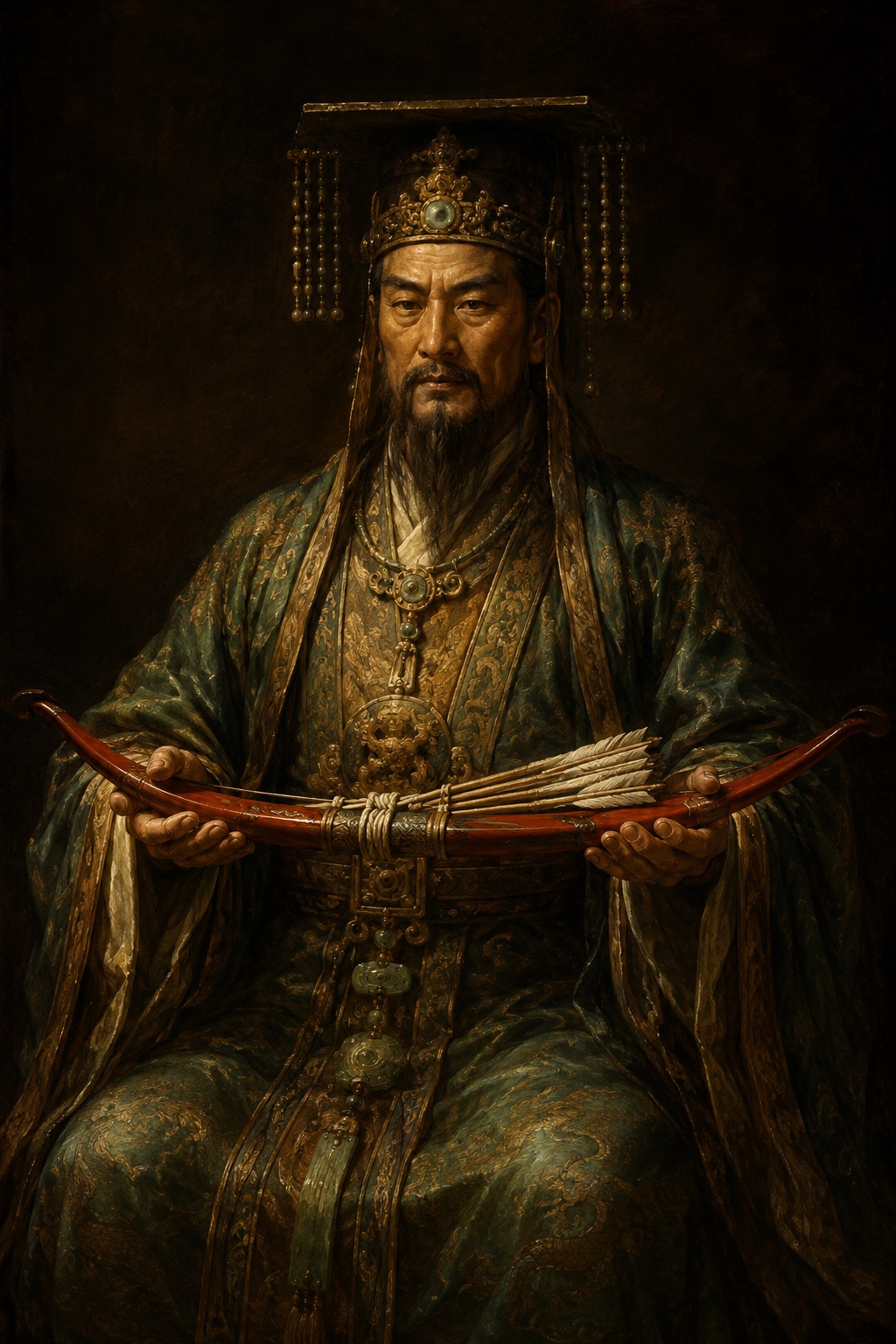
帝俊賜羿彤弓素矰,以扶下國,羿是始去恤下地之百艱
“Dijun granted Yi a vermilion bow and white-corded arrows, to succour the lands below; and it was Yi who thereupon set out to relieve the hundred hardships of the world beneath.” — Shanhaijing, “Classic of Regions Within the Seas”; tr. Mythos Atlas
賜, granted, not 生, begot — for one sentence Dijun does something instead of fathering someone. The archer the text names is written 羿 alone, with no 后 in front of it; this wiki’s own entry for him carries the fuller name, Hou Yi, that later tradition and this encyclopedia both use, but the Shanhaijing itself never writes it here. The vermilion bow and the white-corded arrows that change hands in this line are exactly the “red bow and white arrows” already named as Hou Yi’s own attribute in his own entry — the weapon still in his hand when the ten suns rise together and he shoots nine of them back down.
Two wives, and every light in the sky
Dijun’s own attested deeds nearly stop there. What multiplies instead are his wives and their labour. The “Classic of the Great Wilderness: South” introduces Xihe by her country, then by her work:
東南海之外,甘水之間,有羲和之國。有女子名曰羲和,方浴日於甘淵。羲和者,帝俊之妻,生十日
“Beyond the south-east sea, between the waters of Gan, there is the country of Xihe. There is a woman there named Xihe, and she is bathing the suns in the Gan Abyss. Xihe is the wife of Dijun, and she bore the ten suns.” — Shanhaijing, “Classic of the Great Wilderness: South”; tr. Mythos Atlas
The “Classic of the Great Wilderness: West” gives the western sky the same sentence, with a second wife and a second set of lights:
有女子方浴月。帝俊妻常羲,生月十有二,此始浴之
“There is a woman bathing the moon. Changxi, the wife of Dijun, bore twelve moons, and this is their first washing.” — Shanhaijing, “Classic of the Great Wilderness: West”; tr. Mythos Atlas
Between them, Xihe and Changxi account for the entire visible sky: ten suns taking turns by day, twelve moons for the months of the year. Dijun fathers none of that light himself, in any line either chapter gives him; he is named only as husband, 帝俊之妻 twice over, the fixed point both wives are defined against. A third wife appears in the same southern chapter: Ehuang, who bears a nation of three-bodied people and is never once shown at a pool of her own.
A crowd of sons, and a name later readers borrow
Beside the bow, the rest of 帝俊’s children in the “Classic of Regions Within the Seas” return to the pattern the entry opened with. He begets Yuhao, ancestor of Fanyu, whose line first makes boats; he begets Yanlong, who becomes the qin and the se; he has eight sons who are the first to sing and dance; he begets the Sanshen, the three-bodied clan, whose descendant Yijun becomes patron of the hundred crafts. Elsewhere in the Shanhaijing he begets one more: Zhongrong, whose people live on wild game and tree-fruit and command four birds. None of it is an act of Dijun’s own — every child is a door out of the entry rather than a room in it, which is exactly why the bow and the two bathing wives carry the entry instead.
Ehuang’s own son-nation touches a separate question. The same southern chapter that names her also gives that nation the surname 姚 (Yao) and calls a nearby pool 舜之所浴也, “where Shun bathed” — a detail sitting only a few characters away from Dijun’s own household, without being stated of it.