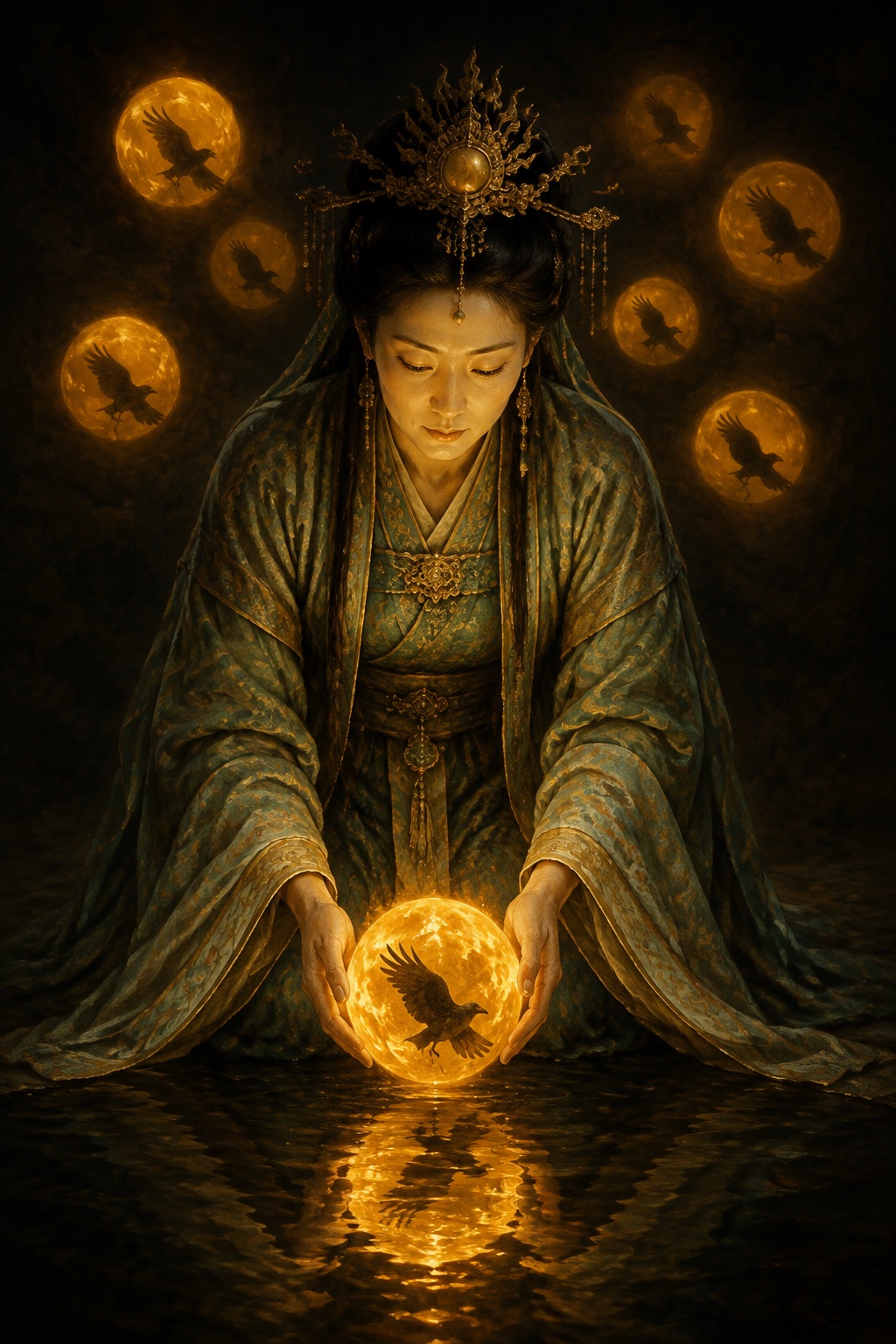
The woman bathing the sun
The Classic of Mountains and Seas introduces her the way it introduces a country: coordinates first, then whatever happens to be there.
東南海之外,甘水之間,有羲和之國。有女子名曰羲和,方浴日於甘淵。羲和者,帝俊之妻,生十日
“Beyond the south-east sea, between the waters of Gan, there is the country of Xihe. There is a woman there named Xihe, and she is bathing the suns in the Gan Abyss. Xihe is the wife of Dijun, and she bore the ten suns.” — Shanhaijing, “Classic of the Great Wilderness: South”; tr. Mythos Atlas
方浴日 — she is in the middle of washing a sun. The particle 方 puts the whole scene in progress, so the sentence catches her at work rather than reporting a completed act, and the object of the verb is a sun, singular, out of ten. She has nine more to do.
Everything about the account is domestic and nothing about it is solar. There is no chariot, no crown, no fire. A woman kneels at a pool of water in a place with a name and lifts her children in and out of it, one at a time, in a routine that is implicitly daily. The Chinese sun is not driven across the sky by a god; it is bathed by its mother before it goes.
Ten of them, and a crow in each
The mechanism is in the eastern book, at the tree the suns leave from.
有谷曰溫源谷,湯谷上有扶木。一日方至,一日方出,皆載於烏
“There is a valley called the Valley of the Warm Source. Above the Boiling Valley stands the Fu tree. One sun is just arriving, one sun is just setting out; each of them is carried by a crow.” — Shanhaijing, “Classic of the Great Wilderness: East”; tr. Mythos Atlas
一日方至,一日方出 — one arriving, one departing, the same 方 of an action in progress used twice. The system is a shift rota: the suns take turns, one on duty and nine waiting in the branches, and the changeover is what the passage describes. 皆載於烏, each carried by a crow, gives the sun a vehicle that is also an animal; later tradition makes the crow three-legged, and the wiki’s Hou Yi entry already has crows falling out of the sky as he shoots.
That is the disaster this entry is the background to. Ten sons who are supposed to go out one at a time all go out together, and the world begins to burn — a failure of turn-taking in a household, dealt with by an archer. Read from Xihe’s side, the ten suns myth is a story about her children disobeying her schedule, and Hou Yi kills nine of them.
The one who washes the moons
The western book has the same sentence again, with a different woman and a different sky.
有女子方浴月。帝俊妻常羲,生月十有二,此始浴之
“There is a woman bathing the moon. Changxi, the wife of Dijun, bore twelve moons, and this is their first washing.” — Shanhaijing, “Classic of the Great Wilderness: West”; tr. Mythos Atlas
Changxi is Xihe’s counterpart and, in the text, her co-wife: both are 帝俊之妻, both bear a numbered set of lights, both are found washing them. Ten suns for the ten days of the old week; twelve moons for the twelve months. The two passages are a matched pair placed at opposite ends of the world, and between them they account for the whole of the calendar as a family with two mothers and a lot of children.
An office, not a mother
By the time of the Book of Documents, the same name is doing an entirely different job — and the grammar has quietly turned a goddess into a department.
乃命羲和,欽若昊天,歷象日月星辰,敬授人時
“He commanded the Xis and Hes, in reverent accordance with (their observation of) the wide heavens, to calculate and delineate (the movements and appearances of) the sun, the moon, the stars, and the zodiacal spaces, and so to deliver respectfully the seasons to be observed by the people.” — Shangshu, “Canon of Yao”; tr. James Legge
Legge’s plural is the whole argument. In the Canon of Yao, Yao commands 羲和 and then splits the name into four officials — Xi the second brother, Xi the third, He the second, He the third — and posts them to the four directions to fix the solstices and equinoxes. The sun-mother has become an astronomical bureau, and her mythic function of sending the suns out in order survives exactly, as the state’s duty to hand the seasons to the people.
Both readings were current at the same time, and neither is a corruption of the other. The wilderness books keep the mother at her pool; the classic of government keeps the office and its calendar. What passed from one to the other is the idea that somebody has to make the sun keep to a timetable.