The son of Neith
Sobek is the modern spelling of the name and the headword this wiki files him under. It is not the spelling of the man who translated every passage quoted below. Budge writes Sebek throughout, and the reader should take that word, wherever it appears inside a quotation on this page, as the same god the heading names. Budge’s forms of the other names need the same allowance: his Net is the goddess this atlas files as Neith, and his Temu is Atum.
The oldest place Budge finds him is the pyramid of Unas. In one passage the dead king simply is Sobek with the green feather, and he comes to his pools on the banks of a canal and makes his garden flourish at the edge of the horizon. Then he rises.
Unas hath taken his place in the horizon, he riseth like Sebek, the son of Net — E. A. Wallis Budge, The Gods of the Egyptians (1904), vol. 1, p. 455, from the Pyramid Text of Unas
The text names the god through his mother, as a man is named in a genealogy, and that is the whole of the family it gives him: a mother and no father. It is not a passing phrase. An earlier line of the same text wishes that Unas may look on those it addresses as Sobek looks on Neith, so the texts of Unas name the pair twice, and both times the son is looking toward the mother or rising in her name.
Budge’s own conclusion on what the relationship means runs through a third god.
it is clear that Net must have been a form of the power of the Eye of Horus, as well as of Isis, his mother; her son Sebek is a local form of Horus — E. A. Wallis Budge, The Gods of the Egyptians (1904), vol. 1, p. 457
The argument is a chain of identities. Neith is a form of Isis; Isis is the mother of Horus; so the son of Neith is a form of Horus, and the adjective is the important word. He is Horus as one district knew him, a Horus in the shape of a crocodile. Budge thinks the two crocodiles seen with Neith in her images belong to Henti, a form of Osiris, though he allows that one of them may be Horus. Neith’s own entry lists Sobek among her children, next to the Ra she bore at Sais.
The lost hands of Horus
Everywhere else in these sources Sobek is a name in a list, a face on a wall, or a power the dead call on. In one chapter of the Book of the Dead he acts and speaks. It is Chapter CXIII of the Theban Recension, the chapter of knowing the Souls of Nekhen, and in it the dead man declares that he knows the hidden things of that city: what the mother of Horus did for her son. She sent her voice out over the waters. Ra said that this son of Isis had perished. And she cried out that Sobek, the lord of the papyrus swamp, should be brought to them.
swamp, shall be brought to us.’ [And Sebek] fished for them and he found them, and the mother of Horus — The Book of the Dead: Theban Recension (1901), Papyrus of Nu, Chapter CXIII, tr. E. A. Wallis Budge
The quotation opens on the last word of Isis’s cry because the scan sets a quotation mark at the start of every line of quoted text, and each fragment on this page is a clean run between two of those marks. The square brackets are Budge’s and stay as he printed them. The pronoun has no noun yet. The chapter does not say what Sobek fished for until Ra names it at the end, and the reader finds out only when the net comes up. Isis then made the things he found grow in the places they belonged to, and the chapter turns to Sobek.
Then Sebek, the lord of his papyrus swamp — The Book of the Dead: Theban Recension (1901), Papyrus of Nu, Chapter CXIII, tr. E. A. Wallis Budge
The page ends there, and on the next page he speaks for himself.
I went and I found the place where they had passed with my fingers on the edge of the waters, and — The Book of the Dead: Theban Recension (1901), Papyrus of Nu, Chapter CXIII, tr. E. A. Wallis Budge
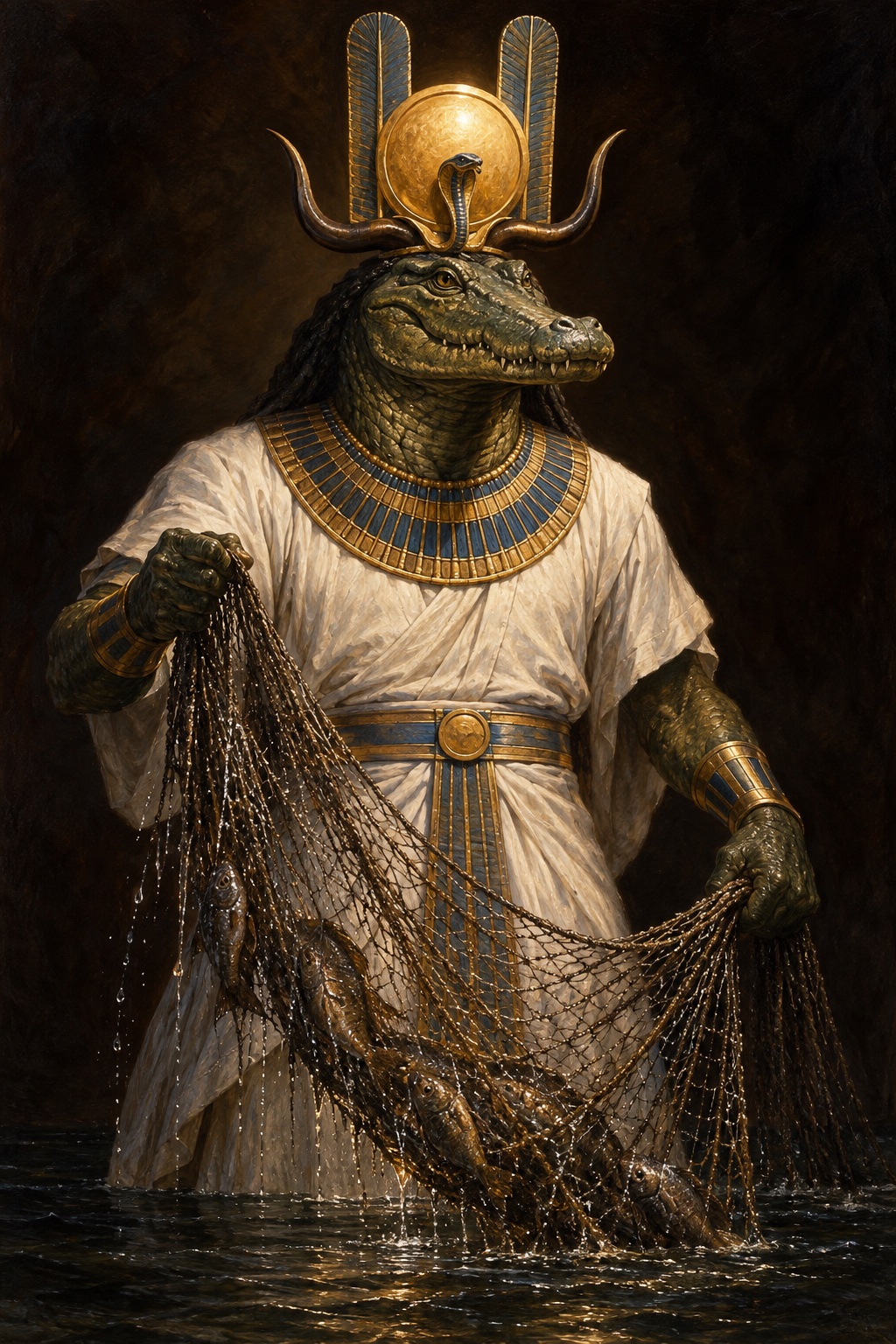
He goes on to say that he enclosed them in his net, and that the net was strong. Then Ra answers, and the answer is a naming: so there are fish with the god Sobek, says Ra, and he has found the hands and arms of Horus in the land of fish. That land became the city of Remu, which Budge glosses as Fish, and Ra gave the city of Nekhen to Horus as the dwelling of his two arms and hands. The whole scene explains how one city got its name and another got its god, and the one who makes it possible is the crocodile with the net. He does not fight anyone. He searches the water’s edge by touch, as a fisherman does, and brings up what a god has lost.
Good to the dead
Budge begins his chapter on the god with the animal, and the animal is not good. In the early times, he writes, when the canals dried up, the crocodile could wander the fields and kill whatever came in its way, and the Egyptians made it the embodiment of evil and of death, and a companion of Set. He thinks that in the early dynastic period the god’s attributes were probably those of a destructive beast. Then he turns.
Sebek was believed to be a god who was good to the dead is clear, and it was held that he would do for them that which he had done in primitive times for Horus — E. A. Wallis Budge, The Gods of the Egyptians (1904), vol. 2, p. 356
Budge’s sentence begins two words before the quotation does, and its grammar runs the long way round: the whole clause about the god is the subject, and the verb is the verdict that this is clear. The claim is a precedent. What Sobek does for the dead is what he did once for Horus, and the net scene above is the fullest account of that. Budge’s next evidence comes from an earlier chapter of the same Book of the Dead, Chapter CVIII.
Sebek, Temu, and Hathor were the Spirits of the West, and that Sebek dwelt in a temple which was built on the Mount of the Sunrise, and that he assisted Horus to be re-born daily — E. A. Wallis Budge, The Gods of the Egyptians (1904), vol. 2, p. 356
The geography in that sentence looks like a contradiction and is not one. Chapter CVIII is the chapter of knowing the Souls of the West, and its vignette seats Atum, Sobek as lord of Bakhau, and Hathor as lady of Masheru. But the text of the chapter puts the Mountain of Bakhau, on which heaven supports itself, in the eastern part of the sky, and it puts Sobek to the east of that mountain with his temple on the earth there. A Soul of the West keeps his house where the sun comes up, and the work Budge credits him with, the daily rebirth of Horus, fits that address.
The Pyramid Texts give him the same work on a smaller scale: one dead body at a time.
Sebek is made to restore the eyes to the deceased, and to make firm his mouth, and to give him the use of his head, and to bring Tsis and Nephthys to him, and to assist in the over- throw of Set — E. A. Wallis Budge, The Gods of the Egyptians (1904), vol. 2, p. 356
Tsis is the scan’s misreading of Isis, and the gap in over- throw is a line-end hyphen; both stay as the page prints them. The list runs in order. First the parts of the body come back: the eyes, the mouth, the head. Then the two sisters come. Then the enemy falls. It is the work of the Horus chapter again, done for an ordinary dead man: what was taken from a body is given back to it. Budge goes on to carry the pattern to its end. Sobek opened the doors of heaven to the dead, led them along its paths, and helped them rise to new life, as he had once helped the child Horus take his seat on the throne of his father Osiris.
The last clause of the Pyramid Texts list is the strangest one in his record. On the page before it, Budge writes that before the end of the Sixth Dynasty Sobek was identified with Ra and also with Set, the enemy who murdered Osiris. The crocodile was a companion of Set, and the crocodile god was at one time a form of Set; yet the Pyramid Texts make him help to overthrow Set. Budge sets these statements down within three pages and does not try to reconcile them, and nothing in these sources does. One way to read it is as an old animal cult with the theology of Osiris built over it: the beast that the Egyptians feared stays in the record beside the god who helps the dead.
A crocodile-headed man
Budge’s description of the figure comes from the pictures and reliefs, and the quotation begins just after the words that say so.
represented the god Sebek in the form of a crocodile-headed man who wore either a solar disk encircled with a uraeus, or a pair of horns surmounted by a disk and a pair of plumes — E. A. Wallis Budge, The Gods of the Egyptians (1904), vol. 2, p. 355
Budge adds in the same sentence that a small pair of horns sometimes sits above large ram’s horns, and in the next one that the god is often drawn simply as the animal sacred to him, a crocodile. The body can be a man’s or a beast’s. Both forms of the headdress carry a disk, and the disk is the sun. Before the end of the Sixth Dynasty, Budge writes, Sobek was identified with Ra, the sun god, and with the form of Ra called the son of Neith, so the two sons that Neith has in this atlas meet in one god. The running head over that page of Budge’s chapter names him Sebek-Ra. Later in the chapter, as Sebek-Ra-Temu, he is the power of the sun that created the world, which adds Atum to the compound.
This entry records two seats of his cult, though Budge lists more. Budge counts the cult of the crocodile god in the district of Ta-she, the Fayum, among the extremely ancient cults of Egypt. There the city of Crocodilopolis, known in Strabo’s day as Arsinoe, was the centre of crocodile worship, and Herodotus reports that at Thebes and near Lake Moeris crocodiles were held sacred while in other parts of Egypt people killed them. The other seat is Kom Ombo, which Budge names as one of the god’s chief places of worship. Budge’s chapter on the god calls the town Ombos and makes it the centre of his cult. There Sobek was held to be the father of the god Heru-ur, and was identified with Geb. Budge also reports a view that made Sobek a personification of the primeval god Kekui, and he says that in any case the god was one of the chief forms that the soul of the primeval darkness took.
That last idea brings the entry back to where Budge’s chapter began: a creature of the darkness that the Egyptians feared. Every other text on this page changes the fear into service. The dead king rises in the horizon like him, and he gives the dead their eyes and mouths again. He lives where the sun comes up and helps Horus to be born again each day. When Isis needs something found in the water, she sends for him. He goes down to the edge of the water and comes back with the hands of Horus in his net.