A power of darkness
Sokar is the modern spelling of the name and the headword this wiki files him under. It is not the spelling of the man who translated every passage quoted below. In each of them Budge writes Seker, and the reader should take that word, wherever it appears inside quotation marks on this page, as the same god the heading names.
Budge’s account of where he starts is one sentence long.
Seker was originally a power of darkness, or of the night, which in later times was identified with forms of the night sun like Tem. — E. A. Wallis Budge, The Gods of the Egyptians (1904), vol. 1
The order of the sentence is the argument. Darkness comes first and is what he is; the night sun comes later and is something he was identified with, in the way Egyptian gods are constantly identified with one another. It does not give him a sun of his own. The sun in that clause is the one that has already gone under the horizon, and the god Budge calls Tem is the one this corpus files as Atum. What the sentence establishes is the raw material: night, and the part of the world that is dark.
The dead of one city
Darkness is not by itself an office. The office Budge gives him is narrower than the underworld and attached to a place.
Seker was exalted to the position of god of that portion of the Underworld which was allotted to the souls of the — E. A. Wallis Budge, The Gods of the Egyptians (1904), vol. 1
The quotation stops there because the scan does, at a column break in the middle of the phrase. Budge’s sentence finishes on the inhabitants of Memphis, and his next clause makes him the tutelary god of the necropolis of Sakkara, the burial ground that served that city. So the jurisdiction is an allotment. Other gods hold the underworld at large; this one holds the share of it that belongs to one city’s dead, and his cult is a cemetery’s cult. That is the whole basis of his standing, and everything else on this page is built on top of it.
A name given to Osiris
He is hard to meet on his own, and that difficulty is his character rather than a gap in the record. In the Book of the Dead, Budge’s footnote on the name states flatly that Seker is a name given to Osiris, with reference to the god being shut up in his coffin. In the hymn to Osiris Un-nefer the name is treated as a verb: the god tows along the earth by Ma’at in his name of Seker, and is exceedingly mighty in his name of Osiris — the same being, two names, two things the names describe him doing. Budge’s own summary in The Gods of the Egyptians puts the merger the other way round from what a reader might expect: Osiris himself is merged in Seker, and becomes Osiris Seker. That is why this entry records the identification and the entry for Osiris does not. A second composite runs through Memphis, where Ptah-Seker joins him to the craftsman god of the same city, and Budge calls that compound a form of Osiris too. The craft in it is Ptah’s; the grave is Sokar’s.
The liturgy shows the arrangement working. In the fifteenth chapter of the Theban Recension a petition opens with homage to the lord of the Acacia Tree, and the Seker boat arrives in the same breath as the greeting.
the Seker boat is set upon its sledge; thou — The Book of the Dead: Theban Recension (1901), Papyrus of Ani, Chapter XV, tr. E. A. Wallis Budge
The line stops mid-clause because the scan sets a quotation mark at the start of every line of quoted text, and each fragment here is the clean run between two of them. The petition itself does not stop. It runs straight on into what the god addressed is doing at that moment.
turnest back the Fiend, the worker of evil, and thou — The Book of the Dead: Theban Recension (1901), Papyrus of Ani, Chapter XV, tr. E. A. Wallis Budge
causest the Utchat to rest upon its seat. — The Book of the Dead: Theban Recension (1901), Papyrus of Ani, Chapter XV, tr. E. A. Wallis Budge
Read the three fragments as the single sentence they are and the grammar is unambiguous. The boat is Seker’s: it carries his name. The verbs belong to the thou of the opening homage, the god hailed at the head of the petition. He turns back the enemy and he sets the Utchat back on its seat, while the boat goes up onto its sledge underneath the sentence. This is what it means to be a god who lives inside other gods’ names. His name is on the vessel and the ritual, and the address, the praise and the acts run to somebody else.
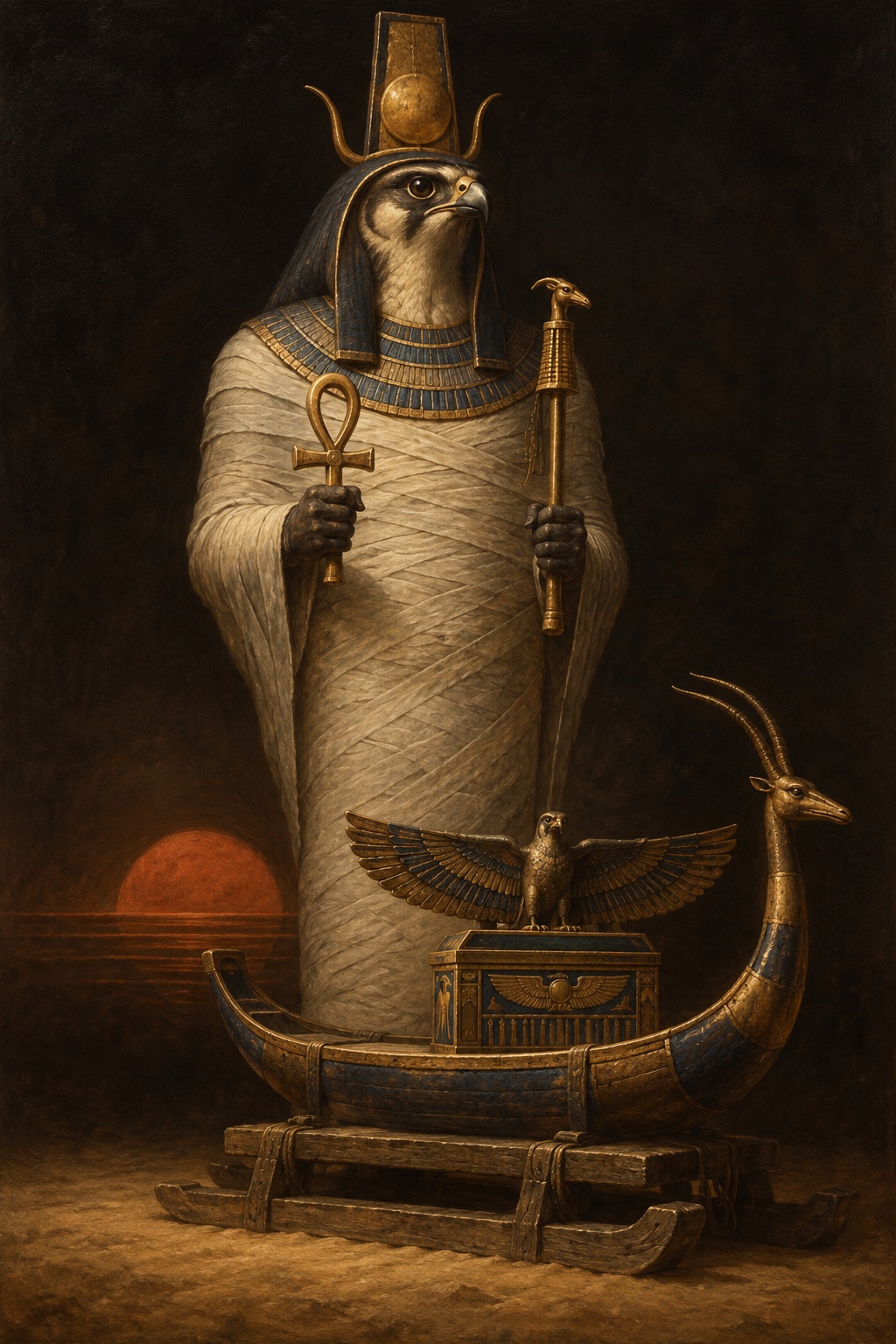
A hawk’s head in a close garment
Budge’s description of the figure is one clause of a longer sentence, and it begins and ends in the middle of it.
depicted in the form of a hawk-headed man in mummied form resembling that of Ptah, and his hands project from the front of his close-fitting garment and hold the emblems of sovereignty and dominion, — E. A. Wallis Budge, The Gods of the Egyptians (1904), vol. 1
Three things are attested here and nothing more. The head is a hawk’s. The body is wrapped like a mummy, in the same close garment this corpus already gives Ptah at Memphis, with nothing free but the two hands. The hands hold the emblems of sovereignty and dominion. The resemblance Budge names is the Memphite one: the god of the workshops and the god of the graveyard wear the same shroud in the same city, which is half the reason the two of them fuse into a single name. A god bandaged to the neck is a god dressed as a corpse, and this one is dressed that way while holding the signs of rule.
The boat is dragged, not sailed
The one act the sources give him entirely is not a deed but a procession, and it happens to his boat rather than to him. Budge describes the vessel in detail.
one end of it was very much higher than the other, and was made in the shape of the head of some kind of gazelle or oryx; the centre of the boat was occupied by a carefully closed coffer which was surmounted by a hawk with protecting wings stretched out over the top of it. This coffer contained the body of the dead Sun-god Af, or of Osiris, and it rested upon a framework or sledge which was provided with runners. — E. A. Wallis Budge, The Gods of the Egyptians (1904), vol. 1
Every element of that is a funerary element. The high prow is an animal’s head. The bird spreading its wings over the middle of the boat is a bird, guarding a box. The box is shut, and what is inside it is a body — the dead sun, or Osiris, which in this theology is nearly the same sentence twice. And the whole thing sits on runners. A hull fitted with runners is a hull that is never going near water: it is built to be dragged across ground, which is what the Memphite necropolis is made of.
Budge puts the ceremony at sunrise, at the moment when the rays of the sun were beginning to spread over the earth, and gives the office its duties.
this official was expected to lift the Seker Boat upon its sledge, and to march at the head of the procession of priests which drew the loaded sledge round the sanctuary. — E. A. Wallis Budge, The Gods of the Egyptians (1904), vol. 1
The quotation begins on an official Budge has already named in the clause before it. The Book of the Dead supplies the same morning from the worshipper’s side: in its first chapter the dead man claims the part of the Sem priest and the duties of the Great Chief of the Work, on the day of placing the Hennu boat of the god Seker upon its sledge. The boat is lifted, loaded, and drawn in a circuit round the sanctuary while the light comes up — a full turn, ending where it began, made by hauling a corpse in a closed box over the ground at the hour the sun comes back.
That is his, and only his. He borrows a face from Ptah and a story from Osiris, and his name spends most of its life hyphenated to theirs. But the boat carries his name and no one else’s, and at first light one official lifts it onto the runners and a column of priests hauls it round the sanctuary.