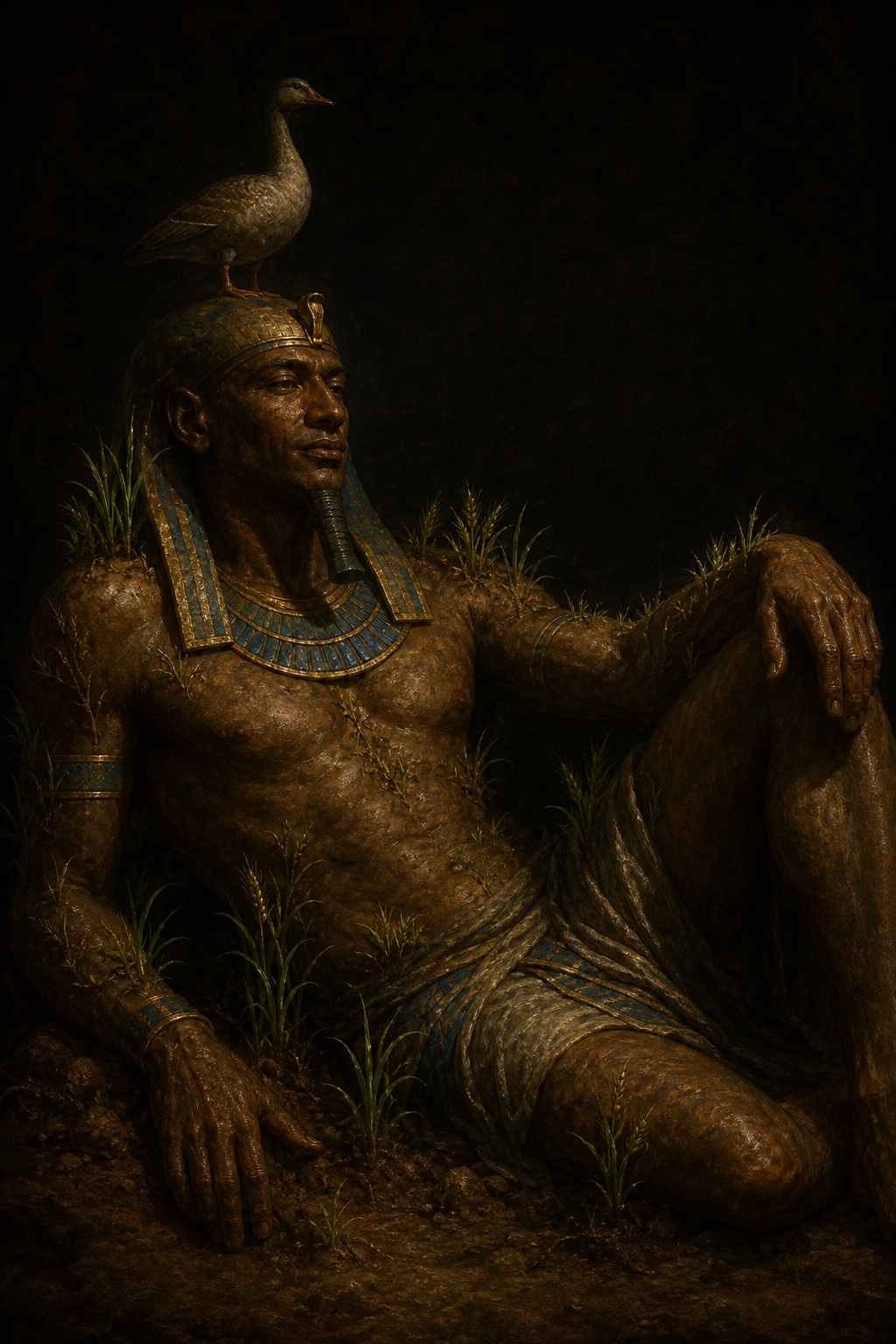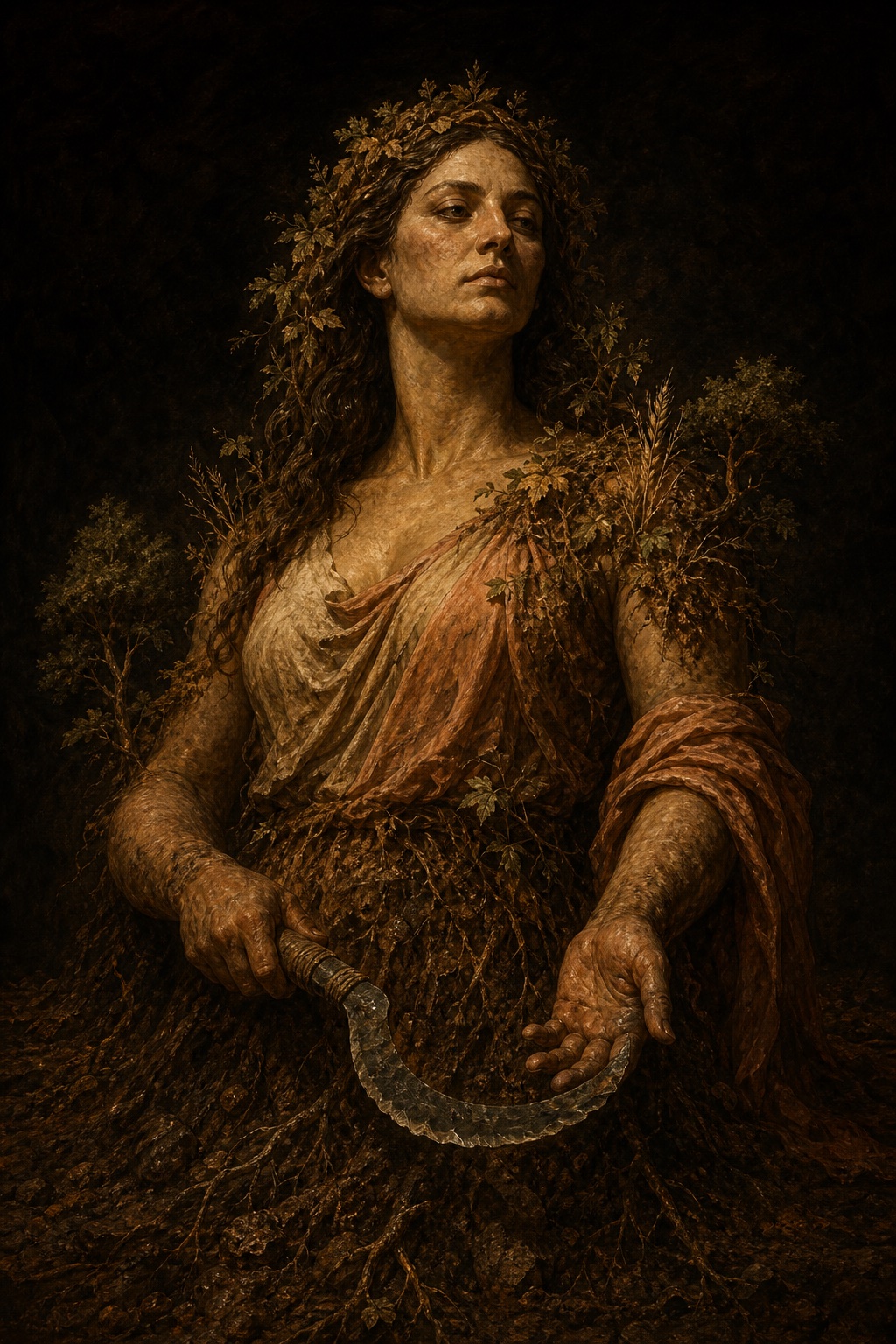
Gaia is the earth, and in Hesiod she is the second thing that exists. Chaos comes first; then Gaia, “the ever-sure foundation of all”, a floor for everything else to stand on. She produces Uranus the sky, the hills and the barren sea out of herself alone, without any partner, and only afterwards lies with the sky she made. Every genealogy in Greek myth runs back through her.
The hymn addresses her as the thing that feeds, which is the aspect an ordinary Greek would have dealt with.
Γαῖαν παμμήτειραν ἀείσομαι ἠϋθέμεθλον πρεσβίστην, ἣ φέρβει ἐπὶ χθονὶ πάνθ’ ὁπόσ’ ἐστίν· ἠμὲν ὅσα χθόνα δῖαν ἐπέρχεται ἠδ’ ὅσα πόντον ἠδ’ ὅσα πωτῶνται, τάδε φέρβεται ἐκ σέθεν ὄλβου
“I will sing of well-founded Earth, mother of all, eldest of all beings. She feeds all creatures that are in the world, all that go upon the goodly land, and all that are in the paths of the seas, and all that fly: all these are fed of her store.” — Homeric Hymn 30, To Earth the Mother of All 1–3, tr. Evelyn-White
But the Theogony is more interested in her as a strategist, and she is a remarkably consistent one: in every succession crisis she supplies the weapon and backs the challenger. She makes the flint sickle and hands it to Cronus against Uranus. She then tells Rhea how to save Zeus from Cronus, and hides the infant herself. She advises Zeus to release the hundred-handed brothers, which wins him the war against the Titans — and then, when Zeus is established, she bears Typhon against him. She is not on anyone’s side. She is on the side of whatever is being suppressed.
Her oldest function is prophetic, and the Greeks remembered it even after it stopped being hers. Delphi was Gaia’s oracle before it was Apollo’s; Aeschylus opens the Eumenides with the Pythia naming Earth as the first prophet of the site, and the transfer to Apollo is presented as an orderly inheritance rather than a conquest — though the killing of the she-serpent Python, the earth’s creature, sits awkwardly inside that account. Sworn oaths were made by her because the earth is the one witness that cannot leave.
Compare Egypt, where the same cosmic pair is arranged the other way around: Geb is the earth and male, Nut the sky and female. The Greek scheme — mother earth beneath, father sky above — is so familiar that it can look inevitable, and Egypt is the standing proof that it is not.