The snake she did not see
Eurydice is never introduced. She arrives inside somebody else’s punishment: the sea-prophet Proteus, pinned down and made to answer, is telling the beekeeper Aristaeus why his hives died, and the answer is that a great wrong is being paid for. Orpheus, says Proteus, is raising this penalty against you, and rages hard for a wife carried off. Only then, in three lines, does the woman herself appear, and she appears already running.
Illa quidem, dum te fugeret per flumina praeceps, immanem ante pedes hydrum moritura puella servantem ripas alta non vidit in herba
“She in her haste to shun thy hot pursuit Along the stream, saw not the coming death, Where at her feet kept ward upon the bank In the tall grass a monstrous water-snake” — Virgil, Georgics 4.457–459, tr. James Rhoades
The whole death is built out of what she cannot see. The te she is fleeing is Aristaeus, who is standing there being told this. The snake is immanem, monstrous, and it is servantem ripas — keeping guard on the bank, not hunting anyone; it is enormous, stationary, and directly in front of her feet. The only verb the sentence gives her is non vidit. She is running headlong away from a danger she can see, into one she cannot, and the two are in the same three lines because Virgil wants them counted as one event.
Rhoades does something here the Latin does not, and it is worth knowing which is which. Moritura puella is the girl about to die: two words that fix her age and her outcome in the same breath. The English folds moritura into “the coming death” and drops puella altogether, which leaves the translation with no word at all for what she is.
That matters, because neither text quoted on this page says what she is. Virgil calls her a puella, a girl. Apollodorus calls her τῆς γυναικὸς αὐτοῦ, his wife. Neither says nympha. The one hint runs the other way and sits in the line immediately after her death, where the mourners are At chorus aequalis Dryadum — the band of Dryads who are her age-mates, which later handbooks read as making her a nymph herself. Age-mates are not a species. This atlas therefore files her as a mortal woman, on the two words the sources actually use, and keeps the Dryad line as the inference it is rather than the statement it is often taken for. Neither source names a parent for her either, so the entry claims none.
Given back, on a condition told to somebody else
Apollodorus disposes of the death, the descent, the grant and the second loss in one sentence, filed under Orpheus. Read it for its grammar rather than its plot, and it turns into a fair description of her whole position in the tradition.
ἀποθανούσης δὲ Εὐρυδίκης τῆς γυναικὸς αὐτοῦ, δηχθείσης ὑπὸ ὄφεως, κατῆλθεν εἰς Ἅιδου θέλων ἀνάγειν αὐτήν, καὶ Πλούτωνα ἔπεισεν ἀναπέμψαι. ὁ δὲ ὑπέσχετο τοῦτο ποιήσειν, ἂν μὴ πορευόμενος Ὀρφεὺς ἐπιστραφῇ πρὶν εἰς τὴν οἰκίαν αὑτοῦ παραγενέσθαι· ὁ δὲ ἀπιστῶν ἐπιστραφεὶς ἐθεάσατο τὴν γυναῖκα, ἡ δὲ πάλιν ὑπέστρεψεν
“And when his wife Eurydice died, bitten by a snake, he went down to Hades, being fain to bring her up, and he persuaded Pluto to send her up. The god promised to do so, if on the way Orpheus would not turn round until he should be come to his own house. But he disobeyed and turning round beheld his wife; so she turned back.” — Apollodorus, Bibliotheca 1.3.2, tr. J. G. Frazer
She opens the sentence as a circumstance — ἀποθανούσης δὲ Εὐρυδίκης, Eurydice having died — and spends the rest of it in the accusative: αὐτήν, the her he wants brought up; τὴν γυναῖκα, the wife he looks at. The bargain is struck between two men. The condition is stated to Orpheus, the promise is given to Orpheus, and nobody in the sentence tells her the terms she is walking under or asks whether she accepts them. Then the last clause, and it is four words long, and it is hers: ἡ δὲ πάλιν ὑπέστρεψεν, and she turned back. The only place in the sentence where she is the subject of an active verb is the place where she goes back down.
The wiki records the same sentence from the other end, where the word that decides everything is ἀπιστῶν, disbelieving. From her side the word is πάλιν, again. She has already made this journey once, in the other direction, and the second time she makes it she is going the way she came.
Iamque vale
Virgil is the one reachable text that lets her answer, and he stages the moment differently from Apollodorus in three ways worth naming before she speaks. His Orpheus has cleared every danger and is iam luce sub ipsa, already under the daylight itself, not somewhere on the road home. What takes him is subita … dementia, a sudden madness; he is immemor, forgetful, where the Greek said only that he did not believe. And the law he breaks is not Pluto’s: namque hanc dederat Proserpina legem — Proserpina, which is Persephone under her Latin name, is the one who set the terms. Then he stops, and looks, and she gets the five lines that are the tradition’s entire record of her voice.
Quis et me, inquit, miseram et te perdidit, Orpheu, quis tantus furor? En iterum crudelia retro Fata vocant, conditque natantia lumina somnus. Iamque vale: feror ingenti circumdata nocte invalidasque tibi tendens, heu non tua, palmas!
“Orpheus! what ruin hath thy frenzy wrought On me, alas! and thee? Lo! once again The unpitying fates recall me, and dark sleep Closes my swimming eyes. And now farewell: Girt with enormous night I am borne away, Outstretching toward thee, thine, alas! no more, These helpless hands.” — Virgil, Georgics 4.494–498, tr. James Rhoades
It opens on a question, not an accusation. Quis tantus furor — what madness is this, so great — and the narration has already answered her four lines earlier with dementia, so the reader knows what she does not. The verb of the question takes two objects and one loss: me … et te perdidit, it has destroyed me and you. She does not say he destroyed her.
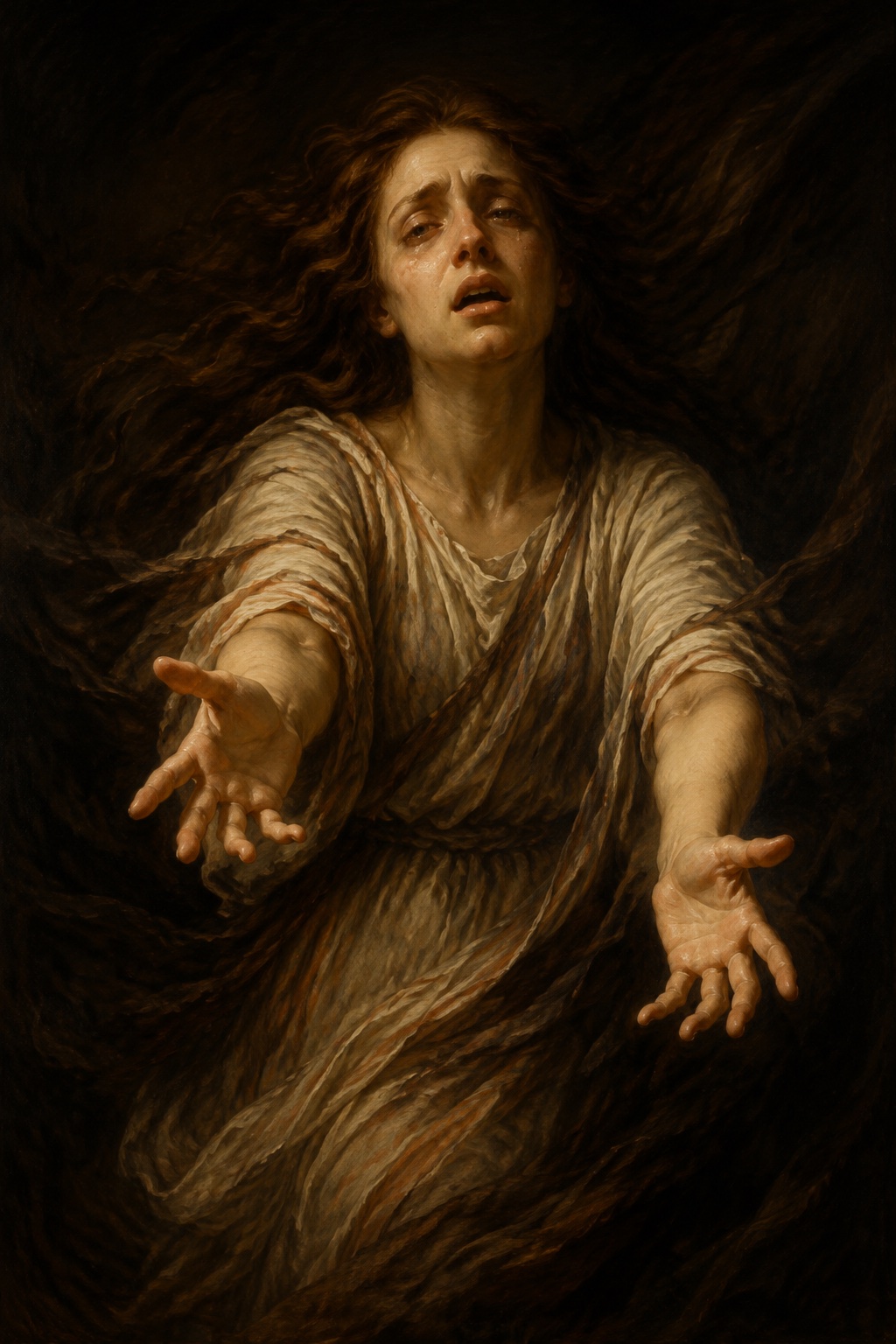
Then the machinery of going back, in the order she feels it. En iterum — look, again, a second time — and crudelia retro Fata vocant, the cruel Fates are calling her backwards; that clause, more than the snake, is why this page carries fate among its domains, because it is the only place in either text where she says what is taking her. Conditque natantia lumina somnus: sleep, not death, closes eyes that are natantia, swimming — brimming and going, not yet shut. Iamque vale, and now farewell, which is two words and the whole of what she has time to give him. Feror, I am carried, passive, by nothing the sentence bothers to name. And the last image is her hands: invalidas … palmas, palms without strength, stretched out toward him and, heu non tua, no longer his.
Three of those clauses, together with the snake in the grass, are the four things this page lists as her symbols. There is no lyre among them, no wedding torch, no meadow. What she is given to be remembered by is a snake in tall grass, a pair of eyes closing, two failing hands, and an enormous night that arrives around her like weather.
Whose story this is
Every word above is inside somebody else’s speech. The snakebite is Proteus’s, delivered to Aristaeus as the explanation of some dead bees. The descent is Apollodorus’s, filed in a section about a singer. Even the farewell is a quotation inside a prophecy that a captured sea-god is giving under duress. Eurydice has no episode of her own in either text: she runs, she does not see, she follows, she turns back, and each of those is reported by a man explaining something else.
What survives that is the five lines, and they are not what a figure invented to be lost would say. She asks one question and blames nobody. She names the thing that is taking her and gets the agency right — the Fates, calling. She says goodbye, which none of the gods in the story bother to do, and she spends her last clause describing her own hands as they fail. It is the only speech in the episode that is about what is happening rather than about who is at fault.
The nearest figure to her anywhere in this atlas is Izanami: a wife in the land of the dead, lost for good when a husband breaks the terms by looking. The shape is identical and the endings could not be further apart. Izanami is the one who set the condition, and when it is broken she stays, and rules, and turns on the man who looked. Eurydice was never told the condition, says farewell, and is carried off. They are kept as separate entries here rather than as equivalents for exactly that reason: Izanami belongs with the sovereigns of the dead, and Eurydice is the opposite role in the same scene — the one the underworld keeps.