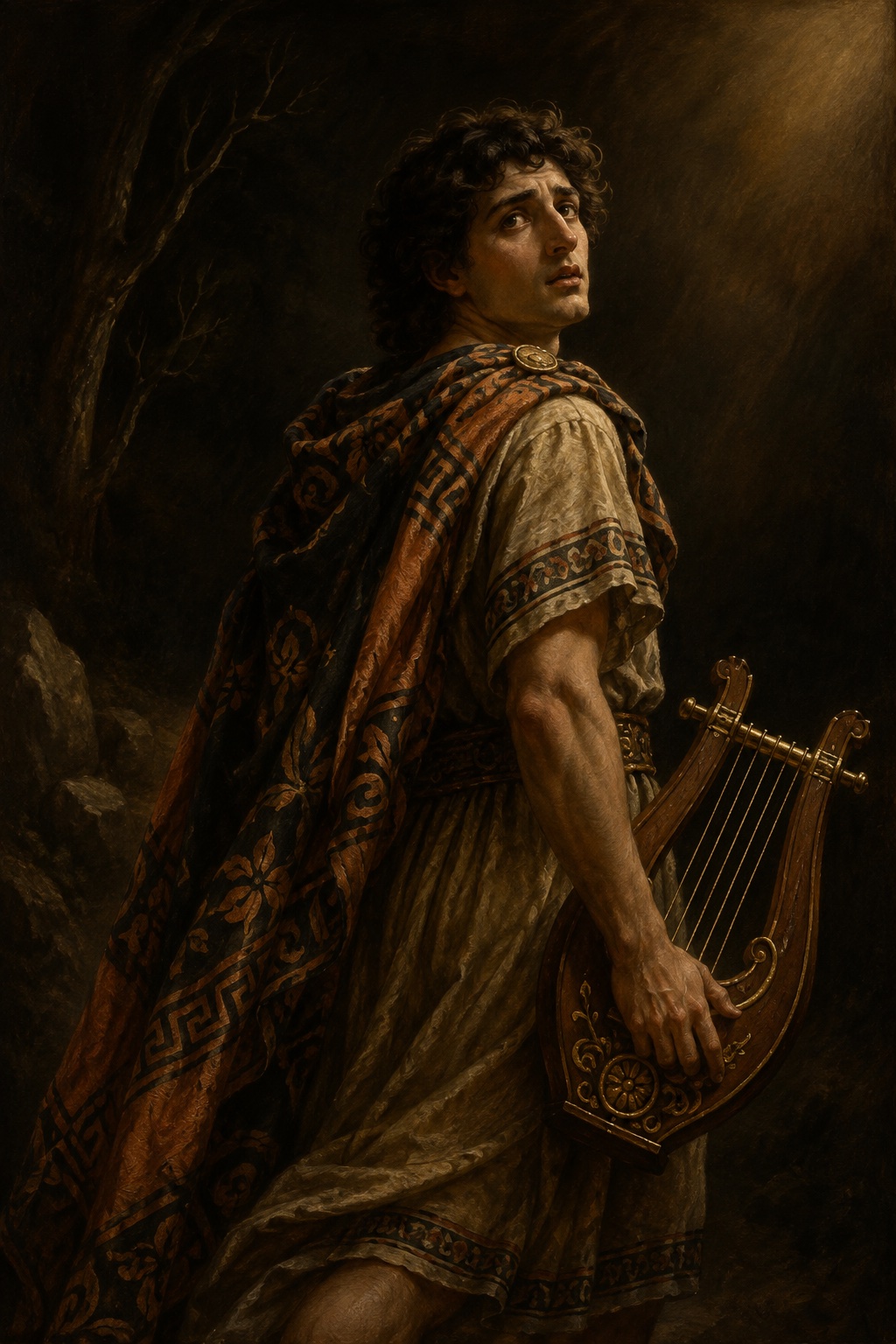
What the singing did
Apollodorus gives Orpheus one section of the Bibliotheca, and it is one of the shortest lives in the book. It opens with the Muse Calliope bearing two sons, and disposes of the first — Linus, killed by Heracles — in a relative clause. The second gets a clause of his own, and everything the Greeks thought about him is inside it.
καὶ Ὀρφεὺς ὁ ἀσκήσας κιθαρῳδίαν, ὃς ᾄδων ἐκίνει λίθους τε καὶ δένδρα
“and another son, Orpheus, who practised minstrelsy and by his songs moved stones and trees” — Apollodorus, Bibliotheca 1.3.2, tr. J. G. Frazer
ἐκίνει is the ordinary word for setting a thing in motion, and its objects here are the two least movable things a Greek writer could have reached for. Not that the stones were charmed, or softened, or made to listen: they moved. Apollodorus spends no more words on the music than that, and never says what he sang. Every later account of Orpheus — the mysteries, the Argo, the head still singing in the river — is an attempt to explain a talent this sentence simply states.
Down for Eurydice, and the turn
The descent gets four times as many words as the music, and almost all of them are spent on the condition and on how it is broken.
ἀποθανούσης δὲ Εὐρυδίκης τῆς γυναικὸς αὐτοῦ, δηχθείσης ὑπὸ ὄφεως, κατῆλθεν εἰς Ἅιδου θέλων ἀνάγειν αὐτήν, καὶ Πλούτωνα ἔπεισεν ἀναπέμψαι. ὁ δὲ ὑπέσχετο τοῦτο ποιήσειν, ἂν μὴ πορευόμενος Ὀρφεὺς ἐπιστραφῇ πρὶν εἰς τὴν οἰκίαν αὑτοῦ παραγενέσθαι· ὁ δὲ ἀπιστῶν ἐπιστραφεὶς ἐθεάσατο τὴν γυναῖκα, ἡ δὲ πάλιν ὑπέστρεψεν
“And when his wife Eurydice died, bitten by a snake, he went down to Hades, being fain to bring her up, and he persuaded Pluto to send her up. The god promised to do so, if on the way Orpheus would not turn round until he should be come to his own house. But he disobeyed and turning round beheld his wife; so she turned back.” — Apollodorus, Bibliotheca 1.3.2, tr. J. G. Frazer
The Greek does not say he forgot, and it does not say he could not bear it. It says ἀπιστῶν — disbelieving. He turned round because he did not believe she was there, which makes the loss a failure of trust rather than of nerve, and puts the blame exactly where the condition had placed it. Note also what the condition actually was: not until the daylight, but πρὶν εἰς τὴν οἰκίαν αὑτοῦ παραγενέσθαι, until he should reach his own house. Apollodorus’s Orpheus does not fail on the last step out of the dark. He fails somewhere on the road home, with no reason given for choosing that moment, which is worse.
Then the sentence that undoes it: ἡ δὲ πάλιν ὑπέστρεψεν, and she turned back. The same verb root as his own turning, handed to her. He turns, and so does she, and the second turn is the one that is permanent.
The mysteries, and Pieria
The last sentence of the section covers a religion and a death in eighteen words.
εὗρε δὲ Ὀρφεὺς καὶ τὰ Διονύσου μυστήρια, καὶ τέθαπται περὶ τὴν Πιερίαν διασπασθεὶς ὑπὸ τῶν μαινάδων
“Orpheus also invented the mysteries of Dionysus, and having been torn in pieces by the Maenads he is buried in Pieria.” — Apollodorus, Bibliotheca 1.3.2, tr. J. G. Frazer
εὗρε is found or discovered — the word for inventing a craft, not for receiving a revelation — and what he finds is Dionysus’s own rite; διασπασθεὶς, torn apart, is what Dionysus’s own women do to him for it. Apollodorus sets the two facts side by side in a single clause and offers no motive, no quarrel, and no connection between them beyond the god they share. He does not say the Maenads killed him because of the mysteries, or in spite of them. He says he found the rite, and the rite’s celebrants tore him to pieces, and he is buried in Pieria — which is where the Muses live, and where his mother is from.
Cerberus, Hades and Persephone are each named in this wiki already for the same reason: because the man who got past them is the standard by which their gates are measured. Apollodorus is the reason it is worth reading them in order. The music that moved stones is asserted in a clause; the descent is granted, then revoked by one look; and the singer ends up scattered across the same ground his mother’s sisters walk. Fifty Greek entries were written before this one, and three of them had already had to mention him.