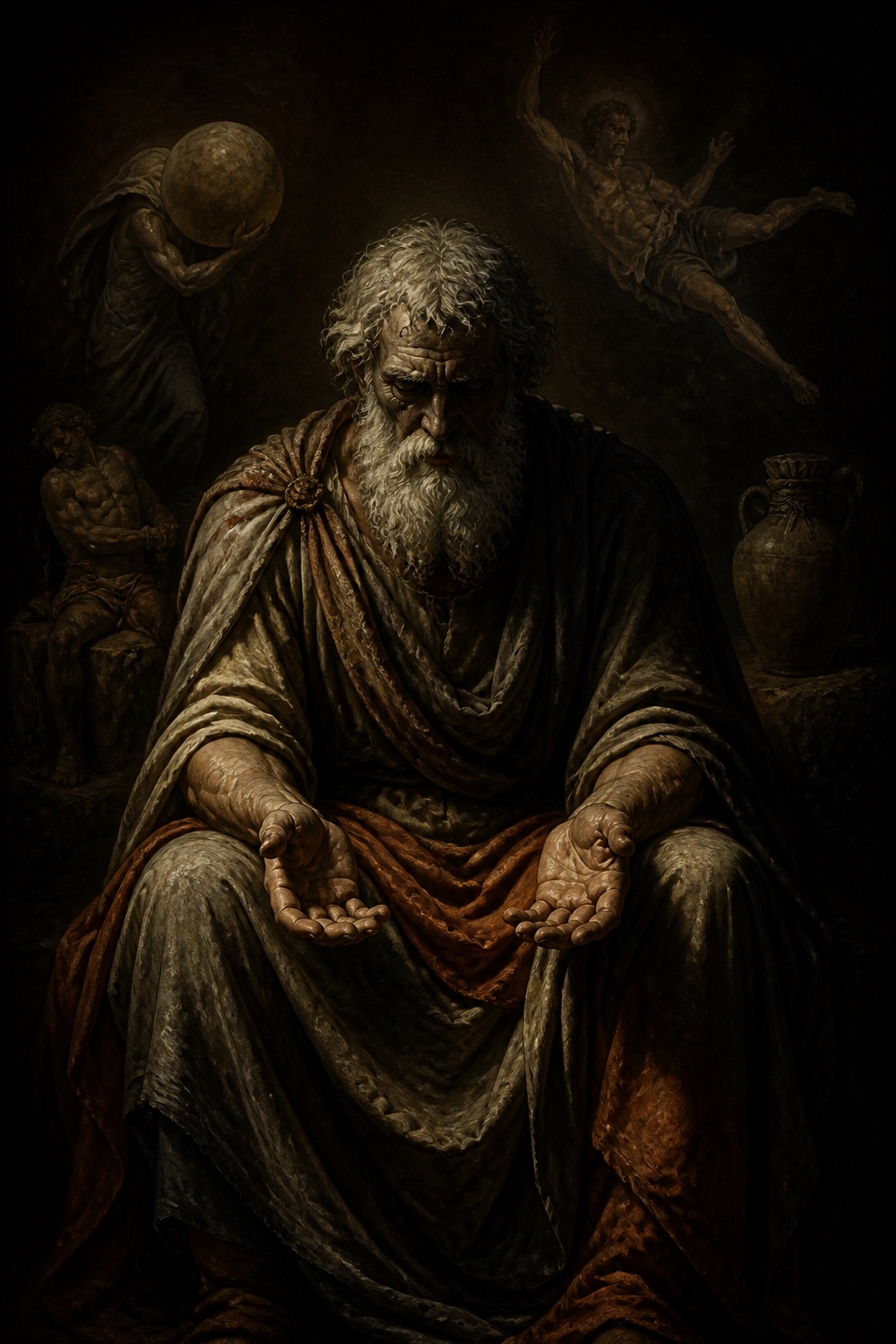
Iapetus does nothing. He is named in the list of Titans, he marries an Oceanid, he fathers four sons, and that is the end of his participation. What makes him worth an entry is that those four sons carry between them almost everything the Greeks had to say about the relationship between gods and men — and every one of them ends badly.
ἣ δέ οἱ Ἄτλαντα κρατερόφρονα γείνατο παῖδα· τίκτε δ᾽ ὑπερκύδαντα Μενοίτιον ἠδὲ Προμηθέα, ποικίλον αἰολόμητιν, ἁμαρτίνοόν τ᾽ Ἐπιμηθέα, ὃς κακὸν ἐξ ἀρχῆς γένετ᾽ ἀνδράσιν ἀλφηστῇσιν
“And she bare him a stout-hearted son, Atlas: also she bare very glorious Menoetius and clever Prometheus, full of various wiles, and scatter-brained Epimetheus who from the first was a mischief to men who eat bread.” — Hesiod, Theogony 509–512, tr. Evelyn-White
Read the list forward and it is a genealogy. Read it as Hesiod immediately proceeds to read it, and it is a charge sheet. Atlas is sentenced to hold up the sky at the western edge of the world. Menoetius is struck with a thunderbolt for insolence and sent down to Erebus. Prometheus steals the fire and is chained with the eagle at his liver. Epimetheus, whose name means afterthought, is the one who accepts the woman Zeus has made and so lets the evils out. Four sons, four punishments, and the punishments are the entire content of the family.
Hesiod insists on the patronymic. Four times across the Prometheus episode the son is named by the father rather than by himself — Ἰαπετιονίδη, son of Iapetus, which is how Zeus addresses him to his face. The quarrel that produces sacrifice, fire and the first woman is not framed as a dispute between Zeus and a clever individual; it is framed as Zeus finishing off a rival lineage. Iapetus is the surname on the indictment.
That leaves him with a strange kind of importance. Because Prometheus makes and saves human beings in the later tradition, and Epimetheus admits the evils that define human life, the Iapetids are the branch of the divine family through which mortality itself descends. The one place Homer mentions Iapetus at all puts him where that fight ended: at the ends of earth and sea, sitting beside Cronus in the dark below Tartarus, with no sun and no wind. The father is filed with the losing generation while his sons are still being punished on the surface.