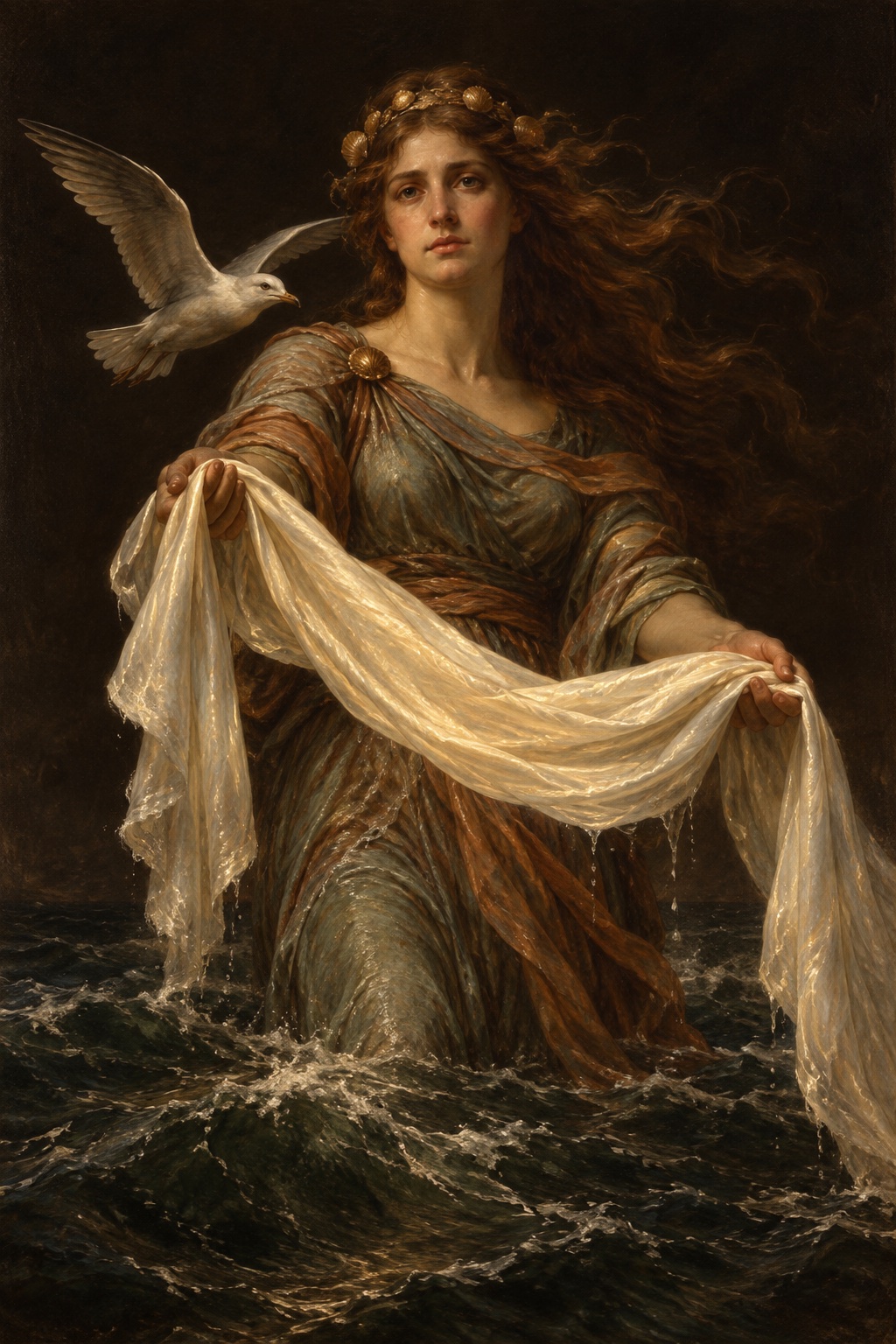
The second wife of Athamas
Ino is one of the four daughters of Cadmus, and Apollodorus marries her off in a single sentence with two of her sisters: Ino to Athamas, Autonoe to Aristaeus, Agave to Echion. Her own story is told in an earlier book, and there she comes into it as a second wife. Athamas, a son of Aeolus who rules over Boeotia, already has two children by Nephele, a son Phrixus and a daughter Helle. By Ino he has two more, Learchus and Melicertes. What Ino does next is aimed at the first family.
ἐπιβουλεύουσα δὲ Ἰνὼ τοῖς Νεφέλης τέκνοις ἔπεισε τὰς γυναῖκας τὸν πυρὸν φρύγειν. λαμβάνουσαι δὲ κρύφα τῶν ἀνδρῶν τοῦτο ἔπρασσον. γῆ δὲ πεφρυγμένους πυροὺς δεχομένη καρποὺς ἐτησίους οὐκ ἀνεδίδου. διὸ πέμπων ὁ Ἀθάμας εἰς Δελφοὺς ἀπαλλαγὴν ἐπυνθάνετο τῆς ἀφορίας. Ἰνὼ δὲ τοὺς πεμφθέντας ἀνέπεισε λέγειν ὡς εἴη κεχρησμένον παύσεσθαι τὴν ἀκαρπίαν, ἐὰν σφαγῇ Διὶ ὁ Φρίξος
“But Ino plotted against the children of Nephele and persuaded the women to parch the wheat; and having got the wheat they did so without the knowledge of the men. But the earth, being sown with parched wheat, did not yield its annual crops; so Athamas sent to Delphi to inquire how he might be delivered from the dearth. Now Ino persuaded the messengers to say it was foretold that the infertility would cease if Phrixus were sacrificed to Zeus.” — Apollodorus, Bibliotheke 1.9.1, tr. J. G. Frazer
The plan has two stages, and at both of them Ino works through other people. First she persuades the women to parch the seed wheat, which they do κρύφα τῶν ἀνδρῶν, without the knowledge of the men, so that the earth gives back no crop. Then, when Athamas sends to Delphi, she gets to the messengers, and the answer they carry home is hers. Apollodorus never says what the god replied. He says only that Ino persuaded the messengers to say it was foretold that the dearth would end if Phrixus were sacrificed to Zeus. The famine is real, and made by hand; the oracle is forged.
It very nearly works. The people of the land force Athamas to bring his son to the altar. Phrixus is saved only because Nephele catches him and his sister up and gives them a ram with a golden fleece, a gift from Hermes, which carries them through the sky over land and sea. Helle slips into the deep and drowns, and the sea there is called the Hellespont after her. Phrixus reaches the Colchians, sacrifices the ram, and gives the fleece to their king Aeetes, who nails it to an oak in a grove of Ares. A stepmother’s plot about seed wheat is how the Golden Fleece comes to hang in Colchis.
The nurse of Dionysus
The Theban book brings Ino back through her sister. Semele dies when Zeus comes to her as he came to Hera, and the other daughters of Cadmus, Ino among them, spread the report that she had lain with a mortal man and lied about Zeus. At the proper time Zeus gives birth to Dionysus himself and entrusts him to Hermes. The child whose divine father the sisters had denied is delivered to Ino’s house.
ὁ δὲ κομίζει πρὸς Ἰνὼ καὶ Ἀθάμαντα καὶ πείθει τρέφειν ὡς κόρην. ἀγανακτήσασα δὲ Ἥρα μανίαν αὐτοῖς ἐνέβαλε, καὶ Ἀθάμας μὲν τὸν πρεσβύτερον παῖδα Λέαρχον ὡς ἔλαφον θηρεύσας ἀπέκτεινεν, Ἰνὼ δὲ τὸν Μελικέρτην εἰς πεπυρωμένον λέβητα ῥίψασα, εἶτα βαστάσασα μετὰ νεκροῦ τοῦ παιδὸς ἥλατο κατὰ βυθοῦ. καὶ Λευκοθέα μὲν αὐτὴν καλεῖται, Παλαίμων δὲ ὁ παῖς, οὕτως ὀνομασθέντες ὑπὸ τῶν πλεόντων· τοῖς χειμαζομένοις γὰρ βοηθοῦσιν
“he conveyed him to Ino and Athamas, and persuaded them to rear him as a girl. But Hera indignantly drove them mad, and Athamas hunted his elder son Learchus as a deer and killed him, and Ino threw Melicertes into a boiling cauldron, then carrying it with the dead child she sprang into the deep. And she herself is called Leucothea, and the boy is called Palaemon, such being the names they get from sailors; for they succour storm-tossed mariners.” — Apollodorus, Bibliotheke 3.4.3, tr. J. G. Frazer
The disguise comes first: Hermes persuades them to rear the boy ὡς κόρην, as a girl. Apollodorus gives no reason for it, and it does not save anyone. Hera is ἀγανακτήσασα, indignant, and the madness she sends falls on both of them, αὐτοῖς. It takes each parent differently. Athamas hunts his elder son Learchus as a deer and kills him. Ino throws Melicertes εἰς πεπυρωμένον λέβητα, into a boiling cauldron, and then leaps κατὰ βυθοῦ, into the deep. Frazer’s English has her carrying the cauldron itself as she goes, the dead child with it; the Greek participle βαστάσασα names no object, only that she lifted something and went into the sea μετὰ νεκροῦ τοῦ παιδὸς, with the dead child.
The last sentence changes both of them. The mother is called Λευκοθέα and the son Παλαίμων, and Apollodorus says where the names come from: ὑπὸ τῶν πλεόντων, from the people who sail. The reason he gives is the reason a sailor would care, τοῖς χειμαζομένοις γὰρ βοηθοῦσιν, for they succour storm-tossed mariners. The woman who killed her son, and the son she killed, come out of the same sentence as a pair of rescuers. Apollodorus adds that Sisyphus instituted the Isthmian games in honor of Melicertes.
The goddess on the raft
Homer gives her a single scene, in the fifth book of the Odyssey, and it is the only one in these sources where she acts to someone’s good. Odysseus is at sea on a raft, still in the garments Calypso gave him, and the winds are throwing the raft back and forth between them. Poseidon is angry with him, as her first words say.
τὸν δὲ ἴδεν Κάδμου θυγάτηρ, καλλίσφυρος Ἰνώ, Λευκοθέη, ἣ πρὶν μὲν ἔην βροτὸς αὐδήεσσα, νῦν δ’ ἁλὸς ἐν πελάγεσσι θεῶν ἐξέμμορε τιμῆς. ἥ ῥ’ Ὀδυσῆ’ ἐλέησεν ἀλώμενον, ἄλγε’ ἔχοντα· αἰθυίῃ δ’ εἰκυῖα ποτῇ ἀνεδύσετο λίμνης, ἷζε δ’ ἐπὶ σχεδίης καί μιν πρὸς μῦθον ἔειπε· «κάμμορε, τίπτε τοι ὧδε Ποσειδάων ἐνοσίχθων ὠδύσατ’ ἐκπάγλως, ὅτι τοι κακὰ πολλὰ φυτεύει; οὐ μὲν δή σε καταφθείσει, μάλα περ μενεαίνων. ἀλλὰ μάλ’ ὧδ’ ἕρξαι, δοκέεις δέ μοι οὐκ ἀπινύσσειν· εἵματα ταῦτ’ ἀποδὺς σχεδίην ἀνέμοισι φέρεσθαι κάλλιπ’, ἀτὰρ χείρεσσι νέων ἐπιμαίεο νόστου γαίης Φαιήκων, ὅθι τοι μοῖρ’ ἐστὶν ἀλύξαι. τῆ δέ, τόδε κρήδεμνον ὑπὸ στέρνοιο τανύσσαι ἄμβροτον· οὐδέ τί τοι παθέειν δέος οὐδ’ ἀπολέσθαι. αὐτὰρ ἐπὴν χείρεσσιν ἐφάψεαι ἠπείροιο, ἂψ ἀπολυσάμενος βαλέειν εἰς οἴνοπα πόντον πολλὸν ἀπ’ ἠπείρου, αὐτὸς δ’ ἀπονόσφι τραπέσθαι.» ὣς ἄρα φωνήσασα θεὰ κρήδεμνον ἔδωκεν, αὐτὴ δ’ ἂψ ἐς πόντον ἐδύσετο κυμαίνοντα αἰθυίῃ εἰκυῖα· μέλαν δέ ἑ κῦμ’ ἐκάλυψεν
“the daughter of Cadmus, Ino of the fair ankles, saw him, even Leucothea, who of old was a mortal of human speech, but now in the deeps of the sea has won a share of honor from the gods. She was touched with pity for Odysseus, as he wandered and was in sore travail, and she rose up from the deep like a sea-mew on the wing, and sat on the stoutly-bound raft, and spoke, saying: “Unhappy man, how is it that Poseidon, the earth-shaker, has conceived such furious wrath against thee, that he is sowing for thee the seeds of many evils? Yet verily he shall not utterly destroy thee for all his rage. Nay, do thou thus; and methinks thou dost not lack understanding. Strip off these garments, and leave thy raft to be driven by the winds, but do thou swim with thy hands and so strive to reach the land of the Phaeacians, where it is thy fate to escape. Come, take this veil, and stretch it beneath thy breast. It is immortal; there is no fear that thou shalt suffer aught or perish. But when with thy hands thou hast laid hold of the land, loose it from thee, and cast it into the wine-dark sea far from the land, and thyself turn away.” So saying, the goddess gave him the veil, and herself plunged again into the surging deep, like a sea-mew; and the dark wave hid her.” — Homer, Odyssey 5.333–353, tr. Murray
Homer introduces her with her whole history in a line and a half. She is Κάδμου θυγάτηρ, the daughter of Cadmus, καλλίσφυρος Ἰνώ, Ino of the fair ankles, and she is also Λευκοθέη, ἣ πρὶν μὲν ἔην βροτὸς αὐδήεσσα, who of old was a mortal of human speech. Now she lives in the depths of the sea and holds a share of the gods’ honor. Homer writes the name Λευκοθέη, where Apollodorus writes Λευκοθέα, and he says nothing of how the mortal became the goddess. The cauldron and the leap are Apollodorus’s account of that change, not Homer’s.
What she offers is exact. Odysseus is to strip off his clothes, leave the raft to the winds, and swim for the land of the Phaeacians. He is to stretch her κρήδεμνον, her veil, beneath his breast, and it is ἄμβροτον, immortal, so he cannot drown while he wears it. When he touches land he must take it off, throw it back into the sea far from land, and turn away. She comes and goes the same way, αἰθυίῃ εἰκυῖα, like a sea-mew, rising out of the water and plunging back into it. The woman who went into the sea with her dead son comes up out of it to keep a stranger from drowning.
The veil returned
Odysseus does not trust her. Once she is gone he tells his own spirit that one of the gods may be setting a trap for him again, since she is asking him to abandon the raft, and he decides to stay on it until the sea breaks it up. Poseidon settles the question for him. A great wave breaks over the raft and scatters its timbers, and Odysseus sits astride a single plank, strips off the garments Calypso gave him, stretches the veil beneath his breast, and swims.
The veil does what she said it would. When Odysseus has come ashore by a river and has his breath back, he takes off the veil and lets it fall into the river. The current carries it back downstream, and Ino receives it in her hands. He does not throw it far out into the sea as she told him, but it goes home anyway.
This is the work the sailors named her for. Apollodorus says that she helps men caught in storms at sea, and the Odyssey shows her doing it for one of them. Beside the Norse Rán, who takes the sailors the sea drowns, she is the opposite kind of sea-goddess: the one who gives a drowning man back to the land.