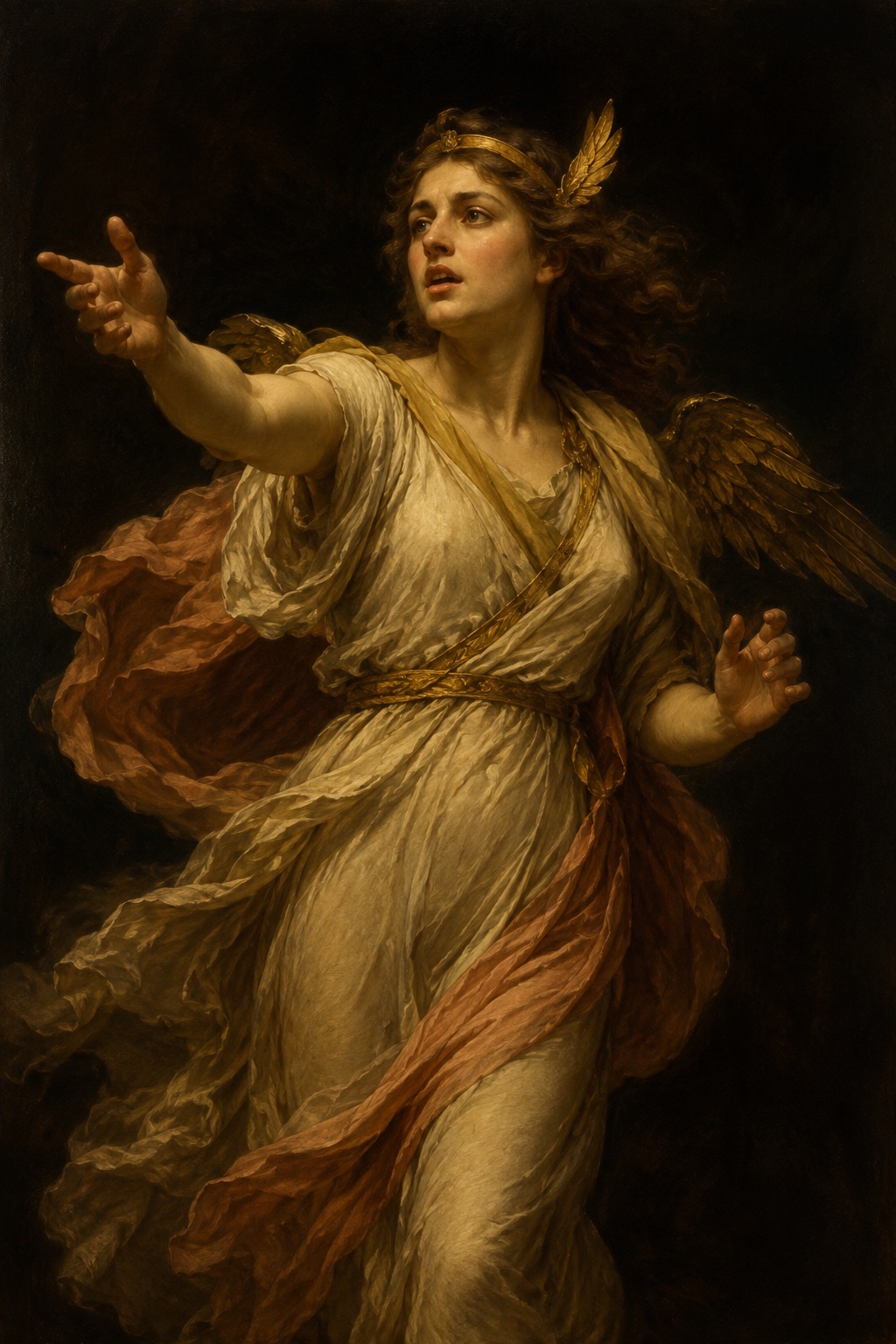
Sent to bring her back
On Delos, Leto has been nine days and nights in labour, and the birth will not happen because Eileithyia, goddess of childbirth, has not been told. Hera is holding her on Olympus under a golden cloud, out of jealousy, and the goddesses gathered around Leto — Dione, Rhea, Themis, Amphitrite — need someone who can reach Eileithyia and bring her down before Hera notices and talks her out of it. They send Iris.
Αἱ δ’ Ἶριν προὔπεμψαν ἐυκτιμένης ἀπὸ νήσου ἀξέμεν Εἰλείθυιαν, ὑποσχόμεναι μέγαν ὅρμον χρυσείοισι λίνοισιν ἐερμένον, ἐννεάπηχυν· νόσφιν δ’ ἤνωγον καλέειν λευκωλένου Ἥρης μή μιν ἔπειτ’ ἐπέεσσιν ἀποστρέψειεν ἰοῦσαν. αὐτὰρ ἐπεὶ τό γ’ ἄκουσε ποδήνεμος ὠκέα Ἶρις βῆ ῥα θέειν, ταχέως δὲ διήνυσε πᾶν τὸ μεσηγύ. αὐτὰρ ἐπεί ῥ’ ἵκανε θεῶν ἕδος, αἰπὺν Ὄλυμπον αὐτίκ’ ἄρ’ Εἰλείθυιαν ἀπὲκ μεγάροιο θύραζε ἐκπροκαλεσσαμένη ἔπεα πτερόεντα προσηύδα πάντα μάλ’, ὡς ἐπέτελλον Ὀλύμπια δώματ’ ἔχουσαι. τῇ δ’ ἄρα θυμὸν ἔπειθεν ἐνὶ στήθεσσι φίλοισι, βὰν δὲ ποσὶ τρήρωσι πελειάσιν ἴθμαθ’ ὁμοῖαι
“But the goddesses sent out Iris from the well-set isle to bring Eilithyia, promising her a great necklace strung with golden threads, nine cubits long. And they bade Iris call her aside from white-armed Hera, lest she might afterwards turn her from coming with her words. When swift Iris, fleet of foot as the wind, had heard all this, she set to run; and quickly finishing all the distance she came to the home of the gods, sheer Olympus, and forthwith called Eilithyia out from the hall to the door and spoke winged words to her, telling her all as the goddesses who dwell on Olympus had bidden her. So she moved the heart of Eilithyia in her dear breast; and they went their way, like shy wild-doves in their going” — Homeric Hymn 3, To Apollo 102–114, tr. Evelyn-White
The whole errand is one unbroken run of clauses in the Greek: sent, runs, arrives, calls her aside, speaks, persuades, returns. Nothing complicates it and nothing interrupts it. Iris is told exactly what to say and whom to avoid, and she manages both on the first attempt.
Nothing that is hers
The bribe that makes the plan work — a necklace of golden threads, nine cubits long — is never Iris’s. It is promised to Eileithyia, to get her to come; Iris only carries the offer and fetches the goddess who accepts it. The hymn calls her ποδήνεμος ὠκέα, which Evelyn-White renders “swift Iris, fleet of foot as the wind,” and it means that literally: she covers the whole distance to Olympus and back on her own feet, with nothing said about wings. What she is paid, once the errand succeeds, is nothing at all — not even a line of thanks from the goddesses whose problem she has just solved.
The same errand, refused
Not every errand like this one lands. In the Homeric Hymn to Demeter, Zeus sends Iris on an identical kind of mission — go, find the goddess who is refusing to appear, bring her back — except this time the goddess is Demeter, who has shut herself inside her own temple and stopped every seed on earth from growing until her daughter is returned to her. Demeter turns Iris away. She turns away every god sent after Iris with gifts as well, and the famine ends only when Zeus himself gives in. Iris runs that whole distance too, delivers the same kind of message with the same urgency, and comes back with nothing to show for it. The two errands are close enough in shape that the only real difference is who is being asked.
A second calling
Iris and Hermes divide the traffic Olympus most needs carried: Hermes to mortals and to the dead, Iris to the gods themselves and, in this hymn, to a goddess they are trying to win over.
Every version of her keeps the same shape. She is fast, she is reliable, and she is never the reason the story happened.