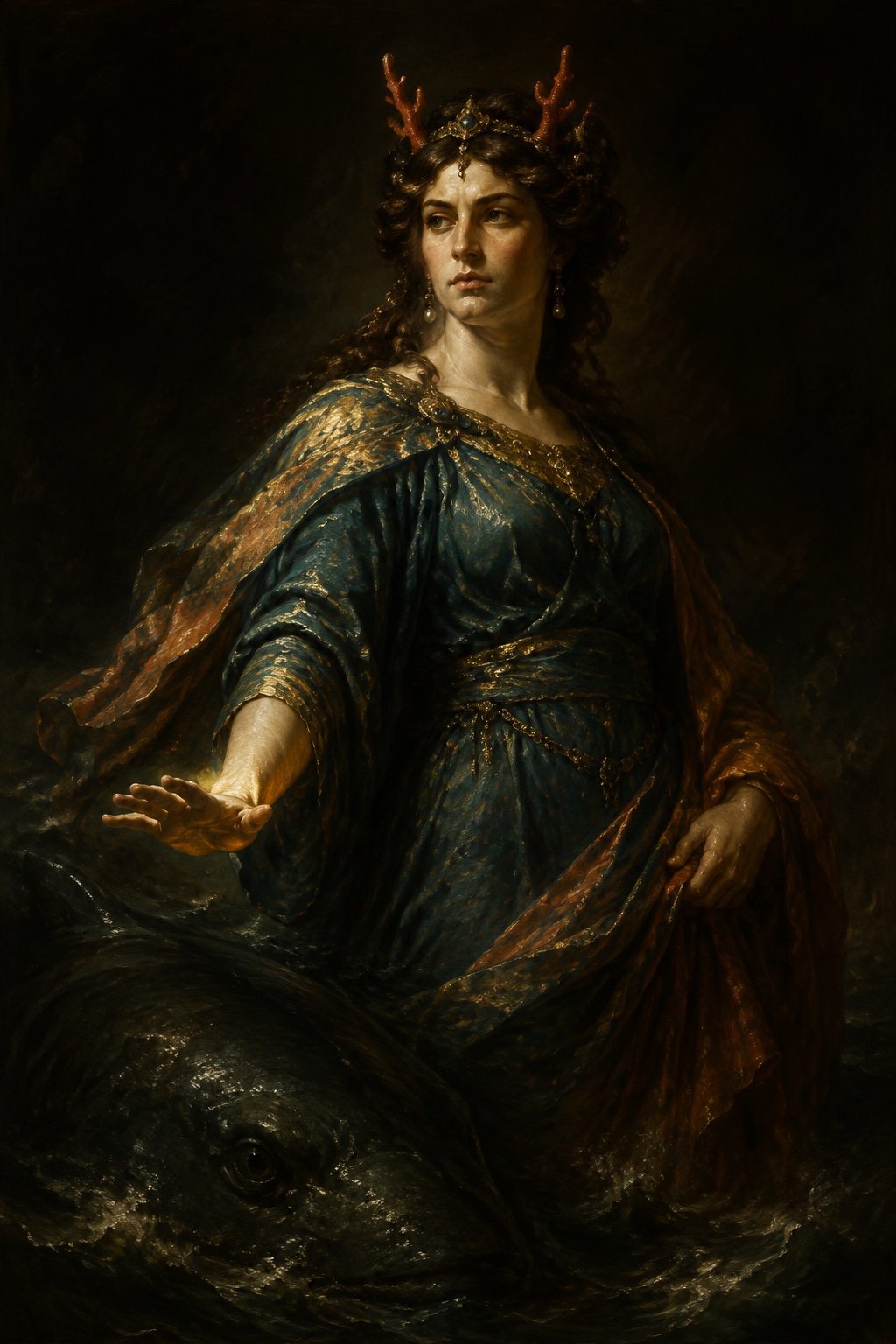
The golden house on the sea floor
The Theogony closes with a run of divine marriages, one after another, and most of them amount to a name, a wife and a child. Amphitrite’s comes with an address. Hesiod names her ahead of her husband, gives her a son, and puts all three of them in a house at the bottom of the sea.
Ἐκ δ᾽ Ἀμφιτρίτης καὶ ἐρικτύπου Ἐννοσιγαίου Τρίτων εὐρυβίης γένετο μέγας, ὅστε θαλάσσης πυθμέν᾽ ἔχων παρὰ μητρὶ φίλῃ καὶ πατρὶ ἄνακτι ναίει χρύσεα δῶ, δεινὸς θεός
“And of Amphitrite and the loud-roaring Earth-Shaker was born great, wide-ruling Triton, and he owns the depths of the sea, living with his dear mother and the lord his father in their golden house, an awful god” — Hesiod, Theogony 930–933, tr. Evelyn-White
The husband is not named. He is the Earth-Shaker, loud-roaring — Poseidon under his title — and the line wants the title rather than the name: the noise of the sea, set beside the goddess who lives underneath it. Triton is the grammatical subject and the one the sentence is about, but the house belongs to all three, his dear mother first and the lord his father second. Amphitrite is not a wife who visits the depths. The depths are her address, and the gold is hers as much as it is his.
What the sea rears
Odysseus is in the water off the Phaeacian coast with his raft broken apart under him, working through the list of things that can still kill him: the surf, the rocks, the wind that might carry him back out. Then he adds one more, and it is the only item on the list with an owner.
ἠέ τί μοι καὶ κῆτος ἐπισσεύῃ μέγα δαίμων ἐξ ἁλός, οἷά τε πολλὰ τρέφει κλυτὸς Ἀμφιτρίτη
“or lest some god may even send forth upon me some great monster from out the sea — and many such does glorious Amphitrite breed” — Homer, Odyssey 5.421–422, tr. Murray
The god who would send it is Poseidon, whom the next line names as the one whose anger has been following him. The creature, though, is not Poseidon’s. The κῆτος — the sea-beast, the thing the poem gives no shape to — is hers, and the verb attached to her, τρέφει, is the one for bringing something up rather than merely having it about. Murray renders it “breed”. What frightens Odysseus is not that the sea is dangerous. It is that the danger has a keeper, and that she has many of them.
The waves laid easy
Hesiod’s roll of the Nereids is almost entirely names. Fifty daughters go past in a handful of lines, and the poem stops for almost none of them. Three lines in the middle of it stop to say what some of the sisters do.
Κυμοδόκη θ᾽, ἣ κύματ᾽ ἐν ἠεροειδέι πόντῳ πνοιάς τε ζαέων ἀνέμων σὺν Κυματολήγῃ ῥεῖα πρηΰνει καὶ ἐυσφύρῳ Ἀμφιτρίτῃ
“and Cymodoce who with Cymatolege and Amphitrite easily calms the waves upon the misty sea and the blasts of raging winds” — Hesiod, Theogony 252–254, tr. Evelyn-White
The act is shared, and Amphitrite does not govern the verb: two sisters are named ahead of her and she is attached to them, third, in the dative. It is still the one place in the catalogue where she does anything at all, and the one place in Hesiod where the weather answers to her and not only the water — not just the waves but the blasts of the winds that raise them.
The Greek also gives her an adjective the English does not have. She is ἐυσφύρῳ in that line, and Evelyn-White prints nothing for it; two independent copies of his translation carry the same sentence word for word, and neither renders the word at all. He gives other ankle-epithets in the poem their English. This one he passes over, and a reader working from the translation alone would never know it was there.
One of fifty
Hesiod puts her in the sea’s oldest family. Nereus, the old man of the sea, and Doris, a daughter of Oceanus, have fifty daughters between them; Amphitrite is the fourth name on the list, and the catalogue closes by counting itself. That is why her sisters are recorded here as a body rather than as names. The number is the point of the roll, and almost none of the fifty are anything more than a name inside it.
Either way the sea is hers by birth before it is hers by marriage. She is born near the top of its genealogy, and the Theogony leaves her still living at the bottom of it, in the golden house, with the sea’s monsters somewhere outside.