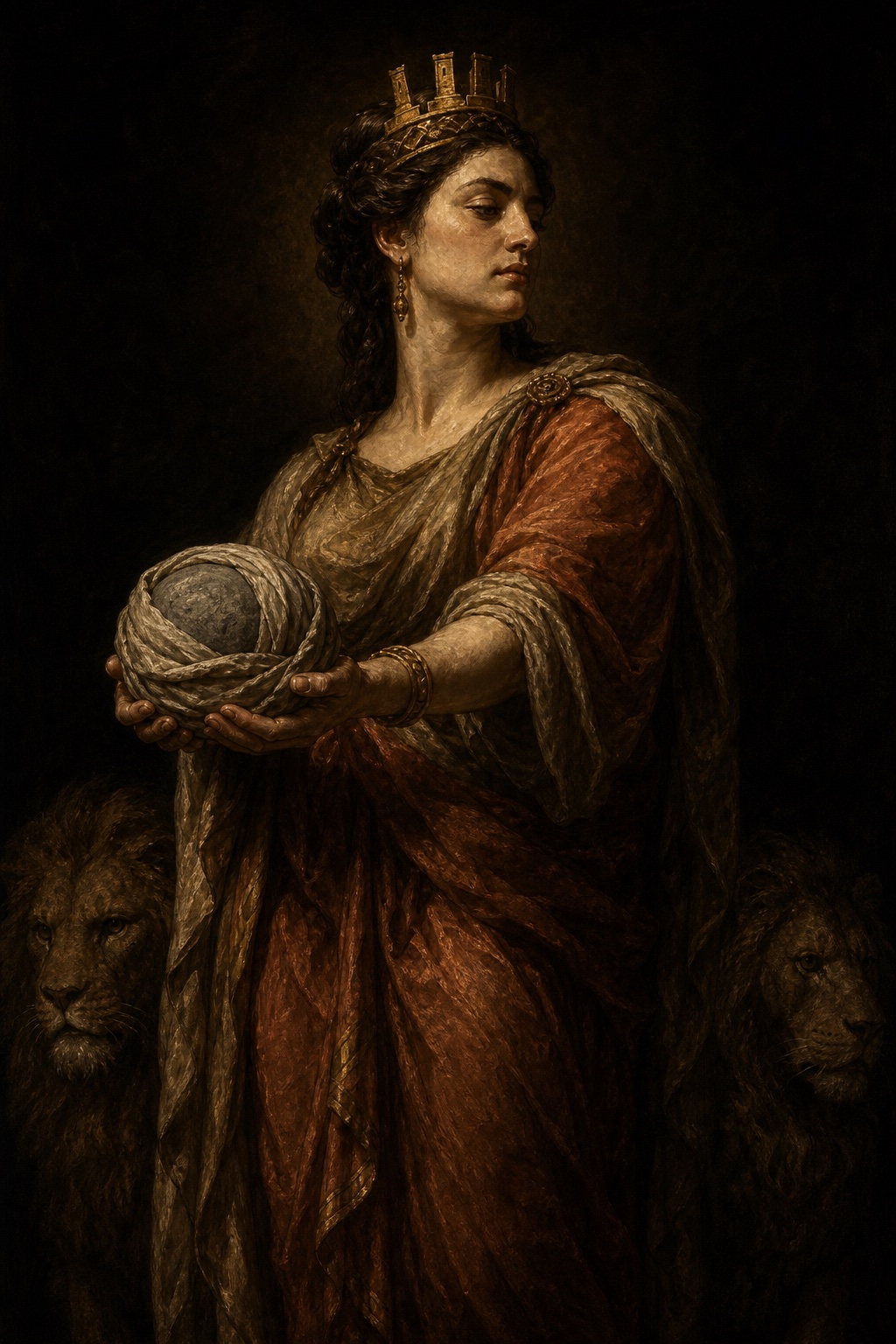
Rhea is a Titaness, sister and wife to Cronus, and the mother of the six gods who become the core of the Olympian order. Hesiod introduces her almost administratively — she “was subject in love to Cronos and bare splendid children” — and then spends the next lines on what those children’s father does to them. Her part of the story is what she does about it.
Ῥέην δ᾽ ἔχε πένθος ἄλαστον. ἀλλ᾽ ὅτε δὴ Δί᾽ ἔμελλε θεῶν πατέρ᾽ ἠδὲ καὶ ἀνδρῶν τέξεσθαι, τότ᾽ ἔπειτα φίλους λιτάνευε τοκῆας τοὺς αὐτῆς, Γαῖάν τε καὶ Οὐρανὸν ἀστερόεντα, μῆτιν συμφράσσασθαι, ὅπως λελάθοιτο τεκοῦσα παῖδα φίλον
“and unceasing grief seized Rhea. But when she was about to bear Zeus, the father of gods and men, then she besought her own dear parents, Earth and starry Heaven, to devise some plan with her that the birth of her dear child might be concealed.” — Hesiod, Theogony 467–471, tr. Evelyn-White
The plan is the one that works. Gaia and Uranus send her to Crete; she bears Zeus at night and hides him in a cave on Mount Aegeum, and hands Cronus a large stone wrapped in swaddling-bands, which he swallows without looking. The child is raised out of sight — nursed on goat’s milk, his crying drowned by armed dancers clashing their shields — and comes back grown to force his father to disgorge the rest. The stone comes up first, and Zeus sets it at Delphi, where it was still shown to visitors centuries later.
Rhea is the hinge between two regimes rather than a ruler in either. After the Titans fall she keeps a quiet standing among the victors; in the Homeric Hymn to Demeter it is Rhea whom Zeus finally sends to fetch her grieving daughter back to the gods, precisely because she is the one mother the other will listen to. Greek cult increasingly ran her together with the Anatolian Great Mother, Cybele, and from that fusion she takes the lions, the turreted crown and the drum that later art gives her.