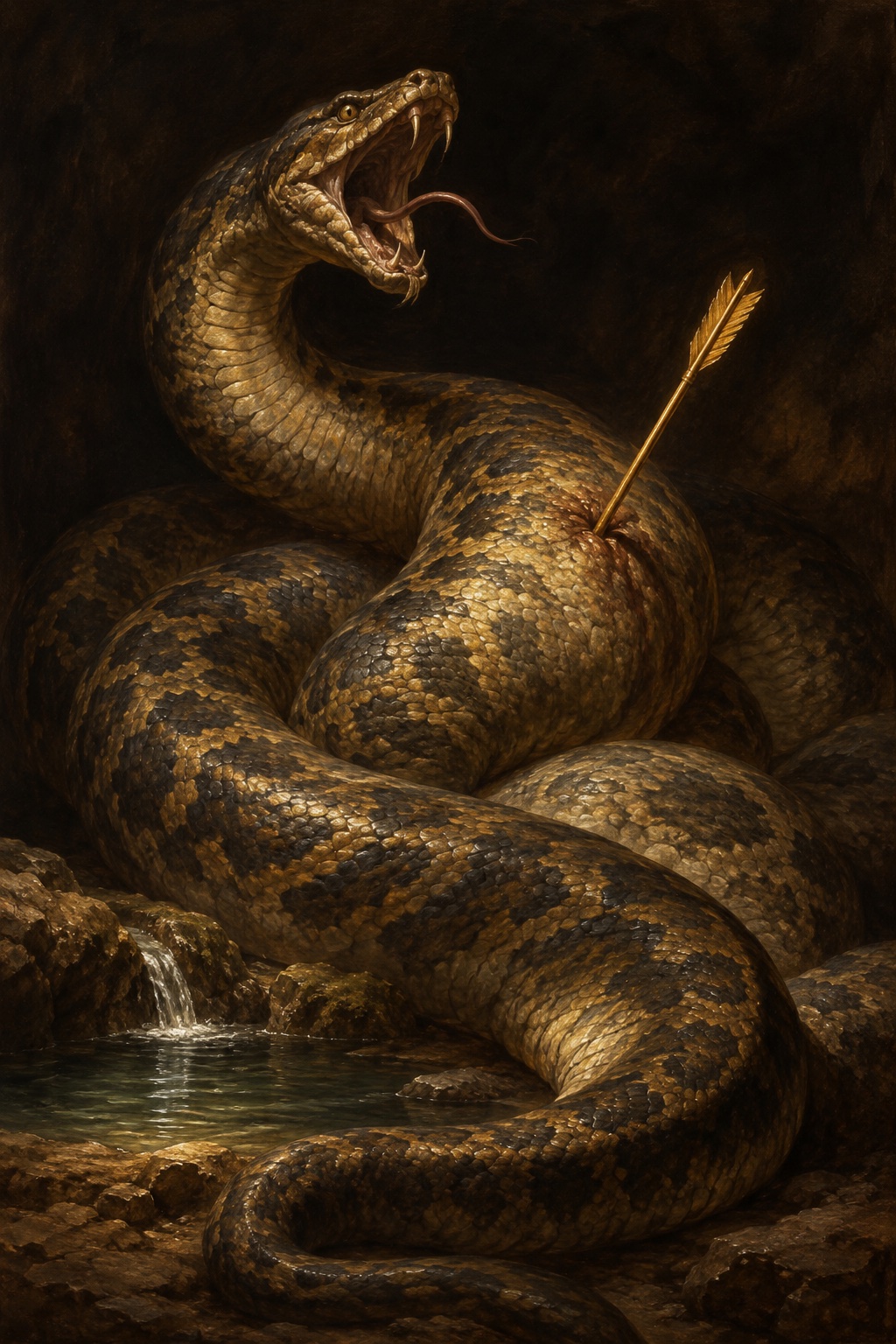
The she-dragon by the spring
The Homeric Hymn to Apollo comes to her only after the temple is built. Apollo has come to Crisa beneath snowy Parnassus and chosen it for a temple that is to be an oracle for men. He lays out the foundations himself; Trophonius and Agamedes, the sons of Erginus, lay a footing of stone on them, and the countless tribes of men build the rest. Only then does the poem look beside the temple.
ἀγχοῦ δὲ κρήνη καλλίρροος ἔνθα δράκαιναν κτεῖνεν ἄναξ Διὸς υἱὸς ἀπὸ κρατεροῖο βιοῖο ζατρεφέα μεγάλην τέρας ἄγριον, ἣ κακὰ πολλὰ ἀνθρώπους ἔρδεσκεν ἐπὶ χθονί, πολλὰ μὲν αὐτοὺς πολλὰ δὲ μῆλα ταναύποδ’ ἐπεὶ πέλε πῆμα δαφοινόν. καὶ ποτε δεξαμένη χρυσοθρόνου ἔτρεφεν Ἥρης δεινόν τ’ ἀργαλέον τε Τυφάονα πῆμα βροτοῖσιν
“But near by was a sweet flowing spring, and there with his strong bow the lord, the son of Zeus, killed the bloated, great she-dragon, a fierce monster wont to do great mischief to men upon earth, to men themselves and to their thin-shanked sheep; for she was a very bloody plague. She it was who once received from gold-throned Hera and brought up fell, cruel Typhaon to be a plague to men” — Homeric Hymn 3, To Apollo 300–306, tr. Evelyn-White
The poem’s word for her is δράκαιναν, which Evelyn-White renders she-dragon here and dragoness when the story comes back to her. The word is feminine, and the Hymn keeps her feminine to the end: it is δεξαμένη, she who received, who takes in the child in the last lines of the passage. Of her body the poem says only ζατρεφέα μεγάλην τέρας ἄγριον, bloated, great, a fierce monster. Then it turns to what she did. She did great mischief to men upon the earth, to the men themselves and to their sheep, ἐπεὶ πέλε πῆμα δαφοινόν, for she was a very bloody plague. Apollo kills her ἀπὸ κρατεροῖο βιοῖο, with his strong bow, and the Hymn tells the killing in a single clause.
What the poem leaves out is just as plain. It gives her no name, here or anywhere else in the Hymn, and it gives her no parents. It does not set her to guard anything. The spring is only ἀγχοῦ, near by, and the Hymn has told the whole building of the temple before it mentions her at all. Nothing in the passage says that she stood in Apollo’s way.
Nurse of Typhon
The last two lines of the passage give her a foster-child. καὶ ποτε δεξαμένη χρυσοθρόνου ἔτρεφεν Ἥρης: she once received from gold-throned Hera, and reared, Τυφάονα, fell, cruel Typhaon. Typhaon is the Hymn’s form of the name of Typhon.
The poem then leaves her for more than forty lines to explain the child. Hera bore him herself. She was angry with Zeus, who had given birth to Athena apart from her, and she prayed that she might bear a son apart from Zeus; when the months and days were fulfilled, she bore one like neither the gods nor mortal men. In this poem Typhon is Hera’s son, and the she-dragon is his nurse, not his mother.
When the poem comes back to her, it picks up the handover where it broke off. Hera takes the child and gives him to her, κακῷ κακόν, one evil thing to another such, and ἡ δ’ ὑπέδεκτο, she received him. The Hymn says nothing about how she raised him. The next thing it tells is the harm he did among the tribes of men, and then the harm she did to whoever met her.
The arrow and the rotting
The passage that ends her life begins with that handover.
αὐτίκα τόνδε λαβοῦσα βοῶπις πότνια Ἥρη δῶκεν ἔπειτα φέρουσα κακῷ κακόν, ἡ δ’ ὑπέδεκτο. ὃς κακὰ πόλλ’ ἔρδεσκεν κατὰ κλυτὰ φῦλ’ ἀνθρώπων· ὃς τῇ γ’ ἀντιάσειε, φέρεσκέ μιν αἴσιμον ἦμαρ πρίν γέ οἱ ἰὸν ἐφῆκεν ἄναξ ἑκάεργος Ἀπόλλων καρτερόν· ἡ δ’ ὀδύνῃσιν ἐρεχθομένη χαλεπῇσι κεῖτο μέγ’ ἀσθμαίνουσα κυλινδομένη κατὰ χῶρον. θεσπεσίη δ’ ἐνοπὴ γένετ’ ἄσπετος, ἡ δὲ καθ’ ὕλην πυκνὰ μάλ’ ἔνθα καὶ ἔνθα ἑλίσσετο, λεῖπε δὲ θυμὸν φοινὸν ἀποπνείουσ’, ὁ δ’ ἐπηύξατο Φοῖβος Ἀπόλλων· ἐνταυθοῖ νῦν πύθευ ἐπὶ χθονὶ βωτιανείρῃ, οὐδὲ σύ γε ζωοῖσι κακὸν δήλημα βροτοῖσιν ἔσσεαι, οἳ γαίης πολυφόρβου καρπὸν ἔδοντες ἐνθάδ’ ἀγινήσουσι τεληέσσας ἑκατόμβας, οὐδέ τί τοι θάνατόν γε δυσηλεγέ’ οὔτε Τυφωεὺς ἀρκέσει οὔτε Χίμαιρα δυσώνυμος, ἀλλά σέ γ’ αὐτοῦ πύσει Γαῖα μέλαινα καὶ ἠλέκτωρ Ὑπερίων. Ὣς φάτ’ ἐπευχόμενος, τὴν δὲ σκότος ὄσσε κάλυψε. τὴν δ’ αὐτοῦ κατέπυσ’ ἱερὸν μένος Ἠελίοιο, ἐξ οὗ νῦν Πυθὼ κικλήσκεται, οἱ δὲ ἄνακτα Πύθιον ἀγκαλέουσιν ἐπώνυμον οὕνεκα κεῖθι αὐτοῦ πῦσε πέλωρ μένος ὀξέος Ἠελίοιο
“Straightway large-eyed queenly Hera took him and bringing one evil thing to another such, gave him to the dragoness; and she received him. And this Typhaon used to work great mischief among the famous tribes of men. Whosoever met the dragoness, the day of doom would sweep him away, until the lord Apollo, who deals death from afar, shot a strong arrow at her. Then she, rent with bitter pangs, lay drawing great gasps for breath and rolling about that place. An awful noise swelled up unspeakable as she writhed continually this way and that amid the wood: and so she left her life, breathing it forth in blood. Then Phoebus Apollo boasted over her: ‘Now rot here upon the soil that feeds man! You at least shall live no more to be a fell bane to men who eat the fruit of the all-nourishing earth, and who will bring hither perfect hecatombs. Against cruel death neither Typhoeus shall avail you nor ill-famed Chimera, but here shall the Earth and shining Hyperion make you rot.’ Thus said Phoebus, exulting over her: and darkness covered her eyes. And the holy strength of Helios made her rot away there; wherefore the place is now called Pytho, and men call the lord Apollo by another name, Pythian; because on that spot the power of piercing Helios made the monster rot away” — Homeric Hymn 3, To Apollo 353–374, tr. Evelyn-White
One arrow is enough. The first passage gave Apollo a strong bow; this one gives him ἰὸν … καρτερόν, a strong arrow, and calls him ἑκάεργος, who deals death from afar. Her death is slow and loud. She lies drawing great gasps for breath and rolling about the place, she writhes this way and that amid the wood, καθ’ ὕλην, and at last she breathes out her life in blood.
Apollo’s boast opens with the verb that will name the place: ἐνταυθοῖ νῦν πύθευ, Now rot here. She will no longer be a bane, he says, to the men who will bring perfect hecatombs to this spot, the worshippers of the new temple. Then he names the help she will not get. Neither Τυφωεὺς, Typhoeus, nor Χίμαιρα δυσώνυμος, ill-famed Chimera, will keep death from her. Typhon comes back into the poem under a second spelling, in a list of those who cannot save her.
What will rot her, in Apollo’s words, is Γαῖα μέλαινα καὶ ἠλέκτωρ Ὑπερίων, the Earth and shining Hyperion. When the poet tells it in his own voice, the power is Helios’s: κατέπυσ’ ἱερὸν μένος Ἠελίοιο, the holy strength of Helios made her rot away. The Earth appears in her story only here, as one of two powers that will rot her body. None of the passages quoted here says who her parents were.
The rotting names everything except her. ἐξ οὗ νῦν Πυθὼ κικλήσκεται: from it the place is now called Pytho, and men call the lord Apollo Πύθιον, Pythian. The last line gives the reason once more: on that spot the power of Helios πῦσε πέλωρ, made the monster rot away. Between the boast and the end of the passage the verb for rotting comes four times, as πύθευ, πύσει, κατέπυσ’ and πῦσε, and the Hymn derives the name Pytho from it. The place takes its name from her rotting, and so does the god’s new title. She is left with no name at all. At the moment the poem names the place and the god, it calls her πέλωρ, the monster.
The name Python
The Hymn names the place and the god after her death, and it never names her. Among the passages quoted here, the name Python belongs to the creature itself only in Apollodorus, and his account differs from the Hymn’s at almost every point.
Ἀπόλλων δὲ τὴν μαντικὴν μαθὼν παρὰ Πανὸς τοῦ Διὸς καὶ Ὕβρεως ἧκεν εἰς Δελφούς, χρησμῳδούσης τότε Θέμιδος· ὡς δὲ ὁ φρουρῶν τὸ μαντεῖον Πύθων ὄφις ἐκώλυεν αὐτὸν παρελθεῖν ἐπὶ τὸ χάσμα, τοῦτον ἀνελὼν τὸ μαντεῖον παραλαμβάνει
“Apollo learned the art of prophecy from Pan, the son of Zeus and Hybris, and came to Delphi, where Themis at that time used to deliver oracles; and when the snake Python, which guarded the oracle, would have hindered him from approaching the chasm, he killed it and took over the oracle” — Apollodorus, Bibliotheke 1.4.1, tr. Frazer
In Apollodorus the oracle comes first. Apollo has already learned prophecy, from Pan, whom Apollodorus calls the son of Zeus and Hybris. He comes to Δελφούς, Delphi, the place the Hymn calls Pytho, and the oracle there is already working and is not his: χρησμῳδούσης τότε Θέμιδος, where Themis at that time used to deliver oracles. The snake belongs to that oracle. Apollodorus calls it ὁ φρουρῶν τὸ μαντεῖον Πύθων ὄφις, the snake Python that guarded the oracle, and its one act is to try to keep Apollo from τὸ χάσμα, the chasm. Apollo kills it, and the verb for what follows is παραλαμβάνει: he took over the oracle. In the Hymn the temple is built before the poem so much as mentions the she-dragon, and her death gives the place its name. In Apollodorus the death gives Apollo the oracle.
Apollodorus’s creature differs from the Hymn’s in grammar as well. The article ὁ and the participle φρουρῶν are masculine, and so is τοῦτον in τοῦτον ἀνελὼν, the words for the killing; Frazer calls the snake it. The Hymn’s creature is a she from first to last, and has no name. Apollodorus’s is a he, and is called Python.
So each fact has its own text. From the Hymn come the she-dragon without a name; her killing with a strong bow and one arrow, beside a spring near Apollo’s new temple; the harm she did to men and flocks; her fostering of Typhon at Hera’s hands; her slow death and Apollo’s boast; and the rotting that names the place Pytho and the god Pythian. From Apollodorus come the name Python; a masculine snake; its post as guard of an oracle where Themis was then giving answers; the chasm it tried to keep Apollo from; and the oracle that Apollo took by killing it. Apollodorus does not say how Apollo killed it, so the arrow is the Hymn’s. Neither text gives the creature parents, and neither describes its body beyond the Hymn’s bloated, great. This entry takes its name from Apollodorus and most of its story from the Hymn.