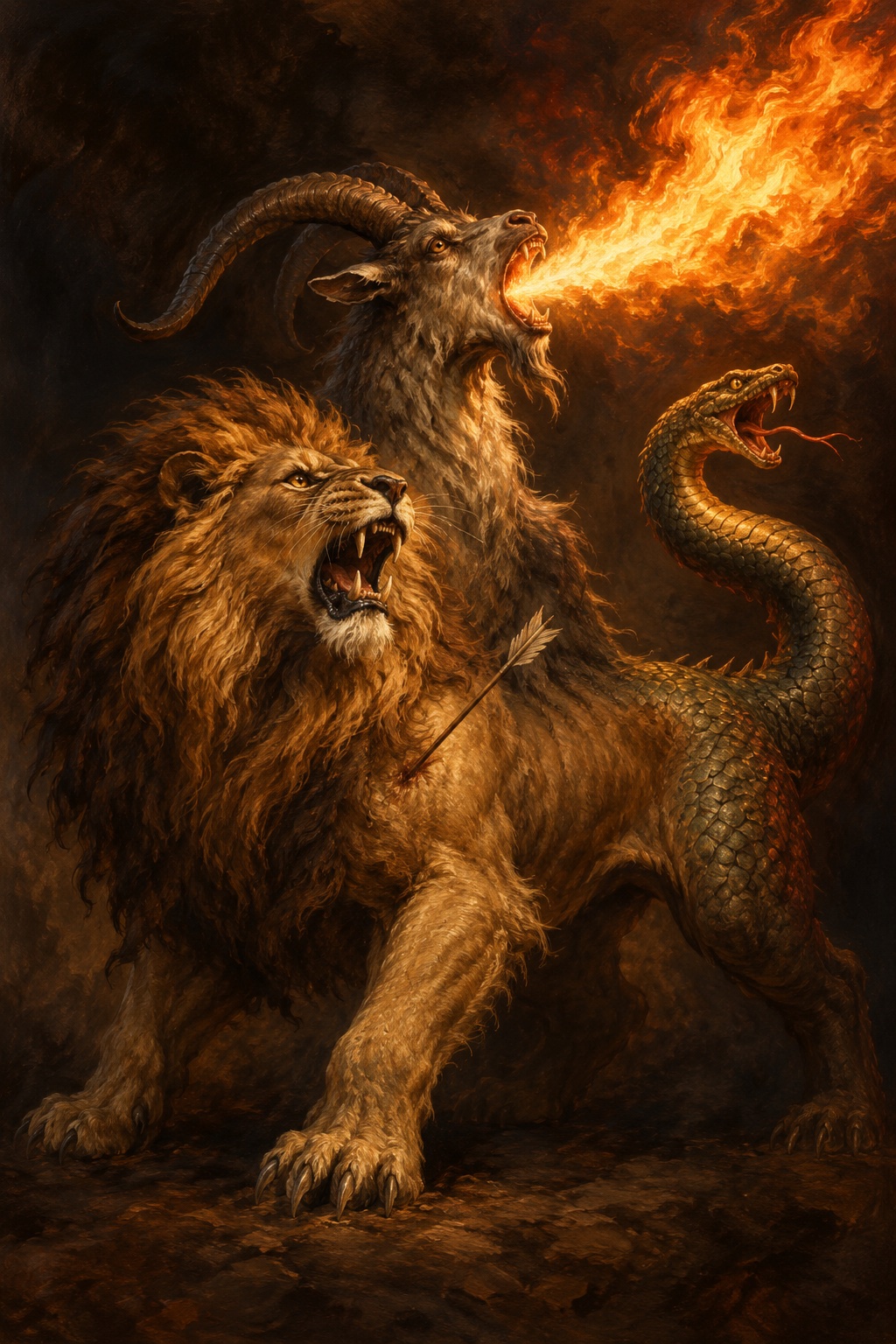
Of divine stock
Homer tells of the Chimera in a story told on a battlefield. In the sixth book of the Iliad, Glaucus and Diomedes meet in the space between the two armies, and Diomedes asks who Glaucus is. Glaucus answers with his lineage, and the lineage goes back to his grandfather Bellerophon. Anteia, the wife of Proetus, accused Bellerophon falsely, and Proetus would not kill him himself. He sent him to Lycia, to his wife’s father, with baneful tokens in a folded tablet. The king of Lycia entertained the guest for nine days. On the tenth day he asked to see the token, and when he had received it he gave Bellerophon his first task.
πρῶτον μέν ῥα Χίμαιραν ἀμαιμακέτην ἐκέλευσε πεφνέμεν· ἣ δ’ ἄρ’ ἔην θεῖον γένος οὐδ’ ἀνθρώπων, πρόσθε λέων, ὄπιθεν δὲ δράκων, μέσση δὲ χίμαιρα, δεινὸν ἀποπνείουσα πυρὸς μένος αἰθομένοιο, καὶ τὴν μὲν κατέπεφνε θεῶν τεράεσσι πιθήσας
“first he bade him slay the raging Chimaera. She was of divine stock, not of men, in the fore part a lion, in the hinder a serpent, and in the midst a goat, breathing forth in terrible wise the might of blazing fire. And Bellerophon slew her, trusting in the signs of the gods” — Homer, Iliad 6.179–183, tr. A. T. Murray
Five lines hold the task, the monster and her death. The first thing that Homer gives her is an epithet, ἀμαιμακέτην, which Murray renders raging. The second is her kind: θεῖον γένος οὐδ’ ἀνθρώπων, of divine stock, not of men. Homer does not name her parents. He says only that her stock is divine.
Then he gives her body in one line: πρόσθε λέων, ὄπιθεν δὲ δράκων, μέσση δὲ χίμαιρα. A lion is in front, a serpent behind, and a goat in the middle. Homer describes three parts of one body, the front, the back and the middle, and he does not count heads. The last word of the line is χίμαιρα, the goat in her middle, and it is the same word as her name, Χίμαιραν, two lines before. Murray translates the one as a goat and keeps the other as a name. The next line gives her fire: δεινὸν ἀποπνείουσα πυρὸς μένος αἰθομένοιο, breathing forth in terrible wise the might of blazing fire. Homer does not say which part of her breathes it.
Her death takes one clause. καὶ τὴν μὲν κατέπεφνε θεῶν τεράεσσι πιθήσας: And Bellerophon slew her, trusting in the signs of the gods. The Greek has only the verb, and the name Bellerophon comes from Murray. Homer gives no weapon and no horse. Next Bellerophon fought the Solymi, so the Chimera is the first of his tasks.
Homer names her once more, in the sixteenth book. Two spearmen among the companions of Sarpedon die in the fighting there, and Homer names their father, Amisodarus, as the man who reared the Chimera. He gives her the same epithet, ἀμαιμακέτην, and he calls her an evil for many men. So in these two passages the Iliad gives her a man who brought her up, but not a father or a mother.
Lion, serpent and goat
Apollodorus tells the same story in his own order. Proetus believes his wife’s accusation and gives Bellerophon a letter to take to Iobates, in which it was written that he was to kill Bellerophon. Iobates is Apollodorus’s name for the Lycian king, whom Homer does not name in Glaucus’s story.
Ἰοβάτης δὲ ἀναγνοὺς ἐπέταξεν αὐτῷ Χίμαιραν κτεῖναι, νομίζων αὐτὸν ὑπὸ τοῦ θηρίου διαφθαρήσεσθαι· ἦν γὰρ οὐ μόνον ἑνὶ ἀλλὰ πολλοῖς οὐκ εὐάλωτον, εἶχε δὲ προτομὴν μὲν λέοντος, οὐρὰν δὲ δράκοντος, τρίτην δὲ κεφαλὴν μέσην αἰγός, δι᾽ ἧς πῦρ ἀνίει. καὶ τὴν χώραν διέφθειρε, καὶ τὰ βοσκήματα ἐλυμαίνετο· μία γὰρ φύσις τριῶν θηρίων εἶχε δύναμιν
“Having read the letter, Iobates ordered him to kill the Chimera, believing that he would be destroyed by the beast, for it was more than a match for many, let alone one; it had the fore part of a lion, the tail of a dragon, and its third head, the middle one, was that of a goat, through which it belched fire. And it devastated the country and harried the cattle; for it was a single creature with the power of three beasts” — Apollodorus, Bibliotheke 2.3.1, tr. J. G. Frazer
Apollodorus states the king’s purpose openly: νομίζων αὐτὸν ὑπὸ τοῦ θηρίου διαφθαρήσεσθαι, believing that he would be destroyed by the beast. He gives the reason for that belief too. The beast was οὐ μόνον ἑνὶ ἀλλὰ πολλοῖς οὐκ εὐάλωτον, more than a match for many, let alone one.
His body follows Homer’s in its order, but he counts heads. προτομὴν μὲν λέοντος, the fore part of a lion. οὐρὰν δὲ δράκοντος, the tail of a dragon. τρίτην δὲ κεφαλὴν μέσην αἰγός, its third head, the middle one, was that of a goat. The serpent is the same word in both authors, δράκων in Homer and δράκοντος here, but Murray renders it serpent and Frazer dragon. Apollodorus’s goat is αἰγός, the ordinary word, not the word that is her name. He also says which head breathes the fire: δι᾽ ἧς πῦρ ἀνίει, through which it belched fire. In Apollodorus the fire comes out of the goat’s head.
He is also the only one of these authors who tells what she did to the land. καὶ τὴν χώραν διέφθειρε, καὶ τὰ βοσκήματα ἐλυμαίνετο: it devastated the country and harried the cattle. He explains her strength with one more clause, μία γὰρ φύσις τριῶν θηρίων εἶχε δύναμιν, a single creature with the power of three beasts. Then he adds what is said of her: that she was bred by Amisodarus, as Homer also affirms, and that she was begotten by Typhon on Echidna, as Hesiod relates.
Hesiod’s text describes her twice. In Evelyn-White’s translation of the Theogony she breathed raging fire, and she was fearful, great, swift-footed and strong. She had three heads, one of a grim-eyed lion, another of a goat, and another of a snake, a fierce dragon. Then come two lines that are word for word the same as Homer’s: πρόσθε λέων, ὄπιθεν δὲ δράκων, μέσση δὲ χίμαιρα, δεινὸν ἀποπνείουσα πυρὸς μένος αἰθομένοιο. The Greek text on el.wikisource prints these two lines in square brackets, the editor’s mark of doubt. So Hesiod’s text first gives her three heads and then gives her Homer’s three parts of one body. Apollodorus’s account stands between the two. It has a lion’s fore part and a serpent’s tail, as Homer does, but it calls the goat her third head.
Shot down from Pegasus
Homer tells nothing of how Bellerophon killed her. Apollodorus continues directly from the Chimera’s parentage to the kill, and he gives the method.
ἀναβιβάσας οὖν ἑαυτὸν ὁ Βελλεροφόντης ἐπὶ τὸν Πήγασον, ὃν εἶχεν ἵππον ἐκ Μεδούσης πτηνὸν γεγεννημένον καὶ Ποσειδῶνος, ἀρθεὶς εἰς ὕψος ἀπὸ τούτου κατετόξευσε τὴν Χίμαιραν
“So Bellerophon mounted his winged steed Pegasus, offspring of Medusa and Poseidon, and soaring on high shot down the Chimera from the height” — Apollodorus, Bibliotheke 2.3.2, tr. J. G. Frazer
The horse comes with its own descent. Pegasus is ἵππον ἐκ Μεδούσης πτηνὸν γεγεννημένον καὶ Ποσειδῶνος, a winged horse born of Medusa and Poseidon. Bellerophon mounts him and rises into the air, ἀρθεὶς εἰς ὕψος, soaring on high. The verb of the kill is κατετόξευσε. It means that he shot her down with arrows, and Frazer renders it shot down the Chimera from the height. The beast that was more than a match for many men is killed by one man who shoots from the air. Apollodorus does not say that she fought back.
Hesiod names the killers and nothing more: Her did Pegasus and noble Bellerophon slay. In his line the horse comes before the rider, and he names no weapon. Homer names no horse and no weapon. He gives only the signs of the gods, θεῶν τεράεσσι πιθήσας. So the arrows are in Apollodorus alone. After the Chimera, Iobates ordered him to fight the Solymi, and after that the Amazons.
Echidna’s daughter, or the Hydra’s
Hesiod puts the Chimera in the catalogue of monsters in the Theogony, directly after the Hydra. The line that brings her in is Ἥ δὲ Χίμαιραν ἔτικτε, She was the mother of Chimaera, and the pronoun does not say who she is. It may go back to Echidna, whose children the catalogue has been listing, or it may point to the Hydra, the last of those children to be named. This wiki’s Hydra entry names the Chimera neither as the Hydra’s sister nor as her daughter, because the line does not decide.
Apollodorus decides it. When he says that she was begotten by Typhon on Echidna, as Hesiod relates, he reads Hesiod’s pronoun as Echidna. This entry follows Apollodorus. On his reading the Chimera is a full sister of Orthus and Cerberus, the first two children that Hesiod gives to Echidna and Typhon. The Hydra is not in her list of siblings, because on the other reading of the line the Hydra is her mother.
The Homeric Hymn to Apollo names her once, together with Typhon. Apollo has shot Python with an arrow, and as she dies he boasts over her that neither Τυφωεὺς, Typhoeus, nor Χίμαιρα δυσώνυμος, ill-famed Chimera, will keep death from her. Typhoeus is the hymn’s spelling of Typhon. In the hymn the two monsters are named side by side, and neither of them can save her.