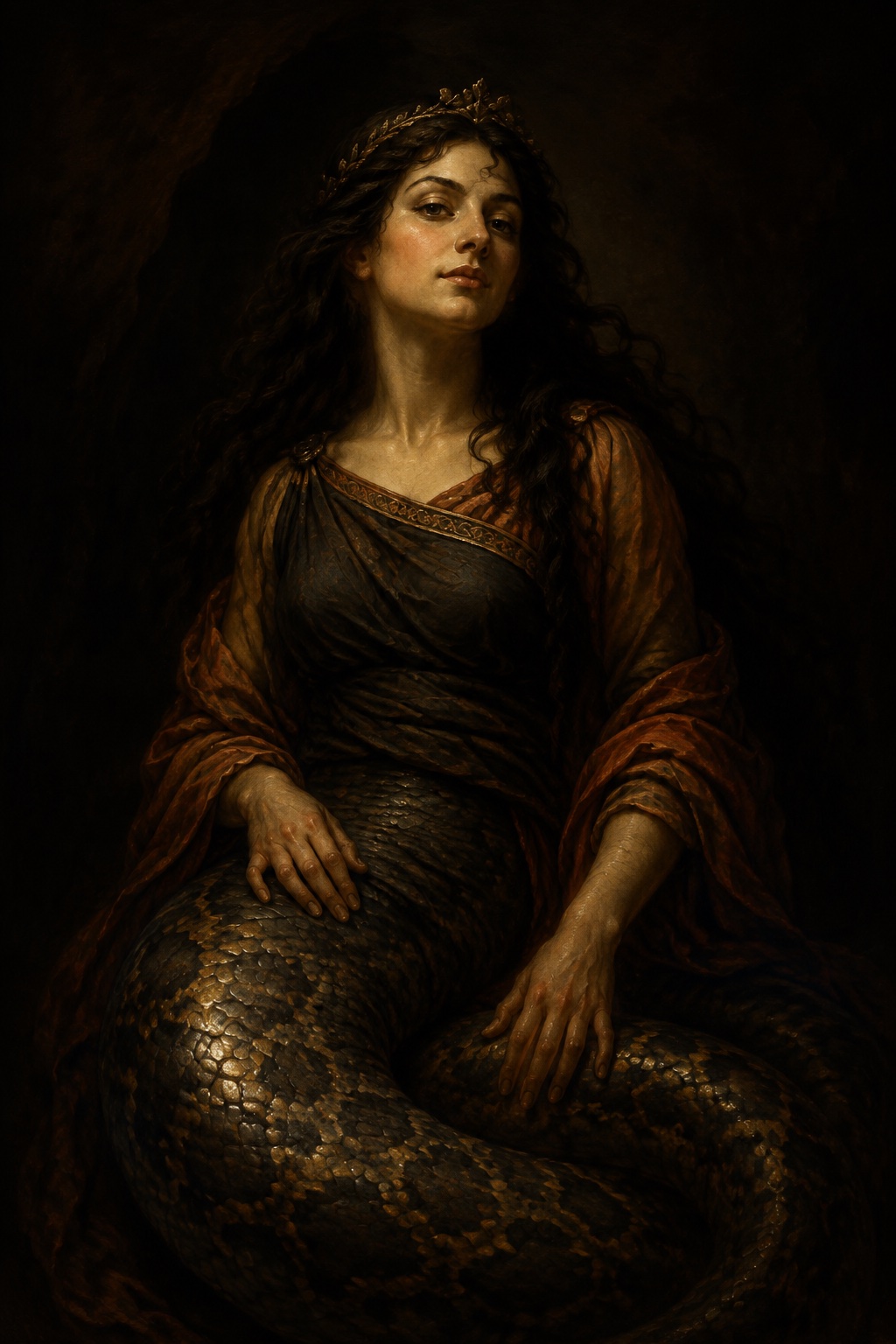
Half nymph, half serpent
Hesiod reaches Echidna in the middle of a digression on Heracles: the poem has just said that he drove Geryon’s cattle to Tiryns, killing the herdsman Eurytion and the hound Orthus along the way, and turns from there, almost as an aside, to name one more monster before returning to genealogy proper.
ἄλλο πέλωρον ἀμήχανον, οὐδὲν ἐοικὸς θνητοῖς ἀνθρώποις οὐδ᾽ ἀθανάτοισι θεοῖσιν, ἐν σπῆι ἔνι γλαφυρῷ θείην κρατερόφρον᾽ Ἔχιδναν, ἥμισυ μὲν νύμφην ἑλικώπιδα καλλιπάρῃον, ἥμισυ δ᾽ αὖτε πέλωρον ὄφιν δεινόν τε μέγαν τε αἰόλον ὠμηστὴν ζαθέης ὑπὸ κεύθεσι γαίης. ἔνθα δέ οἱ σπέος ἐστὶ κάτω κοίλῃ ὑπὸ πέτρῃ τηλοῦ ἀπ᾽ ἀθανάτων τε θεῶν θνητῶν τ᾽ ἀνθρώπων· ἔνθ᾽ ἄρα οἱ δάσσαντο θεοὶ κλυτὰ δώματα ναίειν. ἣ δ᾽ ἐρυτ᾽ εἰν Ἀρίμοισιν ὑπὸ χθόνα λυγρὴ Ἔχιδνα, ἀθάνατος νύμφη καὶ ἀγήραος ἤματα πάντα
“And in a hollow cave she bare another monster, irresistible, in no wise like either to mortal men or to the undying gods, even the goddess fierce Echidna who is half a nymph with glancing eyes and fair cheeks, and half again a huge snake, great and awful, with speckled skin, eating raw flesh beneath the secret parts of the holy earth. And there she has a cave deep down under a hollow rock far from the deathless gods and mortal men. There, then, did the gods appoint her a glorious house to dwell in: and she keeps guard in Arima beneath the earth, grim Echidna, a nymph who dies not nor grows old all her days.” — Hesiod, Theogony 294–304, tr. Evelyn-White
The description turns on a single hinge, ἥμισυ μέν… ἥμισυ δ᾽ αὖτε, “half… and half again.” Everything above the hinge is a Homeric beauty formula, ἑλικώπιδα καλλιπάρῃον, glancing-eyed and fair-cheeked, the same words a poet gives a mortal woman — and it stops exactly at the waist. Below it is πέλωρον ὄφιν, a monstrous serpent, αἰόλον, not merely spotted but shimmering, quick to catch the light and never one fixed color, and ὠμηστήν, eating raw flesh — the same epithet Hesiod gives her son Cerberus a few lines later, marking it a family trait rather than something singular to her. Her home is doubled the same way her body is: a cave under a hollow rock, set deliberately far from gods and mortals alike, in a place named Arima, and she herself is called ἀθάνατος… καὶ ἀγήραος ἤματα πάντα, immortal and ageless all her days — an eternity granted to a body that is only half divine to start with.
Whose daughter
Several lines earlier in the same poem, Hesiod had already named Ceto as the mother, by Phorcys, of daughters born before Echidna in the same family line. A long digression comes between that sentence and this one — Poseidon’s union with Medusa, the son born from her blood at her death, and that son’s own son in turn — before the poem circles back by way of Heracles’s raid on the cattle that grandson kept, and only then returns to say “she bare another monster, irresistible.” By that point the subject is a bare, unnamed pronoun. No name is restated.
The conventional reading — grammatical gender, plus the last established childbearing subject — makes Echidna the daughter of Phorcys and Ceto, and it is the reading this wiki’s own Cerberus and Typhon entries silently assume by never raising the question at all. But Hesiod himself does not say it at this line, and Evelyn-White’s translation carries the same unresolved “she” into English rather than supplying a name of its own.
Mother of monsters
Τυφάονά φασι μιγήμεναι ἐν φιλότητι δεινόν θ᾽ ὑβριστήν τ᾽ ἄνομόν θ᾽ ἑλικώπιδι κούρῃ· ἣ δ᾽ ὑποκυσαμένη τέκετο κρατερόφρονα τέκνα. Ὄρθον μὲν πρῶτον κύνα γείνατο Γηρυονῆι· δεύτερον αὖτις ἔτικτεν ἀμήχανον, οὔ τι φατειὸν
“Men say that Typhaon the terrible, outrageous and lawless, was joined in love to her, the maid with glancing eyes. So she conceived and brought forth fierce offspring; first she bare Orthus the hound of Geryones, and then again she bare a second, a monster not to be overcome and that may not be described” — Hesiod, Theogony 305–309, tr. Evelyn-White
Hesiod’s Greek calls her mate Τυφάονα, Typhaon, here — a third spelling for the same figure whose own entry quotes him as Τυφωέα, Typhoeus, a few hundred lines later. This entry follows the corpus’s own settled usage and calls him Typhon throughout, the way Typhon’s own entry does for its own passage. The first child, Orthus, has already appeared once in this same stretch of the poem — killed by Heracles at the raid on Geryon’s cattle, several lines before Hesiod gets around to narrating his birth here. The quotation breaks off one word short of naming the second child outright: “a monster not to be overcome and that may not be described” is Cerberus, named in the very next word of Hesiod’s Greek and quoted in full under this wiki’s own entry for him. Hesiod goes on, a few lines further, to name a third and fourth in the same breath — the Hydra and the Chimera. Between them, Orthus, the Hydra, and Cerberus would each end up measured against Heracles: two killed, one dragged living out of the underworld and returned. (The family grows one generation further still: Orthus, full-grown, later mates with his own mother to father the Sphinx and the Nemean lion — a different, later act than the one Typhon fathered.)
Caught asleep
Hesiod, having called her immortal and ageless all her days, never gives Echidna a death. Apollodorus does, centuries later, in a single sentence that also gives her a different parentage.
τὴν Ταρτάρου καὶ Γῆς Ἔχιδναν, ἣ τοὺς παριόντας συνήρπαζεν, ἐπιτηρήσας κοιμωμένην ἀπέκτεινεν
“Echidna, daughter of Tartarus and Earth, who used to carry off passers-by, was caught asleep and slain by Argus.” — Apollodorus, Bibliotheke 2.1.2, tr. J. G. Frazer
Apollodorus’s Argus is Argus Panoptes, the many-eyed watchman his own chapter introduces two sentences earlier as covered in eyes over the whole of his body — it is that watchfulness, not strength, that eventually catches Echidna off guard. Apollodorus’s Echidna also has a habit Hesiod’s passage never mentions: she preys on travelers, carrying off passers-by, rather than simply keeping to her cave far from gods and mortals. It takes Apollodorus one sentence to give her a parentage Hesiod won’t confirm, a habit Hesiod never describes, and an end Hesiod’s own “ageless all her days” had already ruled out.