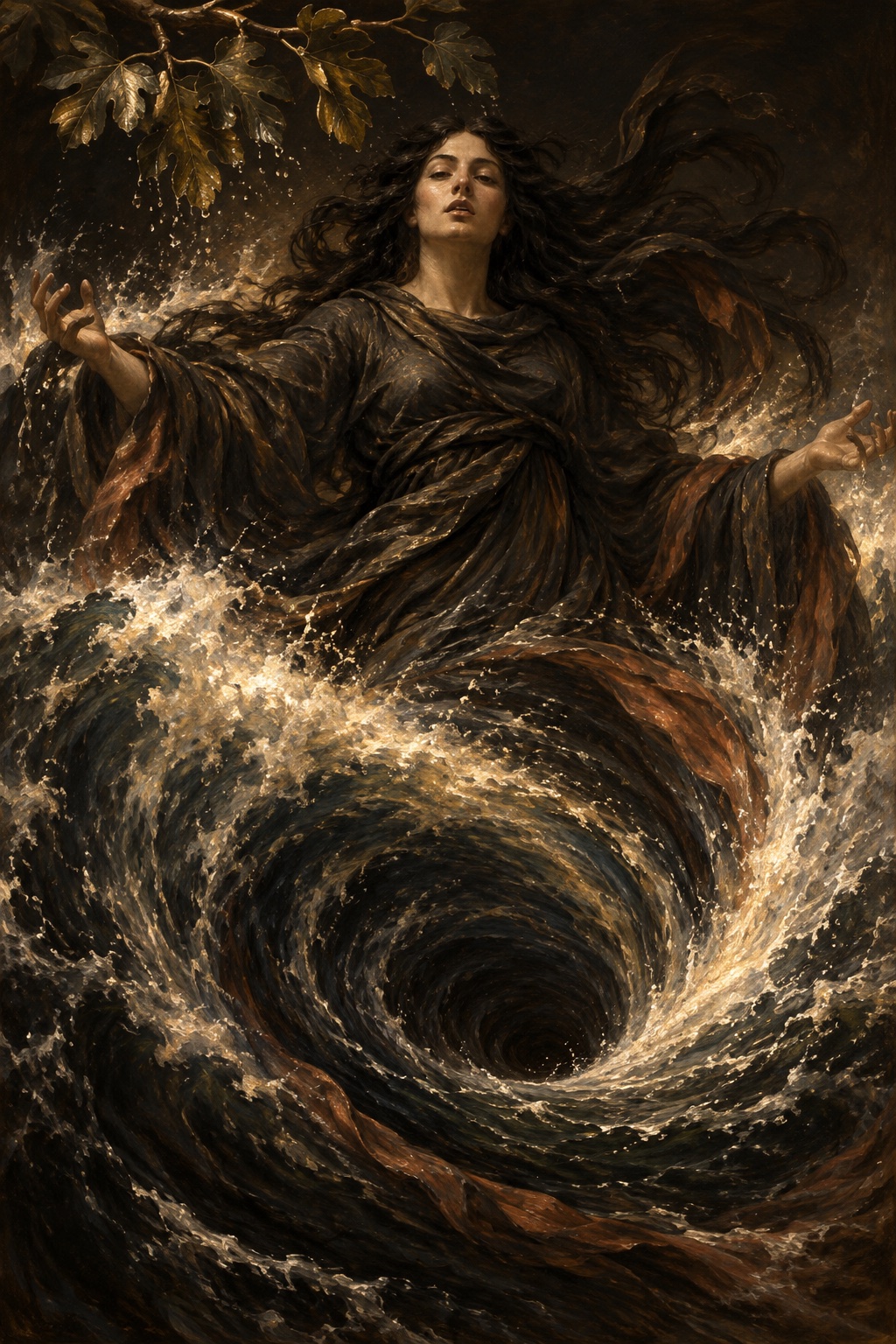
Under the lower cliff
Homer tells of Charybdis in the twelfth book of the Odyssey. The goddess Circe warns Odysseus about the sea road ahead of him. One way runs between two cliffs. Circe first describes the higher cliff and Scylla, who lives in a cave in it. Then she turns to the other cliff.
τὸν δ’ ἕτερον σκόπελον χθαμαλώτερον ὄψει, Ὀδυσσεῦ, πλησίον ἀλλήλων· καί κεν διοϊστεύσειας. τῷ δ’ ἐν ἐρινεός ἐστι μέγας, φύλλοισι τεθηλώς· τῷ δ’ ὑπὸ δῖα Χάρυβδις ἀναῤῥυβδεῖ μέλαν ὕδωρ. τρὶς μὲν γάρ τ’ ἀνίησιν ἐπ’ ἤματι, τρὶς δ’ ἀναρυβδεῖ, δεινόν· μὴ σύ γε κεῖθι τύχοις, ὅτε ῥυβδήσειεν· οὐ γάρ κεν ῥύσαιτό σ’ ὑπὲκ κακοῦ οὐδ’ ἐνοσίχθων
“the other cliff, thou wilt note, Odysseus, is lower—they are close to each other; thou couldst even shoot an arrow across—and on it is a great fig tree with rich foliage, but beneath this divine Charybdis sucks down the black water. Thrice a day she belches it forth, and thrice she sucks it down terribly. Mayest thou not be there when she sucks it down, for no one could save thee from ruin, no, not the Earth-shaker” — Homer, Odyssey 12.101–107, tr. Murray
Circe begins with the place, not with Charybdis. τὸν δ’ ἕτερον σκόπελον χθαμαλώτερον ὄψει: the other cliff, thou wilt note, … is lower. The two cliffs stand πλησίον ἀλλήλων, close to each other, so close that a man could shoot an arrow from one to the other. Then comes a tree. τῷ δ’ ἐν ἐρινεός ἐστι μέγας, φύλλοισι τεθηλώς: on the lower cliff there is a great fig tree with rich foliage. Homer’s word for the tree is ἐρινεός. Murray renders it fig tree, and Frazer, who translates the same word in Apollodorus, writes wild fig-tree.
Only after the cliff and the tree does Charybdis come. τῷ δ’ ὑπὸ δῖα Χάρυβδις ἀναῤῥυβδεῖ μέλαν ὕδωρ: beneath this divine Charybdis sucks down the black water. Circe gives her place by the tree: she is ὑπὸ, beneath it. Homer calls her δῖα, which Murray renders divine, and that one word is all the passage says about what she is. Book 12 names no parents for her. It also gives her no body. In these lines she has no face, no mouth and no limb. What Circe describes is the water, and what the water does.
The water keeps a rhythm. τρὶς μὲν γάρ τ’ ἀνίησιν ἐπ’ ἤματι, τρὶς δ’ ἀναρυβδεῖ: three times a day she sends the water up, and three times she sucks it down. The clause ends on one word, δεινόν, terribly. Then comes the warning. μὴ σύ γε κεῖθι τύχοις, ὅτε ῥυβδήσειεν: Mayest thou not be there when she sucks it down. The verb for the sucking down comes three times in three lines, as ἀναῤῥυβδεῖ, ἀναρυβδεῖ and ῥυβδήσειεν. The same letters, ρυβδ, stand in the verb and in her name, Χάρυβδις. The edition quoted here prints the verb in this form, and other editions spell it with οι in place of υ. This entry notes the echo in sound. It does not claim that the name comes from the verb.
The last clause says why the warning matters. οὐ γάρ κεν ῥύσαιτό σ’ ὑπὲκ κακοῦ οὐδ’ ἐνοσίχθων: no one could save thee from ruin, no, not the Earth-shaker. The Earth-shaker is Poseidon. Not even he could pull a man out of Charybdis. Circe then gives her advice (12.108–110). Odysseus must keep close to Scylla’s cliff and drive his ship past quickly, for it is better far to mourn six comrades in thy ship than all together. So the choice between the two cliffs is a choice between six men and the whole ship.
Like a cauldron on a great fire
Later in the book the ship comes to the strait, and Odysseus himself tells what he and his men saw there.
ἡμεῖς μὲν στεινωπὸν ἀνεπλέομεν γοόωντες· ἔνθεν γὰρ Σκύλλη, ἑτέρωθι δὲ δῖα Χάρυβδις δεινὸν ἀνεῤῥύβδησε θαλάσσης ἁλμυρὸν ὕδωρ. ἦ τοι ὅτ’ ἐξεμέσειε, λέβης ὣς ἐν πυρὶ πολλῷ πᾶσ’ ἀναμορμύρεσκε κυκωμένη· ὑψόσε δ’ ἄχνη ἄκροισι σκοπέλοισιν ἐπ’ ἀμφοτέροισιν ἔπιπτεν. ἀλλ’ ὅτ’ ἀναβρόξειε θαλάσσης ἁλμυρὸν ὕδωρ, πᾶσ’ ἔντοσθε φάνεσκε κυκωμένη, ἀμφὶ δὲ πέτρη δεινὸν βεβρύχει, ὑπένερθε δὲ γαῖα φάνεσκε ψάμμῳ κυανέη· τοὺς δὲ χλωρὸν δέος ᾕρει
“We then sailed on up the narrow strait with wailing. For on one side lay Scylla and on the other divine Charybdis terribly sucked down the salt water of the sea. Verily whenever she belched it forth, like a cauldron on a great fire she would seethe and bubble in utter turmoil, and high over head the spray would fall on the tops of both the cliffs. But as often as she sucked down the salt water of the sea, within she could all be seen in utter turmoil, and round about the rock roared terribly, while beneath the earth appeared black with sand; and pale fear seized my men” — Homer, Odyssey 12.234–243, tr. Murray
ἡμεῖς μὲν στεινωπὸν ἀνεπλέομεν γοόωντες: We then sailed on up the narrow strait with wailing. ἔνθεν γὰρ Σκύλλη, ἑτέρωθι δὲ δῖα Χάρυβδις: Scylla is on one side, and on the other is Charybdis. Odysseus names her with the same two words, δῖα Χάρυβδις, that Circe used. Then Odysseus shows both halves of the rhythm that Circe described, one after the other.
First he tells what happens when she sends the water up. ἦ τοι ὅτ’ ἐξεμέσειε: whenever she belched it forth. Murray renders the verb belched here, and he renders the same verb vomit forth when it comes back at the end of the book. Then comes a simile. λέβης ὣς ἐν πυρὶ πολλῷ: like a cauldron on a great fire. πᾶσ’ ἀναμορμύρεσκε κυκωμένη: she would seethe and bubble in utter turmoil. The spray, ἄχνη, goes so high that it falls ἄκροισι σκοπέλοισιν ἐπ’ ἀμφοτέροισιν, on the tops of both the cliffs. So the water of Charybdis reaches the top of Scylla’s cliff too.
Then he tells what happens when she sucks the water down. ἀλλ’ ὅτ’ ἀναβρόξειε θαλάσσης ἁλμυρὸν ὕδωρ: But as often as she sucked down the salt water of the sea. πᾶσ’ ἔντοσθε φάνεσκε κυκωμένη: within she could all be seen in utter turmoil. ἀμφὶ δὲ πέτρη δεινὸν βεβρύχει: round about the rock roared terribly. In Homer the roar belongs to the rock around her. ὑπένερθε δὲ γαῖα φάνεσκε ψάμμῳ κυανέη: beneath the earth appeared black with sand. When the water goes down, the floor of the sea shows. Circe spoke of black water, μέλαν ὕδωρ, and here the ground under that water is black too.
τοὺς δὲ χλωρὸν δέος ᾕρει: pale fear seized my men. The next lines tell what the fear did. So we looked toward her and feared destruction, Odysseus says, and while the men looked at Charybdis, Scylla seized six of them from the ship (12.244–246). Circe’s choice came true as she had set it. The ship passed Charybdis, and Scylla took six men.
The fig tree
Charybdis comes back at the end of the book, and this time Odysseus meets her alone. At sea, the West Wind snaps the forestays of his ship, and Zeus hurls his bolt upon it. His comrades fall into the sea. Odysseus stays on board until the waves tear the sides from the keel and snap off the mast. With the back-stay of ox-hide he lashes the keel and the mast together, and he sits on them. Then the South Wind comes and carries him back the way he came, to Charybdis.
παννύχιος φερόμην, ἅμα δ’ ἠελίῳ ἀνιόντι ἦλθον ἐπὶ Σκύλλης σκόπελον δεινήν τε Χάρυβδιν. ἡ μὲν ἀνεῤῥύβδησε θαλάσσης ἁλμυρὸν ὕδωρ· αὐτὰρ ἐγὼ ποτὶ μακρὸν ἐρινεὸν ὑψόσ’ ἀερθείς, τῷ προσφὺς ἐχόμην ὡς νυκτερίς· οὐδέ πῃ εἶχον οὔτε στηρίξαι ποσὶν ἔμπεδον οὔτ’ ἐπιβῆναι· ῥίζαι γὰρ ἑκὰς εἶχον, ἀπήωροι δ’ ἔσαν ὄζοι μακροί τε μεγάλοι τε, κατεσκίαον δὲ Χάρυβδιν. νωλεμέως δ’ ἐχόμην, ὄφρ’ ἐξεμέσειεν ὀπίσσω ἱστὸν καὶ τρόπιν αὖτις· ἐελδομένῳ δέ μοι ἦλθον, ὄψ’· ἦμος δ’ ἐπὶ δόρπον ἀνὴρ ἀγορῆθεν ἀνέστη κρίνων νείκεα πολλὰ δικαζομένων αἰζηῶν, τῆμος δὴ τά γε δοῦρα Χαρύβδιος ἐξεφαάνθη. ἧκα δ’ ἐγὼ καθύπερθε πόδας καὶ χεῖρε φέρεσθαι, μέσσῳ δ’ ἐνδούπησα παρὲξ περιμήκεα δοῦρα, ἑζόμενος δ’ ἐπὶ τοῖσι διήρεσα χερσὶν ἐμῇσι
“All night long was I borne, and at the rising of the sun I came to the cliff of Scylla and to dread Charybdis. She verily sucked down the salt water of the sea, but I, springing up to the tall fig-tree, laid hold of it, and clung to it like a bat. Yet I could in no wise plant my feet firmly or climb upon the tree, for its roots spread far below and its branches hung out of reach above, long and great, and overshadowed Charybdis. There I clung steadfastly until she should vomit forth mast and keel again, and to my joy they came at length. At the hour when a man rises from the assembly for his supper, one that decides the many quarrels of young men that seek judgment, even at that hour those spars appeared from out Charybdis. And I let go hands and feet from above and plunged down into the waters out beyond the long spars, and sitting on these I rowed onward with my hands” — Homer, Odyssey 12.429–444, tr. Murray
παννύχιος φερόμην: All night long was I borne. At sunrise he comes to Scylla’s cliff and to Charybdis, and this time Homer calls her δεινήν, dread. ἡ μὲν ἀνεῤῥύβδησε θαλάσσης ἁλμυρὸν ὕδωρ: she is sucking down the sea, and the mast and keel go down with it. Odysseus does not. αὐτὰρ ἐγὼ ποτὶ μακρὸν ἐρινεὸν ὑψόσ’ ἀερθείς: he springs up to the tall fig tree. It is the tree that Circe named as the mark of the place, the fig tree on the lower cliff above Charybdis.
τῷ προσφὺς ἐχόμην ὡς νυκτερίς: he clung to it like a bat. He cannot stand on the tree and he cannot climb it. ῥίζαι γὰρ ἑκὰς εἶχον: the roots are far below him. ἀπήωροι δ’ ἔσαν ὄζοι: the branches hang out of reach above him, and κατεσκίαον δὲ Χάρυβδιν, they overshadowed Charybdis. So he hangs from the tree over Charybdis, with nothing under his feet.
Then he waits. νωλεμέως δ’ ἐχόμην: There I clung steadfastly, ὄφρ’ ἐξεμέσειεν ὀπίσσω ἱστὸν καὶ τρόπιν αὖτις, until she should vomit forth mast and keel again. The verb ἐξεμέσειεν is the verb that Odysseus used in the strait when she belched the water up. Charybdis does not keep what she takes. What she sucks down, she sends back up.
Homer marks the hour with a picture from life on land. ἦμος δ’ ἐπὶ δόρπον ἀνὴρ ἀγορῆθεν ἀνέστη: At the hour when a man rises from the assembly for his supper, a man κρίνων νείκεα πολλὰ, that decides the many quarrels of young men who seek judgment. τῆμος δὴ τά γε δοῦρα Χαρύβδιος ἐξεφαάνθη: even at that hour those spars appeared from out Charybdis. Odysseus came to the tree at sunrise, and the timbers came back at the hour of supper. He hung over her from the morning to the evening.
Then he lets go. ἧκα δ’ ἐγὼ καθύπερθε πόδας καὶ χεῖρε φέρεσθαι: he let go with his hands and feet and fell into the water beside the long timbers, περιμήκεα δοῦρα. ἑζόμενος δ’ ἐπὶ τοῖσι διήρεσα χερσὶν ἐμῇσι: sitting on these I rowed onward with my hands. Circe said that no one could save a man from Charybdis, not even Poseidon. No god saves Odysseus here. The fig tree holds him above her until she gives back his timbers.
After this, Odysseus says, the father of gods and men did not let Scylla catch sight of him again (12.445–446). For nine days he was borne on the sea, and on the tenth night the gods brought him to Ogygia, where Calypso lives (12.447–449).
In the Argonautica
Charybdis also stands in the way of the Argonauts, in the fourth book of the Argonautica of Apollonius of Rhodes. Before the ship comes to her, Hera asks Thetis to bring the heroes through. Hera says that the rocks and the waves are all she fears, and that Thetis can foil them with the aid of her sisters. Then Hera names Charybdis.
μηδὲ σύγ’ ἠὲ Χάρυβδιν ἀμηχανέοντας ἐάσῃς ἐσβαλέειν, μὴ πάντας ἀναβρόξασα φέρῃσιν
“And let them not fall in their helplessness into Charybdis lest she swallow them at one gulp” — Apollonius Rhodius, Argonautica 4.825–826, tr. R. C. Seaton
Hera’s fear is the one that stood behind Circe’s advice in the Odyssey: Charybdis would take them all at once. μὴ πάντας: the word πάντας means all of them, and Circe’s advice was that it is better to lose six men than all of them together. Hera’s verb for the swallowing is ἀναβρόξασα, and it is the verb that Odysseus used in the strait, ἀναβρόξειε, when Charybdis sucked down the salt water. Seaton renders it swallow them at one gulp. In the same sentence Hera goes on to Scylla and her lair.
When the Argonauts come to the meeting-place of the seas, Apollonius sets the two dangers side by side, as Homer did.
τῇ μὲν γὰρ Σκύλλης λισσὴ προυφαίνετο πέτρη· τῇ δ’ ἄμοτον βοάασκεν ἀναβλύζουσα Χάρυβδις
“For on one side appeared the smooth rock of Scylla; on the other Charybdis ceaselessly spouted and roared” — Apollonius Rhodius, Argonautica 4.922–923, tr. R. C. Seaton
The order is Homer’s order. Scylla is on one side, τῇ μὲν, and Charybdis is on the other, τῇ δ’. But Apollonius changes the sound. In Homer the rock around her roared, πέτρη δεινὸν βεβρύχει. In the Argonautica Charybdis herself roars: βοάασκεν, roared. Homer also gave her a measure, three times a day. Apollonius gives her none. ἄμοτον: she roars ceaselessly. The word ἀναβλύζουσα, spouted, shows only the water that goes up. Apollonius adds a third danger in the same place, the Wandering rocks, which boom beneath the surge.
Across the three authors, Charybdis never gets a body. Between them, Homer, Apollonius and Apollodorus give her a place under a fig tree, a rhythm of water that goes down and comes up, and a roar. They do not give her a face, a mouth or a family. In all three, she is known only by what the sea does in that one place.