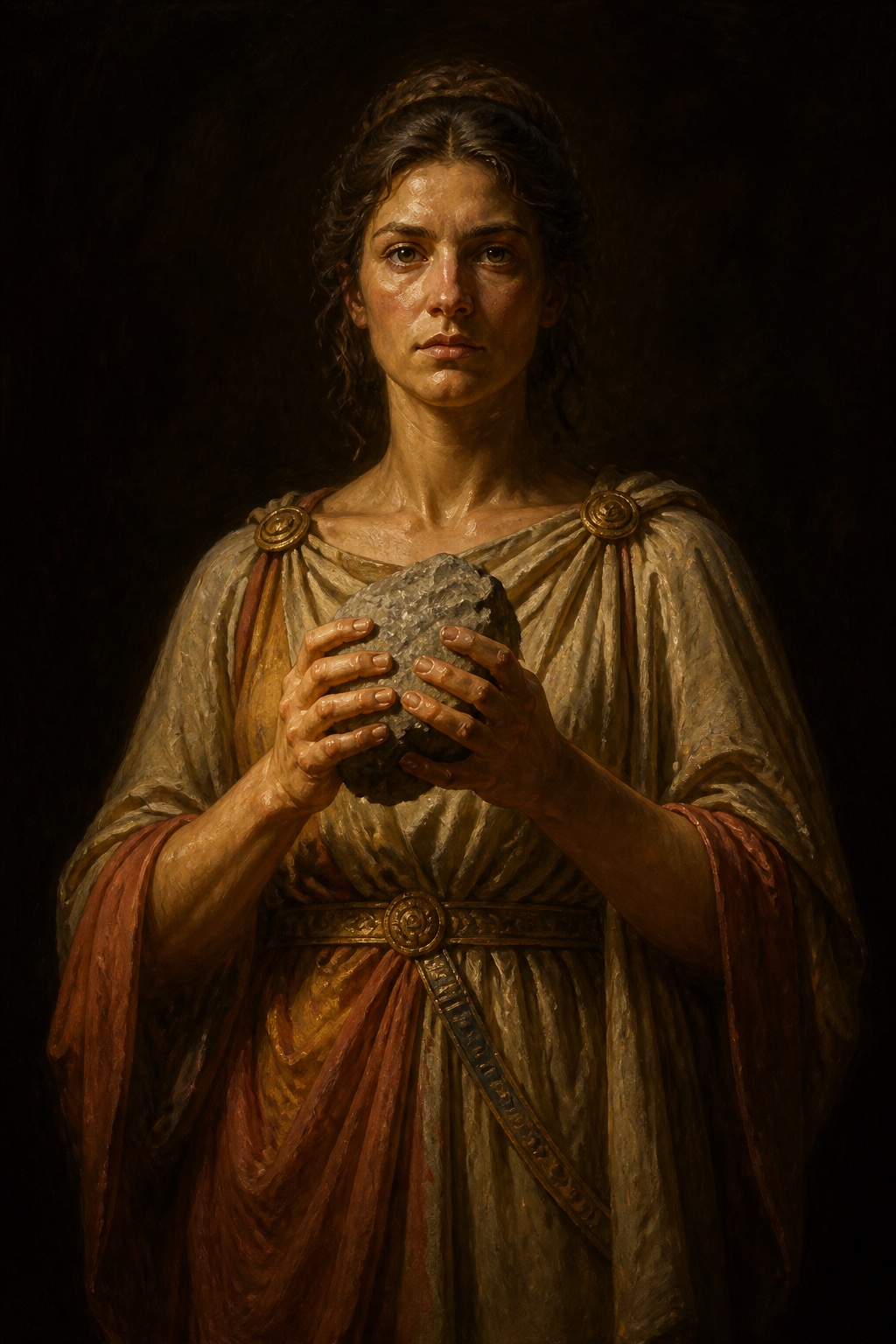
The first woman’s daughter
Apollodorus gives Pyrrha her parents in the same breath as her marriage, and the parentage is doing real work in the sentence. Her mother is Pandora, and he stops to say what Pandora was.
Προμηθέως δὲ παῖς Δευκαλίων ἐγένετο. οὗτος βασιλεύων τῶν περὶ τὴν Φθίαν τόπων γαμεῖ Πύρραν τὴν Ἐπιμηθέως καὶ Πανδώρας, ἣν ἔπλασαν θεοὶ πρώτην γυναῖκα
“And Prometheus had a son Deucalion. He reigning in the regions about Phthia, married Pyrrha, the daughter of Epimetheus and Pandora, the first woman fashioned by the gods” — Apollodorus, Bibliotheke 1.7.2, tr. J. G. Frazer
πρώτην γυναῖκα, the first woman, moulded by gods and married to Epimetheus — and Pyrrha is what that marriage produced. She is therefore the second generation of humanity by the shortest possible route: one remove from a woman who was manufactured. Hesiod’s Works and Days, which this corpus quotes on Pandora’s own page, never follows the story this far. Apollodorus does, and the line he draws runs from the jar of ills straight to the woman who repopulates the world.
Into the chest
When Zeus decides to wipe out the Bronze Age, Prometheus warns his son, and his son builds a box. Pyrrha’s part in the sentence is a single prepositional phrase, and it is the phrase the rest of her story depends on.
ἐπεὶ δὲ ἀφανίσαι Ζεὺς τὸ χαλκοῦν ἠθέλησε γένος, ὑποθεμένου Προμηθέως Δευκαλίων τεκτηνάμενος λάρνακα, καὶ τὰ ἐπιτήδεια ἐνθέμενος, εἰς ταύτην μετὰ Πύρρας εἰσέβη.
“And when Zeus would destroy the men of the Bronze Age, Deucalion by the advice of Prometheus constructed a chest, and having stored it with provisions he embarked in it with Pyrrha.” — Apollodorus, Bibliotheke 1.7.2, tr. J. G. Frazer
μετὰ Πύρρας, with Pyrrha. Everything Apollodorus grants her in the flood itself is that: she is in the chest, and the chest is the only thing that survives. It drifts nine days and as many nights and grounds on Parnassus. The narrative attention through all of it stays on Deucalion, who built it, who lands, who sacrifices — and the story then arrives at a moment that cannot be done by one person.
Her stones became the women
Zeus offers Deucalion whatever he wants; Deucalion asks for people. The instruction that comes back is to throw stones over the head, and the result is sorted by whose hand threw which stone.
Ζεὺς δὲ πέμψας Ἑρμῆν πρὸς αὐτὸν ἐπέτρεψεν αἱρεῖσθαι ὅ τι βούλεται· ὁ δὲ αἱρεῖται ἀνθρώπους αὐτῷ γενέσθαι. καὶ Διὸς εἰπόντος ὑπὲρ κεφαλῆς ἔβαλλεν αἴρων λίθους, καὶ οὓς μὲν ἔβαλε Δευκαλίων, ἄνδρες ἐγένοντο, οὓς δὲ Πύρρα, γυναῖκες
“And Zeus sent Hermes to him and allowed him to choose what he would, and he chose to get men. And at the bidding of Zeus he took up stones and threw them over his head, and the stones which Deucalion threw became men, and the stones which Pyrrha threw became women” — Apollodorus, Bibliotheke 1.7.2, tr. J. G. Frazer
The final clause is the only one in the passage where Pyrrha is the subject of a verb, and it is the verb the whole episode exists for: οὓς δὲ Πύρρα, γυναῖκες — the ones Pyrrha threw, women. Half of the new race is hers, by an act she performs herself and, like her husband, without watching it work.
There is a symmetry in it that Apollodorus leaves entirely unremarked. The first woman was made once, deliberately, by gods, out of earth and water, and delivered as a punishment. The women who come after are made by her daughter, in quantity, out of stones thrown blindly over one shoulder, and they are the answer to a request for the human race to continue.