Made by five gods
Hesiod tells her manufacture as a list of orders, not a birth. Zeus has just finished laughing at the trap he has set for Prometheus — the fire withheld, the price still unnamed — when he turns to his craftsmen and hands out instructions, one god at a time.
ἐγέλασσε πατὴρ ἀνδρῶν τε θεῶν τε. Ἥφαιστον δ᾽ ἐκέλευσε περικλυτὸν ὅττι τάχιστα γαῖαν ὕδει φύρειν, ἐν δ᾽ ἀνθρώπου θέμεν αὐδὴν καὶ σθένος, ἀθανάτῃς δὲ θεῇς εἰς ὦπα ἐίσκειν, παρθενικῆς καλὸν εἶδος ἐπήρατον· αὐτὰρ Ἀθήνην ἔργα διδασκῆσαι, πολυδαίδαλον ἱστὸν ὑφαίνειν· καὶ χάριν ἀμφιχέαι κεφαλῇ χρυσέην Ἀφροδίτην καὶ πόθον ἀργαλέον καὶ γυιοβόρους μελεδώνας· ἐν δὲ θέμεν κύνεόν τε νόον καὶ ἐπίκλοπον ἦθος Ἑρμείην ἤνωγε, διάκτορον Ἀργειφόντην. ὣς ἔφαθ᾽· οἱ δ᾽ ἐπίθοντο Διὶ Κρονίωνι ἄνακτι. αὐτίκα δ᾽ ἐκ γαίης πλάσσε κλυτὸς Ἀμφιγυήεις παρθένῳ αἰδοίῃ ἴκελον Κρονίδεω διὰ βουλάς· ζῶσε δὲ καὶ κόσμησε θεὰ γλαυκῶπις Ἀθήνη· ἀμφὶ δέ οἱ Χάριτές τε θεαὶ καὶ πότνια Πειθὼ ὅρμους χρυσείους ἔθεσαν χροΐ, ἀμφὶ δὲ τήν γε Ὧραι καλλίκομοι στέφον ἄνθεσιν εἰαρινοῖσιν· πάντα δέ οἱ χροῒ κόσμον ἐφήρμοσε Παλλὰς Ἀθήνη. ἐν δ᾽ ἄρα οἱ στήθεσσι διάκτορος Ἀργειφόντης ψεύδεά θ᾽ αἱμυλίους τε λόγους καὶ ἐπίκλοπον ἦθος τεῦξε Διὸς βουλῇσι βαρυκτύπου· ἐν δ᾽ ἄρα φωνὴν θῆκε θεῶν κῆρυξ, ὀνόμηνε δὲ τήνδε γυναῖκα Πανδώρην, ὅτι πάντες Ὀλύμπια δώματ᾽ ἔχοντες δῶρον ἐδώρησαν, πῆμ᾽ ἀνδράσιν ἀλφηστῇσιν
“laughed aloud. And he bade famous Hephaestus make haste and mix earth with water and to put in it the voice and strength of human kind, and fashion a sweet, lovely maiden-shape, like to the immortal goddesses in face; and Athene to teach her needlework and the weaving of the varied web; and golden Aphrodite to shed grace upon her head and cruel longing and cares that weary the limbs. And he charged Hermes the guide, the Slayer of Argus, to put in her a shameless mind and a deceitful nature. So he ordered. And they obeyed the lord Zeus the son of Cronos. Forthwith the famous Lame God moulded clay in the likeness of a modest maid, as the son of Cronos purposed. And the goddess bright-eyed Athene girded and clothed her, and the divine Graces and queenly Persuasion put necklaces of gold upon her, and the rich-haired Hours crowned her head with spring flowers. And Pallas Athene bedecked her form with all manners of finery. Also the Guide, the Slayer of Argus, contrived within her lies and crafty words and a deceitful nature at the will of loud thundering Zeus, and the Herald of the gods put speech in her. And he called this woman Pandora (All Endowed), because all they who dwelt on Olympus gave each a gift, a plague to men who eat bread.” — Hesiod, Works and Days 60–82, tr. Evelyn-White
No single god makes her. Hephaestus mixes earth with water and gives the shape a voice and human strength; Athena teaches her hands their skill and, with the Graces and queenly Persuasion, dresses her in gold; Aphrodite pours grace and aching longing over her head; the Hours crown her with spring flowers. Last, and at Zeus’s own order, Hermes puts a shameless mind and a deceitful nature inside her. Trickery is not something that later happens to Pandora, the way it happens to the men who receive her — it is built into her on the workbench, one gift among many, indistinguishable in the list from the necklaces and the flowers. Zeus names the finished woman himself, and the name states the whole design out loud: Pandora, all-gift, because everyone on Olympus gave her something. Hesiod does not let the etymology stay pretty. In the same breath he calls the gift she is “a plague to men who eat bread.”
The first woman, not a goddess
Twice, in two different authors, the sources go out of their way to say what Pandora is not. Zeus orders Hephaestus to make her “like to the immortal goddesses in face” — a comparison, not a classification. She resembles them in the one respect of her looks; the line would be an odd thing to write about someone who already was one. Centuries later, tracing the marriage of Deucalion to Epimetheus’s and Pandora’s daughter Pyrrha, Apollodorus calls Pandora outright “the first woman” — πρώτην γυναῖκα, not a goddess — “whom the gods fashioned” (Πανδώρας, ἣν ἔπλασαν θεοὶ πρώτην γυναῖκα, Bibliotheke 1.7.2). Made by gods, dressed by gods, and endowed by gods, she is still counted among mortals: the first of them, and the ancestor, through a mortal daughter, of the human line that survives the flood still to come.
The jar
She arrives at Epimetheus’s house already finished — clothed, named, and carrying whatever Hermes put in her — and Hesiod moves straight from her manufacture to the one thing every later age remembers her for doing.
πρὶν μὲν γὰρ ζώεσκον ἐπὶ χθονὶ φῦλ᾽ ἀνθρώπων νόσφιν ἄτερ τε κακῶν καὶ ἄτερ χαλεποῖο πόνοιο νούσων τ᾽ ἀργαλέων, αἵ τ᾽ ἀνδράσι Κῆρας ἔδωκαν. αἶψα γὰρ ἐν κακότητι βροτοὶ καταγηράσκουσιν. ἀλλὰ γυνὴ χείρεσσι πίθου μέγα πῶμ᾽ ἀφελοῦσα ἐσκέδασ᾽· ἀνθρώποισι δ᾽ ἐμήσατο κήδεα λυγρά. μούνη δ᾽ αὐτόθι Ἐλπὶς ἐν ἀῤῥήκτοισι δόμοισιν ἔνδον ἔμιμνε πίθου ὑπὸ χείλεσιν, οὐδὲ θύραζε ἐξέπτη· πρόσθεν γὰρ ἐπέλλαβε πῶμα πίθοιο αἰγιόχου βουλῇσι Διὸς νεφεληγερέταο. ἄλλα δὲ μυρία λυγρὰ κατ᾽ ἀνθρώπους ἀλάληται· πλείη μὲν γὰρ γαῖα κακῶν, πλείη δὲ θάλασσα· νοῦσοι δ᾽ ἀνθρώποισιν ἐφ᾽ ἡμέρῃ, αἱ δ᾽ ἐπὶ νυκτὶ αὐτόματοι φοιτῶσι κακὰ θνητοῖσι φέρουσαι σιγῇ, ἐπεὶ φωνὴν ἐξείλετο μητίετα Ζεύς. οὕτως οὔ τί πη ἔστι Διὸς νόον ἐξαλέασθαι
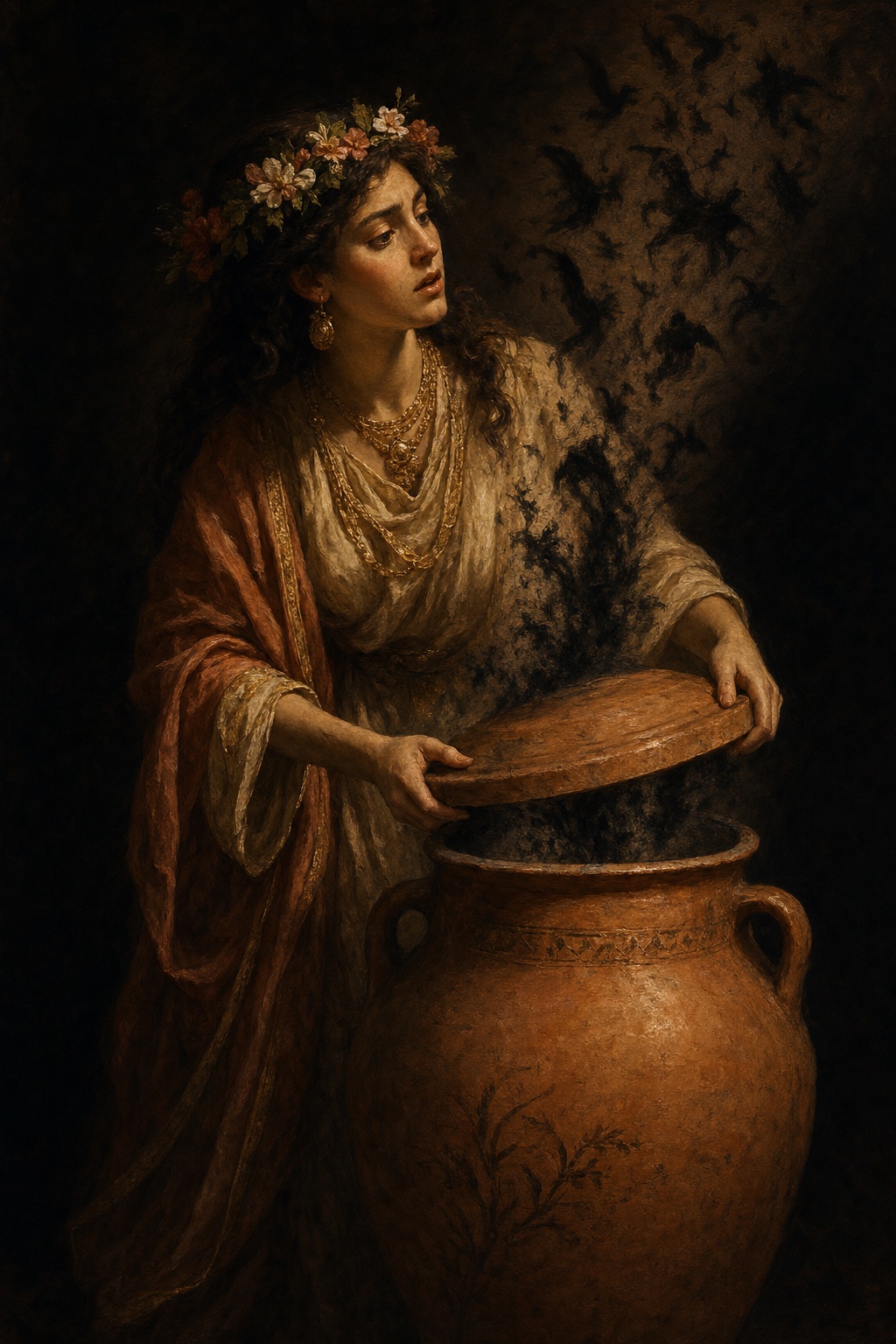
“For ere this the tribes of men lived on earth remote and free from ills and hard toil and heavy sickness which bring the Fates upon men; for in misery men grow old quickly. But the woman took off the great lid of the jar with her hands and scattered all these and her thought caused sorrow and mischief to men. Only Hope remained there in an unbreakable home within under the rim of the great jar, and did not fly out at the door; for ere that, the lid of the jar stopped her, by the will of Aegis-holding Zeus who gathers the clouds. But the rest, countless plagues, wander amongst men; for earth is full of evils and the sea is full. Of themselves diseases come upon men continually by day and by night, bringing mischief to mortals silently; for wise Zeus took away speech from them. So is there no way to escape the will of Zeus.” — Hesiod, Works and Days 90–105, tr. Evelyn-White
Before her, Hesiod says, the tribes of men lived on earth remote and free from ills, hard toil, and heavy sickness — the world she is delivered into is not yet the world that follows her. What the jar is, or how it came to be standing in the house with her, Hesiod never explains, any more than he explains why it was there for her hands to open. He states only that she lifts the great lid off with her own hands and scatters everything inside, and that her own thought is what causes the sorrow that follows. The scattering is total: countless plagues wander earth and sea, and disease comes by day and by night in silence, because Zeus has already taken away mortals’ voice to warn one another. Ninety lines that read as the story of one woman’s hands end on a different subject entirely — there is no way to escape the will of Zeus.
What Hope did not do
Hope is the one thing in the jar Hesiod lingers on. It does not get out with the rest: the lid catches it under the jar’s rim before it can fly through the door, by the will of Zeus. Whether that is mercy or one more thing withheld, Hesiod does not say — he states the fact and moves on, the same reticence with which he never says whether the jar was Pandora’s own or already standing in Epimetheus’s house before she arrived.
What she leaves behind, past the ills and the one thing that stayed, is a daughter. Pandora and Epimetheus’s child Pyrrha survives the flood that ends the age after this one and marries Prometheus’s son Deucalion — the two households Hesiod spends hundreds of lines setting against each other, joined a generation later by the granddaughter of the god who was tricked and the son of the god who did the tricking. Pandora herself has left the poem by then. The house she was delivered into has not: it is the one still standing when the world needs repeopling.