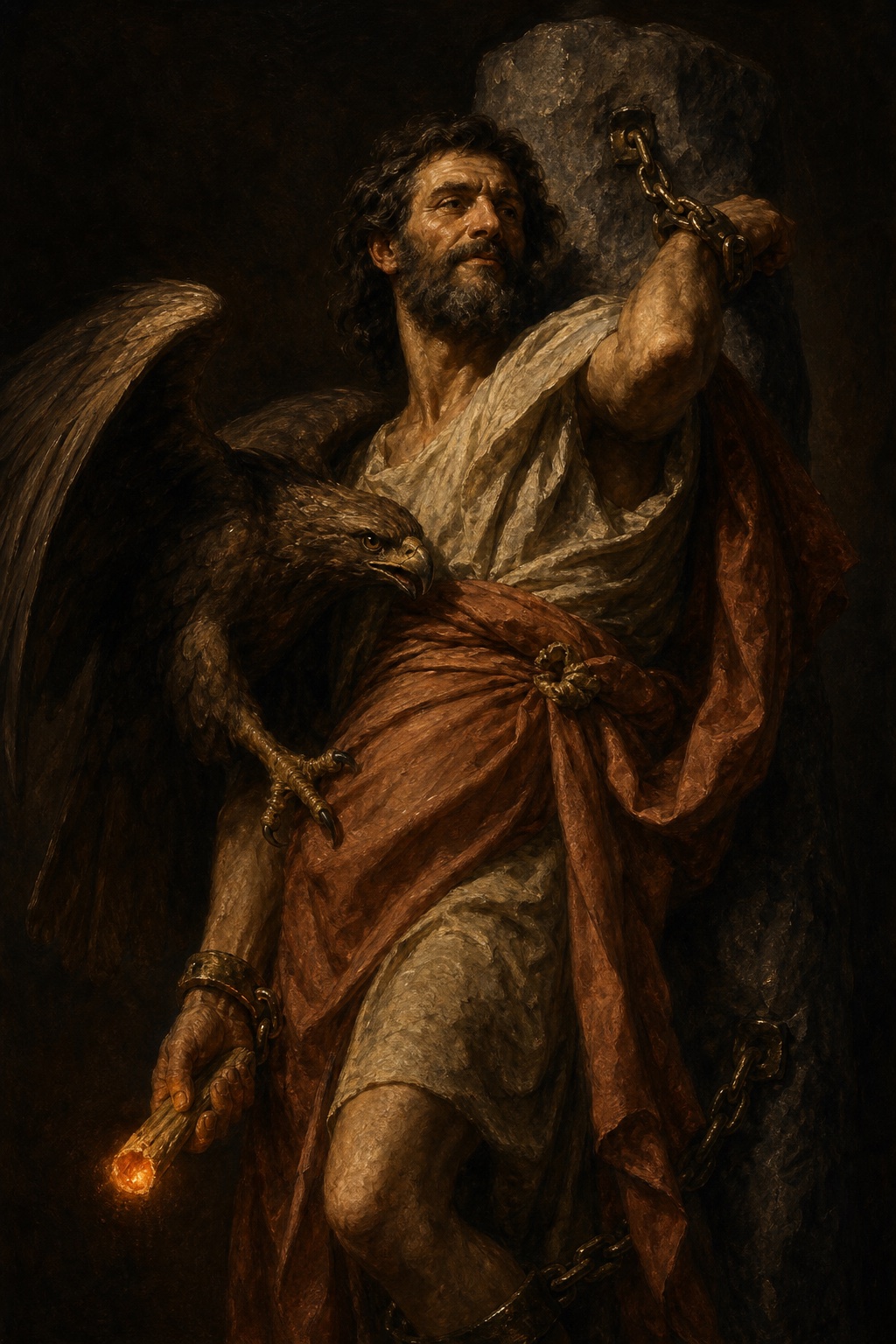
Stealing the fire
Hesiod does not open here with the theft itself but with Zeus already provoked — fire is hidden in the first line because Prometheus has already deceived him once, and hiding it is retaliation already under way before the passage even starts.
Ζεὺς ἔκρυψε, χολωσάμενος φρεσὶν ᾗσιν, ὅττι μιν ἐξαπάτησε Προμηθεὺς ἀγκυλομήτης. τοὔνεκ᾽ ἄρ᾽ ἀνθρώποισιν ἐμήσατο κήδεα λυγρά. κρύψε δὲ πῦρ· τὸ μὲν αὖτις ἐὺς πᾴς Ἰαπετοῖο ἔκλεψ᾽ ἀνθρώποισι Διὸς πάρα μητιόεντος ἐν κοίλῳ νάρθηκι λαθὼν Δία τερπικέραυνον. τὸν δὲ χολωσάμενος προσέφη νεφεληγερέτα Ζεύς· Ἰαπετιονίδη, πάντων πέρι μήδεα εἰδώς, χαίρεις πῦρ κλέψας καὶ ἐμὰς φρένας ἠπεροπεύσας, σοί τ᾽ αὐτῷ μέγα πῆμα καὶ ἀνδράσιν ἐσσομένοισιν. τοῖς δ᾽ ἐγὼ ἀντὶ πυρὸς δώσω κακόν, ᾧ κεν ἅπαντες τέρπωνται κατὰ θυμὸν, ἑὸν κακὸν ἀμφαγαπῶντες
“Zeus in the anger of his heart hid it, because Prometheus the crafty deceived him; therefore he planned sorrow and mischief against men. He hid fire; but that the noble son of Iapetus stole again for men from Zeus the counsellor in a hollow fennel-stalk, so that Zeus who delights in thunder did not see it. But afterwards Zeus who gathers the clouds said to him in anger: ‘Son of Iapetus, surpassing all in cunning, you are glad that you have outwitted me and stolen fire — a great plague to you yourself and to men that shall be. But I will give men as the price for fire an evil thing in which they may all be glad of heart while they embrace their own destruction.’” — Hesiod, Works and Days 47–58, tr. Evelyn-White
The theft happens twice in two lines — Zeus hides the fire, “but that… stole again,” as if the very first theft, the one that provoked the hiding, barely needed mentioning before a second one follows it. The vessel is specific and homely: not a torch carried openly but embers smuggled inside a stalk of giant fennel, hollow enough to hide a spark and slow-burning enough to carry it a long way without going out — small enough that even Zeus, watching from the sky he thunders in, does not see it go.
What follows the theft is not punishment yet but speech. Zeus does not strike him down on the spot — he names him by his father, “Son of Iapetus,” and tells him to his face that he knows exactly what happened and is not fooled for a moment by how pleased with himself Prometheus looks. The price he sets is deliberately withheld: an unnamed “evil thing” that men will love before they understand what it costs them, the opening move of the story Hesiod tells at length elsewhere as the making of Pandora.
Bound with the eagle
The consequence for Prometheus himself, distinct from whatever men eventually pay, comes a few hundred lines earlier in the Theogony’s own account of the family — Atlas condemned to hold up the sky, and immediately after him, his brother.
δῆσε δ᾽ ἀλυκτοπέδῃσι Προμηθέα ποικιλόβουλον δεσμοῖς ἀργαλέοισι μέσον διὰ κίον᾽ ἐλάσσας· καί οἱ ἐπ᾽ αἰετὸν ὦρσε τανύπτερον· αὐτὰρ ὅ γ᾽ ἧπαρ ἤσθιεν ἀθάνατον, τὸ δ᾽ ἀέξετο ἶσον ἁπάντη νυκτός, ὅσον πρόπαν ἦμαρ ἔδοι τανυσίπτερος ὄρνις
“And ready-witted Prometheus he bound with inextricable bonds, cruel chains, and drove a shaft through his middle, and set on him a long-winged eagle, which used to eat his immortal liver; but by night the liver grew as much again everyway as the long-winged bird devoured in the whole day.” — Hesiod, Theogony 521–525, tr. Evelyn-White
Every other divine punishment in Hesiod ends the story it is attached to. Atlas holds the sky, and that is simply his condition from then on; Cronus’s rivals are shut behind bronze doors in Tartarus, and that is where they stay. Prometheus’s liver is the one punishment built never to finish: the bird eats the whole of it in a day, night restores it exactly to where it started, and the eagle returns the next morning to eat it again. What makes the torment possible at all is the single word Hesiod uses for the organ itself — ἀθάνατον, immortal. An ordinary liver could be eaten once. His cannot be, and the chains and the shaft driven through his middle exist only to keep him in place long enough for that difference to matter.
In his own words
Centuries later, on the Athenian stage, Prometheus stops being a figure other poets describe and starts talking. Aeschylus keeps him bound and speaking for the length of an entire play, trading lines with the Chorus who have come to see him suffer.
τυφλὰς ἐν αὐτοῖς ἐλπίδας κατῴκισα. Χορος μέγ᾽ ὠφέλημα τοῦτ᾽ ἐδωρήσω βροτοῖς. Προμηθευς πρὸς τοῖσδε μέντοι πῦρ ἐγώ σφιν ὤπασα. Χορος καὶ νῦν φλογωπὸν πῦρ ἔχουσ᾽ ἐφήμεροι; Προμηθευς ἀφ᾽ οὗ γε πολλὰς ἐκμαθήσονται τέχνας
“I caused blind hopes to dwell within their breasts. CHORUS: A great benefit was this you gave to mortals. PROMETHEUS: In addition, I gave them fire. CHORUS: What! Do creatures of a day now have flame-eyed fire? PROMETHEUS: Yes, and from it they shall learn many arts.” — Aeschylus, Prometheus Bound 252–256, tr. Smyth
This is the only surviving passage in which Prometheus recounts the theft as his own decision rather than something reported about him from outside, and he lists it almost as an afterthought, after the blind hope he claims to have planted in mortals so they would stop foreseeing their own deaths. Fire, in his own accounting, is not the whole gift — it is what makes the rest of human skill possible, the spark the Chorus calls a benefit and Prometheus calls the start of “many arts.” Bound and immortal in his suffering exactly as the Theogony already described, he still frames the theft as something he would apparently do again.
Hesiod does eventually let the story end, in the lines right after the ones quoted above: Heracles kills the eagle, and Zeus permits the release, so that even the one punishment built never to finish eventually does. It is one of the few moments in which an Iapetid gets something back rather than losing it — the pattern the rest of his brothers, and his father before them, never break.