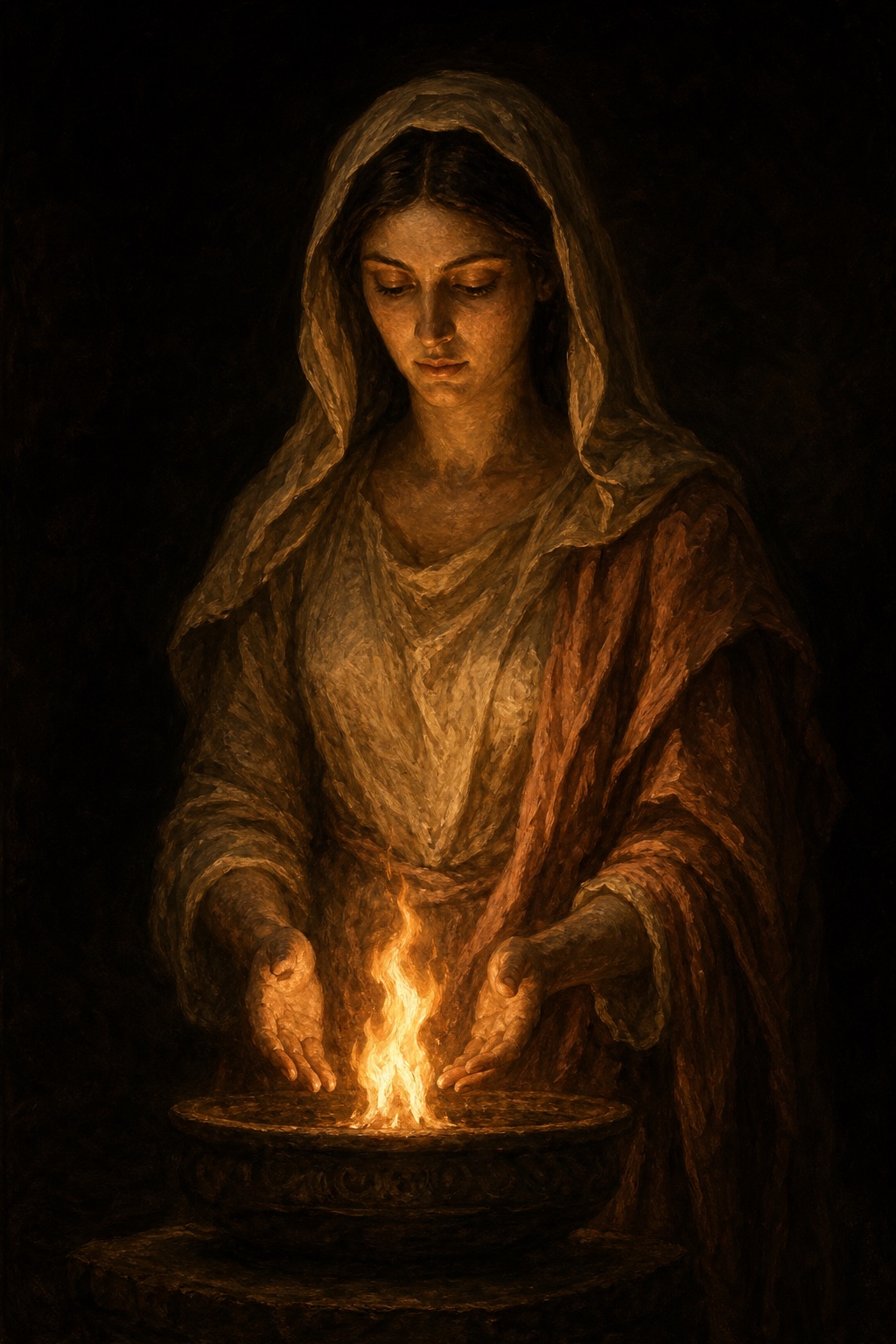
Hestia is the hearth — not a goddess who owns hearths, but the fire itself, addressed directly. She is the eldest child of Cronus and Rhea, which makes her both the first swallowed and, since Cronus disgorged them in reverse, the last brought back up: the Greeks liked to say she was the oldest and the youngest of the gods at once.
She has almost no narrative. There is no abduction, no quarrel, no affair. The one story told about her is a refusal: Poseidon and Apollo both wanted her, and she swore by the head of Zeus to remain unmarried, and was granted instead the centre of the house and the first portion of every sacrifice. That is the whole of it. In a body of myth built out of appetite and grievance, she is the figure defined by declining to participate.
Ἑστίη, ἥ τε ἄνακτος Ἀπόλλωνος ἑκάτοιο Πυθοῖ ἐν ἠγαθέῃ ἱερὸν δόμον ἀμφιπολεύεις, αἰεὶ σῶν πλοκάμων ἀπολείβεται ὑγρὸν ἔλαιον· ἔρχεο τόνδ’ ἀνὰ οἶκον, ἐπέρχεο θυμὸν ἔχουσα σὺν Διὶ μητιόεντι
“Hestia, you who tend the holy house of the lord Apollo, the Far-shooter at goodly Pytho, with soft oil dripping ever from your locks, come now into this house, come, having one mind with Zeus the all-wise.” — Homeric Hymn 24, To Hestia 1–5, tr. Evelyn-White
Her absence from the stories is inverse to her presence in practice. Every meal began and ended with her; the proverbial phrase ἀφ᾽ ἑστίας ἄρχεσθαι, “to begin from the hearth”, meant to start where a thing properly starts — Plato has Socrates use it in the Euthyphro, wryly, of a prosecution that begins at home. Every city kept a public hearth in the prytaneion whose fire was never allowed to go out, and colonists sailing to found a new city carried embers from it, so that the daughter-city’s fire was physically continuous with the mother’s. A supplicant who reached the hearth could not be removed from it. Hestia is what a Greek household and a Greek state had instead of a foundation stone.
This is also why she is hard to picture, and why she is often missing from the canonical twelve — some lists drop her for Dionysus. She is rarely given a distinct face in art, because the thing she is was already in the room. Where other gods are represented, she is simply present: a fire that someone has to keep lit, and that stops being a city the moment it goes out.