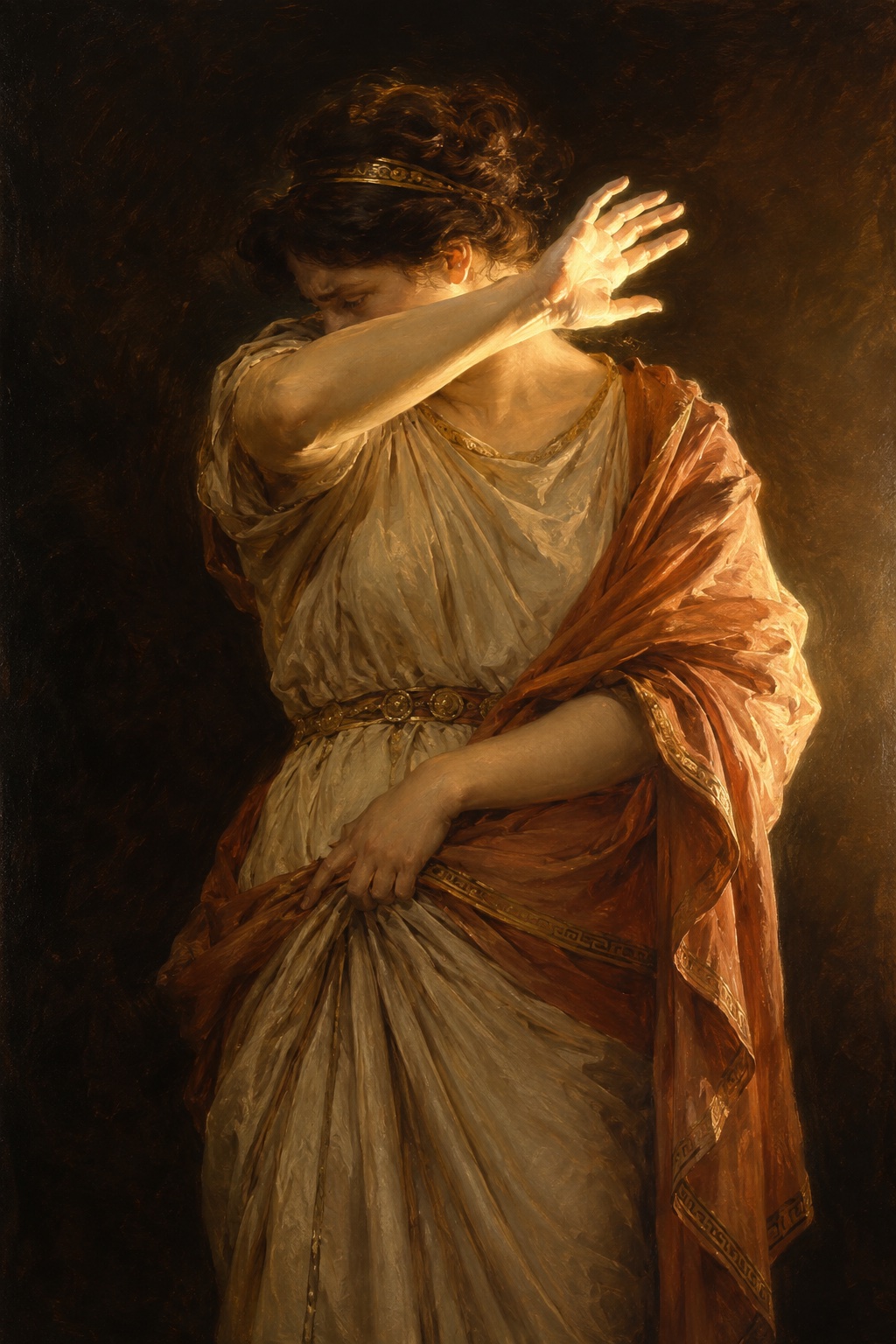
One of four daughters
Apollodorus files Semele in a list before he gives her a story. Cadmus and his wife have four daughters and a son — Autonoe, Ino, Semele, Agave, and Polydorus — and the three sisters are married off in a single sentence: Ino to Athamas, Autonoe to Aristaeus, Agave to Echion. Semele is the one left unaccounted for at the end of the line, and the next sentence is about Zeus.
That structure is worth noticing, because it is the whole shape of her life in the sources. She is a Theban princess with a genealogy and no acts. What happens to her happens in one room, over the course of a single visit, and it is over before she has done anything except ask a question.
What she asked for
The request is not hers. Zeus has already promised to do whatever she asks; Hera, who has been deceived out of nothing, does the asking through her.
Σεμέλης δὲ Ζεὺς ἐρασθεὶς Ἥρας κρύφα συνευνάζεται. ἡ δὲ ἐξαπατηθεῖσα ὑπὸ Ἥρας, κατανεύσαντος αὐτῇ Διὸς πᾶν τὸ αἰτηθὲν ποιήσειν, αἰτεῖται τοιοῦτον αὐτὸν ἐλθεῖν οἷος ἦλθε μνηστευόμενος Ἥραν. Ζεὺς δὲ μὴ δυνάμενος ἀνανεῦσαι παραγίνεται εἰς τὸν θάλαμον αὐτῆς ἐφ᾽ ἅρματος ἀστραπαῖς ὁμοῦ καὶ βρονταῖς, καὶ κεραυνὸν ἵησιν. Σεμέλης δὲ διὰ τὸν φόβον ἐκλιπούσης, ἑξαμηνιαῖον τὸ βρέφος ἐξαμβλωθὲν ἐκ τοῦ πυρὸς ἁρπάσας ἐνέρραψε τῷ μηρῷ
“But Zeus loved Semele and bedded with her unknown to Hera. Now Zeus had agreed to do for her whatever she asked, and deceived by Hera she asked that he would come to her as he came when he was wooing Hera. Unable to refuse, Zeus came to her bridal chamber in a chariot, with lightnings and thunderings, and launched a thunderbolt. But Semele expired of fright, and Zeus, snatching the sixth-month abortive child from the fire, sewed it in his thigh.” — Apollodorus, Bibliotheke 3.4.3, tr. J. G. Frazer
Two details in that sentence do most of the work. The first is μὴ δυνάμενος ἀνανεῦσαι — Zeus is unable to refuse. The king of the gods arrives in his own killing weather not because he wants to but because he has given his word, which makes the death a matter of divine procedure rather than of anger. The second is what actually kills her: διὰ τὸν φόβον, of fright. Apollodorus does not say the thunderbolt struck her. He says the bolt was launched, and that Semele expired of fear. The fire is real enough to have the child snatched out of it, and she is dead before it reaches her.
The request itself is precisely worded, and precisely fatal. She does not ask to see him as a god. She asks that he come to her οἷος ἦλθε μνηστευόμενος Ἥραν — as he came when he was wooing Hera. Hera does not ask Zeus for anything; she gets Semele to ask for Hera’s own wedding night, which no mortal body was built to survive.
The story her sisters told
Semele’s death is not the end of what is done to her. The sisters who were married off in one sentence get a second one, and they use it against her.
ἀποθανούσης δὲ Σεμέλης, αἱ λοιπαὶ Κάδμου θυγατέρες διήνεγκαν λόγον, συνηυνῆσθαι θνητῷ τινι Σεμέλην καὶ καταψεύσασθαι Διός
“On the death of Semele the other daughters of Cadmus spread a report that Semele had bedded with a mortal man, and had falsely accused Zeus.” — Apollodorus, Bibliotheke 3.4.3, tr. J. G. Frazer
It is a rumour built to fit the evidence. A dead girl, a burnt room, and a claim about a god: the simplest reading is that she lied about the father and was punished for the lie. Nothing in the story contradicts it except the child, and the child is currently sewn into Zeus’s thigh where nobody can see him.
Everything that follows in Thebes runs off this slander. When the child is born at the proper time and grows up, the city that told the story about his mother is the city he comes back to, and Agave — one of the sisters who spread it — is the one his rites destroy. Dionysus names his mother in his own voice when he finally announces himself, which the corpus records from his side: son of Zeus and Semele, stated as a fact to a boatload of pirates in the middle of a miracle. The correction takes a generation and arrives as a god.