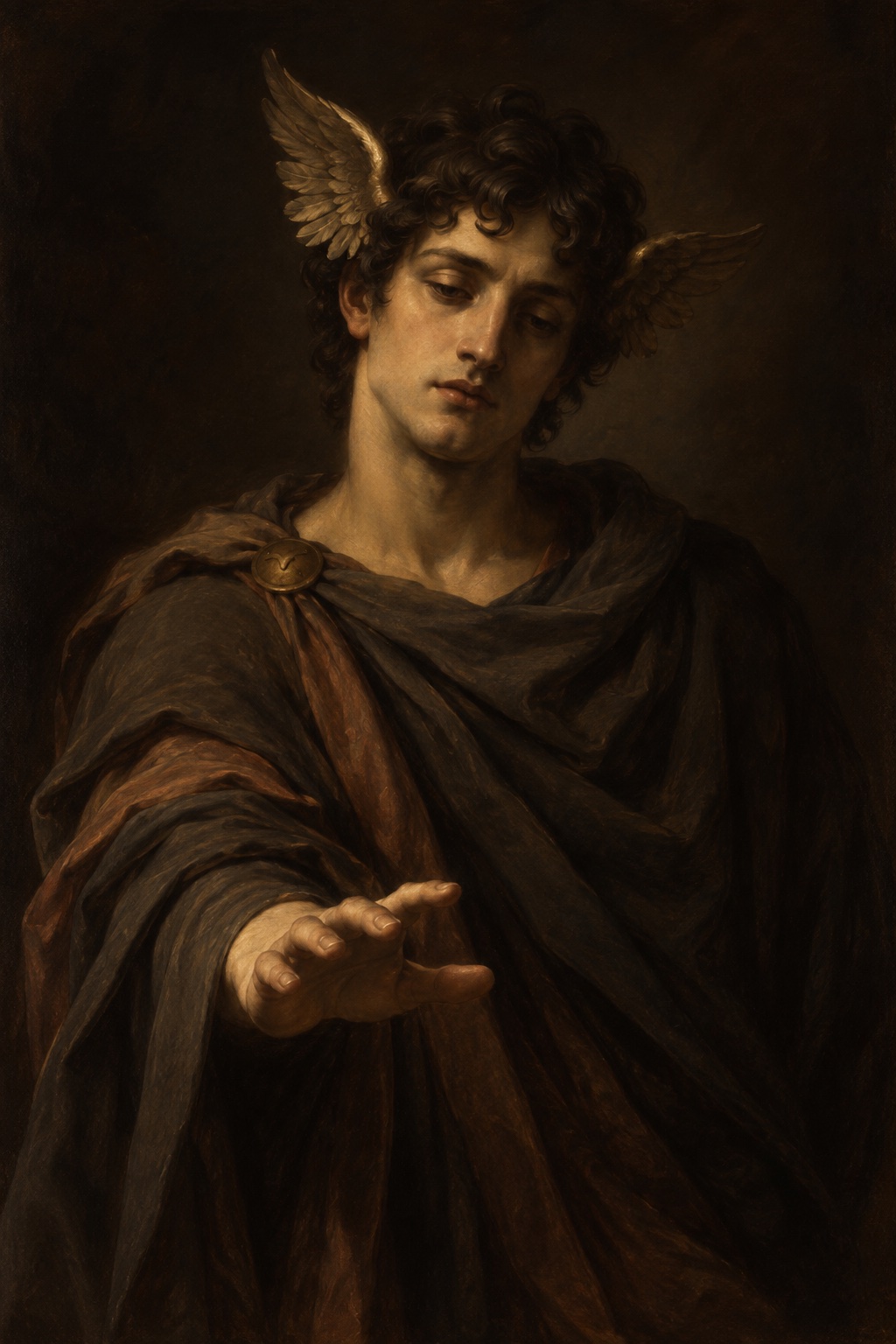
Any god but Zeus
The fourteenth book of the Iliad gives Sleep his one long scene, and it begins with a visit. Hera wants Zeus asleep, so that the Achaeans can be helped while he is not watching, and she knows whom to ask. She crosses the sea to Lemnos, the city of Thoas, and finds him there. Homer introduces him in that line as the brother of Death, and Hera takes him by the hand and hails him as lord of all gods and of all men. The request is plain: close the bright eyes of Zeus as soon as she has lain beside him in love. The payment is a throne of imperishable gold that her son Hephaestus will make, with a footstool under it so that Sleep can rest his feet while he drinks.
Ἥρη πρέσβα θεὰ θύγατερ μεγάλοιο Κρόνοιο, ἄλλον μέν κεν ἔγωγε θεῶν αἰειγενετάων ῥεῖα κατευνήσαιμι, καὶ ἂν ποταμοῖο ῥέεθρα Ὠκεανοῦ, ὅς περ γένεσις πάντεσσι τέτυκται· Ζηνὸς δ’ οὐκ ἂν ἔγωγε Κρονίονος ἆσσον ἱκοίμην, οὐδὲ κατευνήσαιμ’, ὅτε μὴ αὐτός γε κελεύοι. ἤδη γάρ με καὶ ἄλλο τεὴ ἐπίνυσσεν ἐφετμή, ἤματι τῷ ὅτε κεῖνος ὑπέρθυμος Διὸς υἱὸς ἔπλεεν Ἰλιόθεν Τρώων πόλιν ἐξαλαπάξας. ἤτοι ἐγὼ μὲν ἔλεξα Διὸς νόον αἰγιόχοιο νήδυμος ἀμφιχυθείς· σὺ δέ οἱ κακὰ μήσαο θυμῷ, ὄρσασ’ ἀργαλέων ἀνέμων ἐπὶ πόντον ἀήτας, καί μιν ἔπειτα Κόων δ’ εὖ ναιομένην ἀπένεικας, νόσφι φίλων πάντων. ὁ δ’ ἐπεγρόμενος χαλέπαινε, ῥιπτάζων κατὰ δῶμα θεούς, ἐμὲ δ’ ἔξοχα πάντων ζήτει· καί κέ μ’ ἄϊστον ἀπ’ αἰθέρος ἔμβαλε πόντῳ, εἰ μὴ Νὺξ δμήτειρα θεῶν ἐσάωσε καὶ ἀνδρῶν
“Hera, queenly goddess, daughter of great Cronos, another of the gods, that are for ever, might I lightly lull to sleep, aye, were it even the streams of the river Oceanus, from whom they all are sprung; but to Zeus, son of Cronos, will I not draw nigh, neither lull him to slumber, unless of himself he bid me. For ere now in another matter did a behest of thine teach me a lesson, on the day when the glorious son of Zeus, high of heart, sailed forth from Ilios, when he had laid waste the city of the Trojans. I, verily, beguiled the mind of Zeus, that beareth the aegis, being shed in sweetness round about him, and thou didst devise evil in thy heart against his son, when thou hadst roused the blasts of cruel winds over the face of the deep, and thereafter didst bear him away unto well-peopled Cos, far from all his kinsfolk. But Zeus, when he awakened, was wroth, and flung the gods hither and thither about his palace, and me above all he sought, and would have hurled me from heaven into the deep to be no more seen, had Night not saved me—Night that bends to her sway both gods and men.” — Homer, Iliad 14.243–259, tr. A. T. Murray
It is a refusal built on a boast. Sleep claims every other god without effort, and to show the size of the claim he names the hardest case he can think of: Oceanus, the river from whom they all are sprung. Then he names the one exception, and the one condition that would lift it, which is that Zeus should ask for it himself. What follows is not a principle but a memory. Once before, he says, Hera gave him an order like this one. On the day Heracles sailed from Ilios after sacking the Trojans’ city, Sleep poured himself around the mind of Zeus, and while Zeus slept Hera raised a storm on the sea and drove his son away to Cos, far from everyone he knew. Zeus woke in a rage, threw the gods about his palace, and hunted for Sleep above all of them. He would have flung him out of the sky into the sea, never to be seen again.
This is the trickery in him, and it is a particular kind. Sleep does not fight, lie or steal. He makes the strongest god in the poem stop noticing, for exactly as long as somebody else needs, and the trick is so clean that Zeus has to wake up to find out it happened. The Greek has him describe it in two words that fit the scene exactly — νήδυμος ἀμφιχυθείς, sweet, and poured round about — which Murray turns into being shed in sweetness round about him. The sweetness is the method. It is also why, when Zeus woke, Sleep was the one he looked for above all the others.
What saved him was Night. His speech ends on her name and on the power Homer gives her, the one who bends both gods and men to her sway. The two lines that follow, in which Sleep flees to her and Zeus holds back his anger for fear of displeasing swift Night, are quoted on this wiki’s page for Nyx, where they are evidence of her power rather than of his danger. The Iliad does not say in these lines why Night would shelter him. Hesiod does, and his answer is at the end of this page.
One of the youthful Graces
Sleep closes his refusal with a line that sounds as if he already expects to lose: now, he tells Hera, she is asking him again to fulfil “this other task, that may nowise be done.” Hera does not argue with his fear. She argues with his memory. Calling him by name, she asks whether he really thinks Zeus will stand by the Trojans the way he raged for Heracles, his own son. That comparison is the whole of her case — Heracles was the son of Zeus and the Trojans are not, so the anger will not be the same. Then, having taken away the reason to be afraid, she changes the price.
ἀλλ’ ἴθ’, ἐγὼ δέ κέ τοι Χαρίτων μίαν ὁπλοτεράων δώσω ὀπυιέμεναι καὶ σὴν κεκλῆσθαι ἄκοιτιν. [Πασιθέην, ἧς αἰὲν ἱμείρεαι ἤματα πάντα.]» Ὣς φάτο, χήρατο δ’ Ὕπνος, ἀμειβόμενος δὲ προσηύδα· «ἄγρει νῦν μοι ὄμοσσον ἀάατον Στυγὸς ὕδωρ, χειρὶ δὲ τῇ ἑτέρῃ μὲν ἕλε χθόνα πουλυβότειραν, τῇ δ’ ἑτέρῃ ἅλα μαρμαρέην, ἵνα νῶϊν ἅπαντες μάρτυροι ὦσ’ οἳ ἔνερθε θεοὶ Κρόνον ἀμφὶς ἐόντες, ἦ μὲν ἐμοὶ δώσειν Χαρίτων μίαν ὁπλοτεράων, Πασιθέην, ἧς τ’ αὐτὸς ἐέλδομαι ἤματα πάντα.» Ὣς ἔφατ’, οὐδ’ ἀπίθησε θεὰ λευκώλενος Ἥρη, ὄμνυε δ’ ὡς ἐκέλευε, θεοὺς δ’ ὀνόμηνεν ἅπαντας τοὺς ὑποταρταρίους οἳ Τιτῆνες καλέονται.
“‘Nay, come, I will give thee one of the youthful Graces to wed to be called thy wife, even Pasithea, for whom thou ever longest all thy days.’ So spake she, and Sleep waxed glad, and made answer saying: ‘Come now, swear to me by the inviolable water of Styx, and with one hand lay thou hold of the bounteous earth, and with the other of the shimmering sea, that one and all they may be witnesses betwixt us twain, even the gods that are below with Cronos, that verily thou wilt give me one of the youthful Graces, even Pasithea, that myself I long for all my days.’ So spake he, and the goddess, white-armed Hera, failed not to hearken, but sware as he bade, and invoked by name all the gods below Tartarus, that are called Titans.” — Homer, Iliad 14.267–279, tr. A. T. Murray
The golden throne did not move him. A wife does, and the narration says so before he speaks: Sleep waxed glad. The gladness does not make him trusting. He nearly paid once for doing what Hera asked, and now he tells her exactly how she is to swear — by the water of Styx, one hand on the earth and the other on the sea, with the gods below around Cronus called as witnesses. He even dictates the promise she is to make, word for word, and puts the name into it. Hera swears as he tells her to, and names all the gods below Tartarus who are called Titans. Only then does she have what she came for.
This scene gives the page its consort relation, and it should be read exactly. Pasithea is one of the youthful Graces. She is promised to Sleep by Hera, under an oath by Styx, and Sleep says he has longed for her all his days. The Iliad records the promise and the oath sworn on it. It does not narrate a wedding.
A bird the gods call Chalcis
With the oath sworn, the two of them leave Lemnos and Imbros together, clothed in mist, and travel fast. They come to Ida, the mountain of many springs, leave the sea at Lectum and go on over dry land, and the tops of the forest shake under their feet. Hera goes on to find Zeus. Sleep stops short.
ἔνθ’ Ὕπνος μὲν ἔμεινε πάρος Διὸς ὄσσε ἰδέσθαι, εἰς ἐλάτην ἀναβὰς περιμήκετον, ἣ τότ’ ἐν Ἴδῃ μακροτάτη πεφυυῖα δι’ ἠέρος αἰθέρ’ ἵκανεν· ἔνθ’ ἧστ’ ὄζοισιν πεπυκασμένος εἰλατίνοισιν, ὄρνιθι λιγυρῇ ἐναλίγκιος, ἥν τ’ ἐν ὄρεσσι χαλκίδα κικλήσκουσι θεοί, ἄνδρες δὲ κύμινδιν.
“There Sleep did halt, or ever the eyes of Zeus beheld him, and mounted up on a fir-tree exceeding tall, the highest that then grew in Ida; and it reached up through the mists into heaven. Thereon he perched, thick-hidden by the branches of the fir, in the likeness of a clear-voiced mountain bird, that the gods call Chalcis, and men Cymindis.” — Homer, Iliad 14.286–291, tr. A. T. Murray
In these passages this is the only moment when Sleep has a shape the reader can see, and it is a borrowed one. The first thing the lines say about him is that he stops before Zeus can see him. He climbs the tallest tree on the mountain, a fir that reaches through the mist into the upper air, and waits in it thick-hidden by the branches, in the likeness of a bird. Homer gives the bird two names, the one the gods use and the one men use, as if even its name had to be said twice to be pinned down. The fir and the bird are this page’s symbols because they are the only picture of him that these texts give.
Then the plan works. Zeus sleeps on the peak of Gargarus, overcome by sleep and by love, with his wife in his arms. Sleep does not stay to watch. He runs down to the ships of the Achaeans with a message for Poseidon: help them now, while Zeus is sleeping, because Sleep has shed soft slumber over him and Hera has beguiled him into lying with her. Then he goes off among the tribes of men. The god who would not go near Zeus without an oath by Styx ends the episode by putting Zeus to sleep and telling Poseidon the news.
The twin brethren
Two books later Sleep is working for Zeus instead of against him, and he no longer speaks at all. Sarpedon, the son of Zeus and in his father’s own words the dearest of men to him, is fated to die at the hands of Patroclus. Zeus wonders aloud whether to snatch him out of the battle alive. Hera tells him to let the death happen, and then, once the soul and the life have left the body, to send Death and Sleep to carry it home to Lycia, where his brothers and his kinsfolk can bury him. Zeus lets his son die. Then he gives the order.
καὶ τότ’ Ἀπόλλωνα προσέφη νεφεληγερέτα Ζεύς· «εἰ δ’ ἄγε νῦν, φίλε Φοῖβε, κελαινεφὲς αἷμα κάθηρον ἐλθὼν ἐκ βελέων Σαρπηδόνα, καί μιν ἔπειτα πολλὸν ἀποπρὸ φέρων λοῦσον ποταμοῖο ῥοῇσι χρῖσόν τ’ ἀμβροσίῃ, περὶ δ’ ἄμβροτα εἵματα ἕσσον· πέμπε δέ μιν πομποῖσιν ἅμα κραιπνοῖσι φέρεσθαι, Ὕπνῳ καὶ θανάτῳ διδυμάοσιν, οἵ ῥά μιν ὦκα θήσουσ’ ἐν Λυκίης εὐρείης πίονι δήμῳ, ἔνθά ἑ ταρχύσουσι κασίγνητοί τε ἔται τε τύμβῳ τε στήλῃ τε· τὸ γὰρ γέρας ἐστὶ θανόντων.»
“And then unto Apollo spake Zeus, the cloud-gatherer: ‘Up now, dear Phoebus, go cleanse from Sarpedon the dark blood, when thou hast taken him forth from out the range of darts, and thereafter bear thou him far away, and bathe him in the streams of the river, and anoint him with ambrosia, and clothe him about with immortal raiment, and give him to swift conveyers to bear with them, even to the twin brethren, Sleep and Death, who shall set him speedily in the rich land of wide Lycia. There shall his brethren and his kinsfolk give him burial with mound and pillar; for this is the due of the dead.’” — Homer, Iliad 16.666–675, tr. A. T. Murray
The next eight lines carry the order out, and Homer repeats it almost word for word. Apollo goes down from the hills of Ida into the battle, lifts Sarpedon out of range of the spears, bathes him in the river, anoints him with ambrosia and clothes him in immortal raiment, and gives him to the same swift conveyers, the twin brethren, Sleep and Death, “who set him speedily in the rich land of wide Lycia.” The Greek word both times is διδυμάοσιν, twins. Book fourteen had already called Sleep the brother of Death; here the Iliad makes them twins, and this passage is the source of this page’s sibling relation.
What the twins carry is a body that has been washed, anointed and dressed, and their work is the last stage of a funeral that Zeus lays out himself: the journey home, then a mound and a pillar raised by brothers and kinsfolk, because that is the due of the dead. Sleep here is not a trickster and not a bargainer. He is one of a pair of bearers who bring a dead man quickly to the people who will bury him, and the poem gives the pair one formula and no separate words.
Kindly to men
Homer’s Sleep is a character in a story; Hesiod’s is a place in a family. In the Theogony’s catalogue of the children of Nyx, Night bears hateful Doom and black Fate and Death, and she bears Sleep and the tribe of Dreams (211–212). That is the source of this page’s mother relation, and it answers the question the Iliad left open. Read beside it, Sleep’s flight to Night in the fourteenth book of the Iliad is a son running to his mother, although Homer never says so in those lines.
Much later in the poem Hesiod comes back to him. Of Day and Night, he says, the one holds all-seeing light for those on earth, and the other, Night, wrapped in a vaporous cloud, holds in her arms Sleep the brother of Death. Then the poem turns from the mother to her sons.
ἔνθα δὲ Νυκτὸς παῖδες ἐρεμνῆς οἰκί᾽ ἔχουσιν, Ὕπνος καὶ Θάνατος, δεινοὶ θεοί· οὐδέ ποτ᾽ αὐτοὺς Ἠέλιος φαέθων ἐπιδέρκεται ἀκτίνεσσιν οὐρανὸν εἰς ἀνιὼν οὐδ᾽ οὐρανόθεν καταβαίνων. τῶν δ᾽ ἕτερος γαῖάν τε καὶ εὐρέα νῶτα θαλάσσης ἥσυχος ἀνστρέφεται καὶ μείλιχος ἀνθρώποισι, τοῦ δὲ σιδηρέη μὲν κραδίη, χάλκεον δέ οἱ ἦτορ νηλεὲς ἐν στήθεσσιν· ἔχει δ᾽ ὃν πρῶτα λάβῃσιν ἀνθρώπων· ἐχθρὸς δὲ καὶ ἀθανάτοισι θεοῖσιν.
“And there the children of dark Night have their dwellings, Sleep and Death, awful gods. The glowing Sun never looks upon them with his beams, neither as he goes up into heaven, nor as he comes down from heaven. And the former of them roams peacefully over the earth and the sea’s broad back and is kindly to men; but the other has a heart of iron, and his spirit within him is pitiless as bronze: whomsoever of men he has once seized he holds fast: and he is hateful even to the deathless gods.” — Hesiod, Theogony 758–766, tr. Evelyn-White
Hesiod sets the two brothers against each other in a few lines. Both are awful gods, and both live where the Sun never looks. But the first of them roams peacefully over the earth and the sea and is kindly to men, and the second has a heart of iron, holds fast whoever he takes, and is hateful even to the gods. Sleep is the first. The Greek for his half of the sentence is ἥσυχος and μείλιχος ἀνθρώποισι — quiet, and kindly to men — and the second phrase is one of this page’s epithets. Homer’s Sleep bargained, hid and ran; Hesiod’s is the brother that anyone would want to meet.
Directly in front of their house, Hesiod goes on, stand the echoing halls of Hades and of Persephone. The dark house of Sleep and Death sits at the entrance to the underworld, but Sleep himself is not kept there. He is the one of the pair who goes out over land and sea. That gives this page its two domains: night, because he is Night’s son and is carried in her arms, and trickery, because in the one long scene Homer gives him, what he does is make Zeus stop watching.
The attributes that later art gives him — wings, poppies, a torch held downward — are not in any of these passages. Homer shows him as a voice, a bird in a fir and one of two bearers, and Hesiod shows him as a child in his mother’s arms and a gentle presence abroad on the earth. That is the whole of the evidence this page stands on.