A shower of gold, a chest at sea
An oracle warns Acrisius, king of Argos, that his own daughter’s son will kill him. Acrisius answers the only way a frightened king in these stories ever does: he locks Danaë in an underground chamber of bronze, sealed against any suitor who might father the child the oracle names.
The more familiar account, and the one Apollodorus gives second, has Zeus reach her anyway: he comes to her as a stream of gold pouring through the chamber’s roof. When Acrisius learns his daughter has borne a son, he refuses to believe the god had any part in it, and rather than kill Danaë and the infant Perseus outright, he seals them into a wooden chest and casts it into the sea. The chest washes ashore on the island of Seriphus, where the fisherman Dictys hauls it in and raises the boy as his own.
Sent for a Gorgon’s head
Dictys’s brother Polydectes rules Seriphus, and once Perseus is grown, the king wants Danaë for himself and finds the son inconveniently in the way. Polydectes calls his court together under the pretext of collecting wedding gifts for another man’s bride, and when it is Perseus’s turn to give, the young man rashly swears he will not balk even at the head of a Gorgon. Polydectes holds him to it.
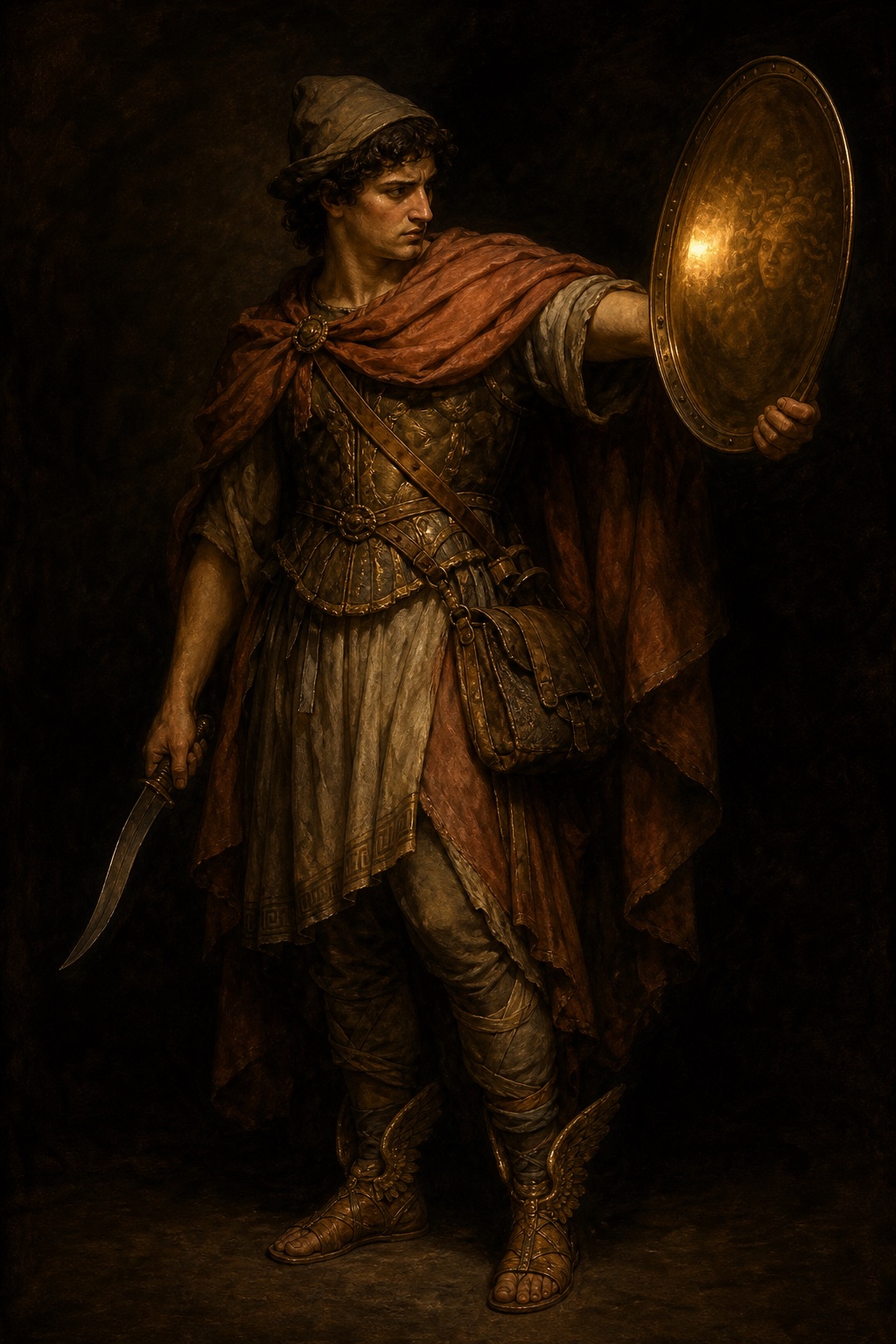
It is meant as a death sentence, and it would be one without help. Hermes and Athena lead Perseus to the nymphs, who fit him with winged sandals and a wallet to carry what he cannot safely look at; Hermes lends him an adamantine sickle for the cutting; and among the gifts is a cap that renders its wearer invisible. Athena adds one thing more, understated next to the rest: a bronze shield polished to a mirror.
Guided by Athena’s hand
Perseus finds the three Gorgon sisters asleep by the sea. Only one of them, Medusa, is mortal — which is why it is her head Perseus has been sent for, and why the encounter is survivable at all.
πετόμενος εἰς τὸν Ὠκεανὸν ἧκε καὶ κατέλαβε τὰς Γοργόνας κοιμωμένας. ἦσαν δὲ αὗται Σθενὼ Εὐρυάλη Μέδουσα. μόνη δὲ ἦν θνητὴ Μέδουσα· διὰ τοῦτο ἐπὶ τὴν ταύτης κεφαλὴν Περσεὺς ἐπέμφθη. εἶχον δὲ αἱ Γοργόνες κεφαλὰς μὲν περιεσπειραμένας φολίσι δρακόντων, ὀδόντας δὲ μεγάλους ὡς συῶν, καὶ χεῖρας χαλκᾶς, καὶ πτέρυγας χρυσᾶς, δι᾽ ὧν ἐπέτοντο. τοὺς δὲ ἰδόντας λίθους ἐποίουν. ἐπιστὰς οὖν αὐταῖς ὁ Περσεὺς κοιμωμέναις, κατευθυνούσης τὴν χεῖρα Ἀθηνᾶς, ἀπεστραμμένος καὶ βλέπων εἰς ἀσπίδα χαλκῆν, δι᾽ ἧς τὴν εἰκόνα τῆς Γοργόνος ἔβλεπεν, ἐκαρατόμησεν αὐτήν. ἀποτμηθείσης δὲ τῆς κεφαλῆς, ἐκ τῆς Γοργόνος ἐξέθορε Πήγασος πτηνὸς ἵππος, καὶ Χρυσάωρ ὁ Γηρυόνου πατήρ
“he flew to the ocean and caught the Gorgons asleep. They were Stheno, Euryale, and Medusa. Now Medusa alone was mortal; for that reason Perseus was sent to fetch her head. But the Gorgons had heads twined about with the scales of dragons, and great tusks like swine’s, and brazen hands, and golden wings, by which they flew; and they turned to stone such as beheld them. So Perseus stood over them as they slept, and while Athena guided his hand and he looked with averted gaze on a brazen shield, in which he beheld the image of the Gorgon, he beheaded her. When her head was cut off, there sprang from the Gorgon the winged horse Pegasus and Chrysaor, the father of Geryon” — Apollodorus, Bibliotheke 2.4.2; tr. J. G. Frazer
Every piece of the errand converges in this one moment: the shield is not armor here but a periscope, the whole point being that Perseus never once looks at what he is killing. His own hand only finishes the stroke; Athena’s is the one that aims it. Out of the wound spring Pegasus and Chrysaor, born the instant the head comes free, as though the killing itself is what releases them.
The oracle fulfilled
Carrying the head in the nymphs’ wallet, Perseus makes his way home by way of Ethiopia, where he finds the princess Andromeda chained out as prey for a sea monster and promises her father Cepheus he will kill it if he can have her for his wife. He does, and she becomes his consort. Back on Seriphus, he finds Polydectes still pressing his mother, and repays him with the one weapon built for exactly this: the king and his court see the Gorgon’s face and are turned to stone where they sit. The head itself passes afterward to Athena, who fixes it to her aegis.
Years later, competing in funeral games in another city, Perseus throws a discus that goes astray and strikes a bystander dead — and the bystander is Acrisius, drawn there by chance or by nothing his grandson intended. The oracle Acrisius spent a lifetime trying to outrun catches him anyway, at the hand of the very grandson the chest at sea was meant to drown. Perseus goes on to rule at Tiryns, strengthening Midea and Mycenae besides, a kingship built on a killing he never chose to commit.