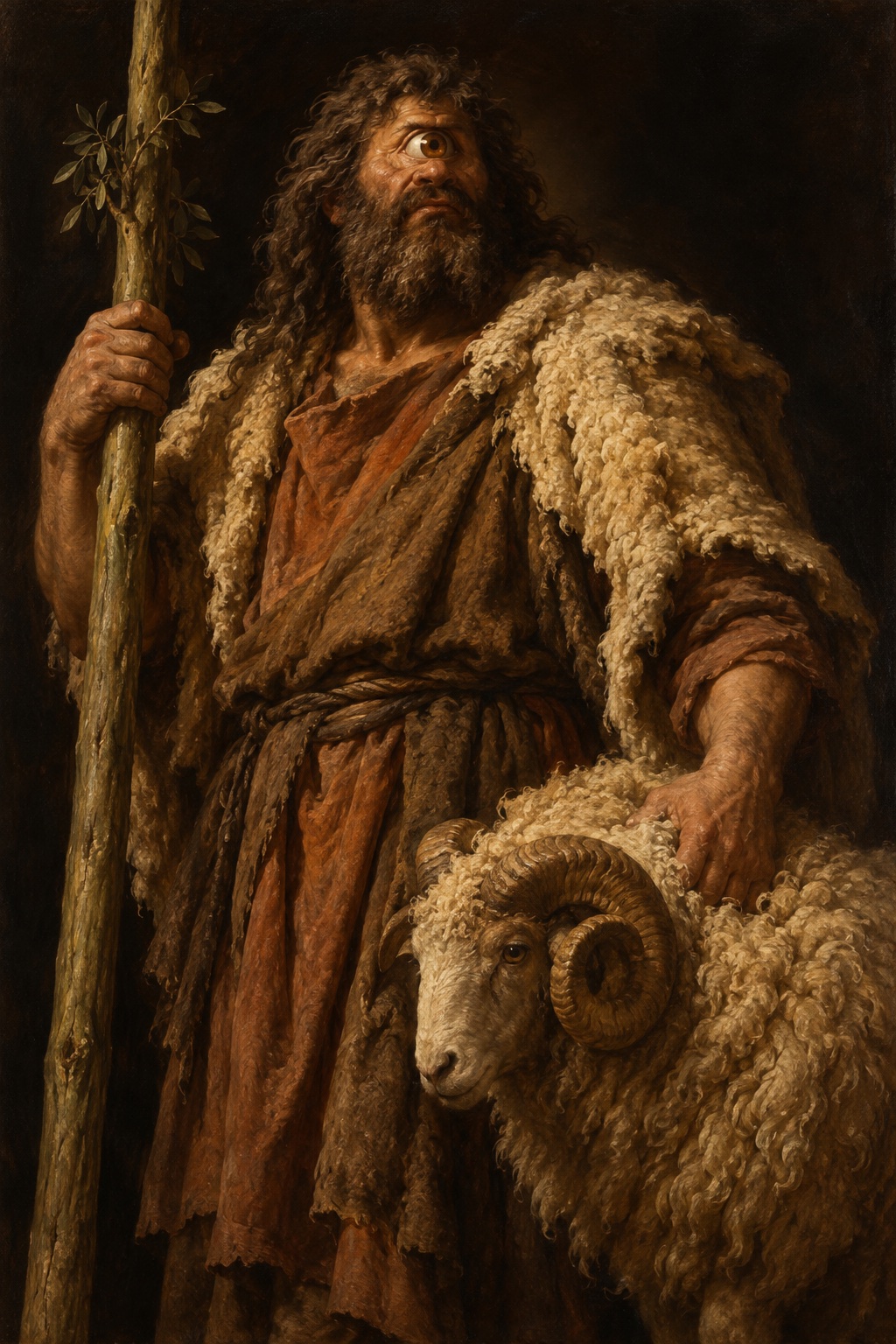
Greatest of the Cyclopes
Homer names him before the story of the cave is told. In the first book of the Odyssey, Zeus explains why one god still holds out against the homecoming of Odysseus. It is Poseidon, he says, who is ever filled with stubborn wrath because of the Cyclops whom Odysseus blinded — the godlike Polyphemus, whose might is greatest among all the Cyclopes. In the same breath Zeus gives his birth. His mother is the nymph Thoosa, daughter of Phorcys who rules over the unresting sea, and she lay with Poseidon in the hollow caves. The son conceived in a cave lives in one.
The Cyclopes of the ninth book are a people, not a family of three. Odysseus, telling the story to his hosts, calls them an overweening and lawless folk who plant nothing and plough nothing, trusting in the immortal gods, and who have neither assemblies for council nor appointed laws; they dwell on the peaks of lofty mountains in hollow caves. Even among them Polyphemus keeps apart. Odysseus describes a monstrous man who shepherded his flocks alone and afar, and mingled not with others, “with his heart set on lawlessness.” He was not made like a man that lives by bread, but like a wooded peak of lofty mountains that stands out to view alone.
These are not Hesiod’s Cyclopes. The Theogony gives Gaia and Uranus three sons of that name — Brontes, Steropes and Arges — who gave Zeus the thunder and made the thunderbolt, and it states their anatomy outright: a single eye was set in the middle of each forehead, and the name Cyclopes, orb-eyed, was given for it. Homer never makes that statement about Polyphemus. Whenever the Odyssey comes to his face it speaks of his eye, in the singular — blinded of his eye, in Zeus’s words; the stake thrust into his eye, in the ninth book — and it never stops to count. Hesiod’s three are smiths, born of Gaia and Uranus. Homer’s Polyphemus is a son of Poseidon, one of a whole people, and he keeps sheep.
Supper in the cave
Odysseus finds the cave before he finds its owner. The crates are laden with cheeses, the pens are crowded with lambs and kids, each age penned by itself, and the milk-pails and bowls are swimming with whey. His comrades want to take the cheeses and go. He wants to see the man himself, and whether he would give gifts of entertainment. So they light a fire, eat of the cheeses, and wait for the host to come home.
He comes at evening with a load of dry wood for his supper, drives the ewes and goats he milks into the cave, leaving the rams and he-goats in the court outside, and closes the mouth with a door-stone that two and twenty stout four-wheeled wagons could not lift from the ground. Then he sits down to his work. He milks the ewes and goats in turn and puts each lamb and kid beneath its mother; he curdles half the milk and lays it away in wicker baskets, and keeps the other half in vessels to drink with his supper. Only when the work is done does he rekindle the fire and catch sight of his guests. Until then, everything the poem shows him doing is the careful work of a shepherd.
Odysseus asks for entertainment, or some present, as the due of strangers, and reminds him that Zeus is the avenger of suppliants and strangers. The answer rejects the whole arrangement. The Cyclopes, he says, reck not of Zeus nor of the blessed gods, since they are better far than they, and he would not spare the strangers to shun the wrath of Zeus unless his own heart bade him. He asks where their ship is moored; Odysseus, suspecting the question, says that Poseidon wrecked it on the rocks. To that the Cyclops makes no answer at all.
ἀναΐξας ἑτάροισ’ ἐπὶ χεῖρας ἴαλλε, σὺν δὲ δύω μάρψας ὥς τε σκύλακας ποτὶ γαίῃ κόπτ’· ἐκ δ’ ἐγκέφαλος χαμάδις ῥέε, δεῦε δὲ γαῖαν. τοὺς δὲ διὰ μελεϊστὶ ταμὼν ὁπλίσσατο δόρπον· ἤσθιε δ’ ὥς τε λέων ὀρεσίτροφος, οὐδ’ ἀπέλειπεν, ἔγκατά τε σάρκας τε καὶ ὀστέα μυελόεντα
“sprang up and put forth his hands upon my comrades. Two of them at once he seized and dashed to the earth like puppies, and the brain flowed forth upon the ground and wetted the earth. Then he cut them limb from limb and made ready his supper, and ate them as a mountain-nurtured lion, leaving naught—ate the entrails, and the flesh, and the marrowy bones” — Homer, Odyssey 9.287–292, tr. Murray
The word for the meal is the ordinary word, δόρπον, supper, and he makes it ready the way he made the milk ready. Homer’s simile belongs to another world: ὥς τε λέων ὀρεσίτροφος, as a mountain-nurtured lion, a predator and not a host. Nothing is left over, ἔγκατά τε σάρκας τε καὶ ὀστέα μυελόεντα — entrails, flesh and marrowy bones.
It is the first of three such meals. Next morning, when he has milked his flocks, again he seizes two men at once and makes ready his meal, then drives the flocks out and puts the door-stone back as easily as one might set the lid on a quiver. That evening, after the milking, he does it a third time. Odysseus had chosen twelve of the best of his comrades to go with him to the cave. By the time the wine comes out, six of them have been eaten.
Noman, and the eye
The wine comes after the third meal. Odysseus holds out a bowl of it and scolds him as he offers it: how shall any man ever come to him again, seeing that he has wrought lawlessness? Polyphemus drinks, is wondrously pleased, and asks for more, and for the stranger’s name, so that he may give him a stranger’s gift. His praise of the wine gives him away. Among the Cyclopes, he says, the earth bears rich clusters of wine and the rain of Zeus gives them increase, but this is a streamlet of ambrosia and nectar. The Cyclops who reckons nothing of Zeus has just credited Zeus with his vines. Three times the bowl goes round, and when he has the name — Noman — he announces his gift: Noman he will eat last among his comrades. Then he falls on his back asleep.
He wakes to the stake. Odysseus has made it from the Cyclops’s own club, a staff of green olive-wood that looked as large as the mast of a twenty-oared ship, cut down to a fathom’s length and heated under the ashes until it glowed. The comrades drive it, sharp at the point, into his eye while Odysseus bears down from above and whirls it round like a shipwright’s drill, and his eye hisses round the stake as an axe hisses when a smith dips it in cold water.
His cry brings the neighbours. The other Cyclopes live round about him in caves among the windy heights, and they come thronging and stand around the cave to ask what ails him. Is some mortal driving off his flocks, or slaying him by guile or by might? Polyphemus answers that Noman is slaying him by guile and not by force. If no man does him violence in his loneliness, they reply, it is a sickness sent by great Zeus that he cannot escape, and he should pray to the lord Poseidon. Then they go away.
Blind, he lifts the stone from the door and sits in the doorway with his hands spread out, feeling for any man who tries to slip out among the sheep. The last of the flock to leave is the ram, heavy with his own fleece and with Odysseus clinging beneath him, and Polyphemus stops him to talk. The ram was always the first to the grass, the first to the streams, the first to want the fold at evening; now he is last, and his master thinks he knows why — the ram is sorrowing for the eye of his master, which an evil man blinded. If the ram could speak and tell where Noman skulks, Noman’s brains would be dashed about the cave. Then he lets the ram go, and Odysseus with it.
The curse
From the ship, pulling away, Odysseus cannot leave the name at Noman. He shouts back that if anyone asks who blinded the Cyclops’s eye, he should say it was Odysseus, the sacker of cities, the son of Laertes, whose home is in Ithaca. Polyphemus’s first answer is not rage but recognition. A prophecy uttered long ago, he groans, has come upon him. A soothsayer named Telemus, son of Eurymus, who grew old as a seer among the Cyclopes, had told him that he would lose his sight at the hands of Odysseus, and he had been looking ever since for some tall and comely man clothed in great might. The man who came was puny, a man of naught and a weakling, who blinded him of his eye when he had overpowered him with wine. Even now he calls Odysseus back to receive gifts of entertainment, the gifts Odysseus came to the cave hoping for, and he says plainly whose son he is: Poseidon declares himself his father, and Poseidon himself will heal him, if it be his good pleasure, but no other god or man. Odysseus answers that not even the Earth-shaker will heal that eye. Then the Cyclops prays.
ἔπειτα Ποσειδάωνι ἄνακτι εὔχετο, χεῖρ’ ὀρέγων εἰς οὐρανὸν ἀστερόεντα· «κλῦθι, Ποσείδαον γαιήοχε κυανοχαῖτα· εἰ ἐτεόν γε σός εἰμι, πατὴρ δ’ ἐμὸς εὔχεαι εἶναι, δὸς μὴ Ὀδυσσῆα πτολιπόρθιον οἴκαδ’ ἱκέσθαι, υἱὸν Λαέρτεω, Ἰθάκῃ ἔνι οἰκί’ ἔχοντα. ἀλλ’ εἴ οἱ μοῖρ’ ἐστὶ φίλους τ’ ἰδέειν καὶ ἱκέσθαι οἶκον ἐϋκτίμενον καὶ ἑὴν ἐς πατρίδα γαῖαν, ὀψὲ κακῶς ἔλθοι, ὀλέσας ἄπο πάντας ἑταίρους, νηὸς ἐπ’ ἀλλοτρίης, εὕροι δ’ ἐν πήματα οἴκῳ
“he then prayed to the lord Poseidon, stretching out both his hands to the starry heaven: ‘Hear me, Poseidon, earth-enfolder, thou dark-haired god, if indeed I am thy son and thou declarest thyself my father; grant that Odysseus, the sacker of cities, may never reach his home, even the son of Laertes, whose home is in Ithaca; but if it is his fate to see his friends and to reach his well-built house and his native land, late may he come and in evil case, after losing all his comrades, in a ship that is another’s; and may he find woes in his house.’” — Homer, Odyssey 9.526–535, tr. Murray
A moment before, he had said flatly that he was Poseidon’s son. After Odysseus’s jibe, the prayer opens on a condition: εἰ ἐτεόν γε σός εἰμι, if indeed I am thy son. The neighbours had told him to pray to the lord Poseidon, and now he has something to pray with. The attacker who was Noman in the night has a full address, and the Cyclops gives it back in Odysseus’s own words — υἱὸν Λαέρτεω, Ἰθάκῃ ἔνι οἰκί’ ἔχοντα, the son of Laertes, whose home is in Ithaca, the same line the boast ended on. What he asks for is practical: no homecoming, or, if fate allows one, a spoiled one — late, in evil case, ὀλέσας ἄπο πάντας ἑταίρους, after losing all his comrades, in a ship that is another’s, and with woes waiting in the house.
The poem answers at once: the dark-haired god heard him. Polyphemus lifts a far greater stone and hurls it with measureless strength. It falls a little behind the ship and barely misses the steering-oar, and the wave it raises carries the ship on to the island where the other ships are waiting. The story leaves him there, but the Odyssey had already told its audience what the prayer bought. In the first book Zeus says it plainly: from that time forth Poseidon does not slay Odysseus, but makes him a wanderer from his native land. The wrath of Poseidon in the first book is a father answering this prayer.