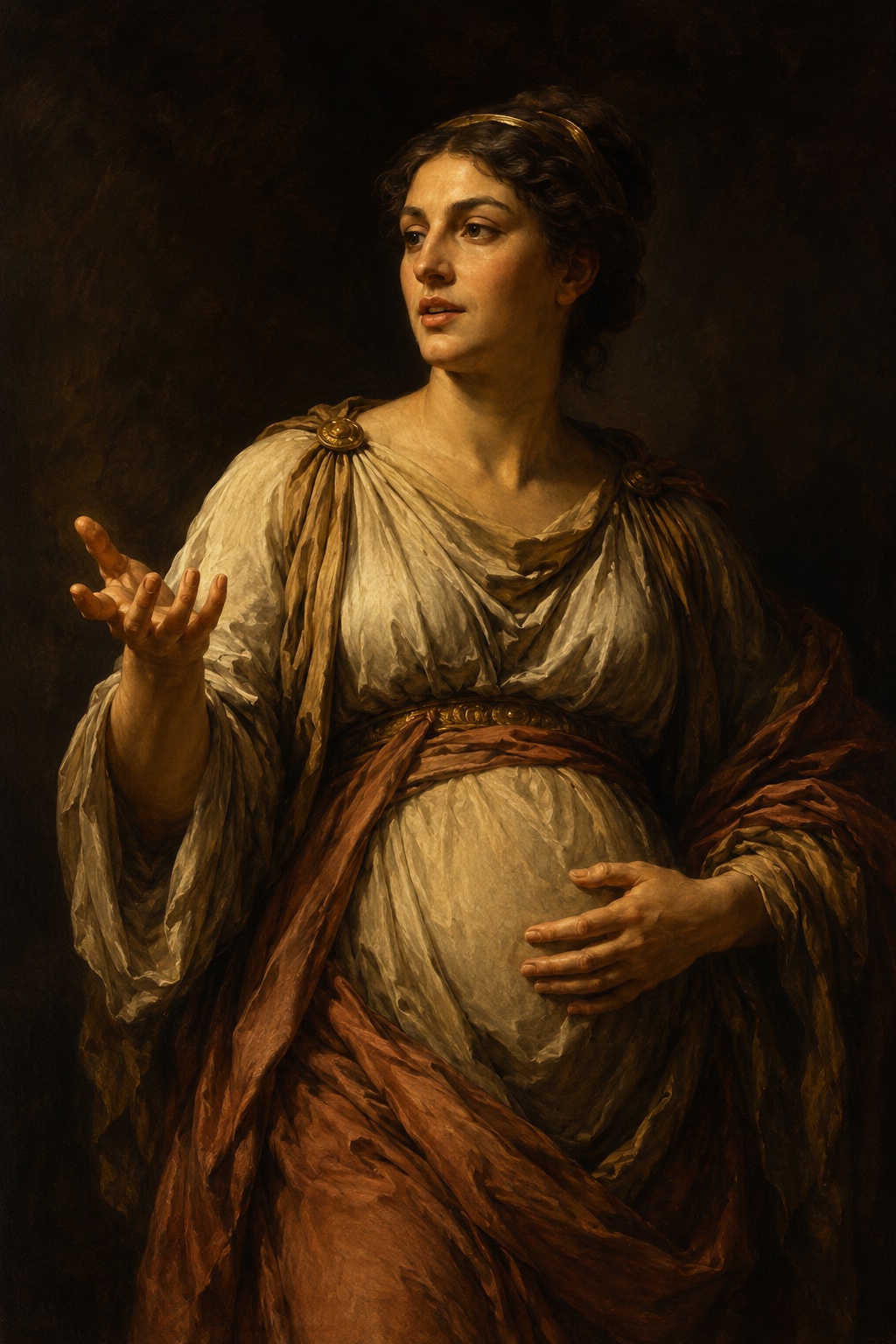
The first wife, and the wisest
Zeus’s marriages are listed in order at the close of the Theogony, and Metis heads the list. She is an Oceanid — Hesiod names her among the daughters of Oceanus and Tethys, in the same long roll that gives the corpus Clymene — and the poem introduces her with a superlative it hands out to nobody else in the catalogue.
Ζεὺς δὲ θεῶν βασιλεὺς πρώτην ἄλοχον θέτο Μῆτιν πλεῖστα τε ἰδυῖαν ἰδὲ θνητῶν ἀνθρώπων. ἀλλ᾽ ὅτε δὴ ἄρ᾽ ἔμελλε θεὰν γλαυκῶπιν Ἀθήνην τέξεσθαι, τότ᾽ ἔπειτα δόλῳ φρένας ἐξαπατήσας αἱμυλίοισι λόγοισιν ἑὴν ἐσκάτθετο νηδὺν Γαίης φραδμοσύνῃσι καὶ Οὐρανοῦ ἀστερόεντος. τὼς γάρ οἱ φρασάτην, ἵνα μὴ βασιληίδα τιμὴν ἄλλος ἔχοι Διὸς ἀντὶ θεῶν αἰειγενετάων.
“Now Zeus, king of the gods, made Metis his wife first, and she was wisest among gods and mortal men. But when she was about to bring forth the goddess bright-eyed Athene, Zeus craftily deceived her with cunning words and put her in his own belly, as Earth and starry Heaven advised. For they advised him so, to the end that no other should hold royal sway over the eternal gods in place of Zeus;” — Theogony 886–893, tr. Hugh G. Evelyn-White
Her name is the Greek word for it. Mētis is cunning intelligence, the practical wisdom that finds the way through — the quality Odysseus is praised for, not the contemplative kind. Hesiod does not say she taught it to Zeus or gave it to him. He says she was more of it than anyone, and that Zeus married her.
Swallowed by his own method
What happens next is the only thing the Theogony records her doing, and it is done to her. Zeus deceives her with cunning words and puts her inside himself. The verb Hesiod chooses is the same one he uses for the swallowing three generations earlier — Cronus taking his children down whole — and the word for the deception, δόλῳ, is the word for the trick Rhea plays on Cronus with the stone.
The advice comes from Gaia and Uranus, the same pair who briefed Cronus and were right both times. Their warning is dynastic, and the poem states it flatly.
πρώτην μὲν κούρην γλαυκώπιδα Τριτογένειαν ἶσον ἔχουσαν πατρὶ μένος καὶ ἐπίφρονα βουλήν. αὐτὰρ ἔπειτ᾽ ἄρα παῖδα θεῶν βασιλῆα καὶ ἀνδρῶν ἤμελλεν τέξεσθαι, ὑπέρβιον ἦτορ ἔχοντα· ἀλλ᾽ ἄρα μιν Ζεὺς πρόσθεν ἑὴν ἐσκάτθετο νηδύν, ὡς δή οἱ φράσσαιτο θεὰ ἀγαθόν τε κακόν τε.
“first the maiden bright-eyed Tritogeneia, equal to her father in strength and in wise understanding; but afterwards she was to bear a son of overbearing spirit, king of gods and men. But Zeus put her into his own belly first, that the goddess might devise for him both good and evil.” — Theogony 895–900, tr. Hugh G. Evelyn-White
The danger is the second child, not the first. Athena, already conceived, is only ever going to equal her father; the son who would have come after would have replaced him. So Zeus removes the mother rather than the son, and does it before the son exists. It is the succession pattern of the whole poem — Uranus, Cronus, Zeus — solved one generation early by a king clever enough to act on a prophecy instead of reacting to it.
The counsel that keeps working
The last clause of the passage is the part that makes her different from every other figure a god swallows. Zeus does not put her away to silence her. He puts her away ὡς δή οἱ φράσσαιτο — so that she may advise him — of good and evil alike. Cronus’s swallowed children come back out and destroy him. Metis stays in, and works.
Hesiod does not describe what that is like, or say another word about her afterwards. She simply becomes an internal faculty of the king of the gods, which is what her name meant before the story started. The narrative arrangement is neat to the point of being a definition: the god who rules by mētis has Mētis inside him, permanently, having taken her by a trick she was too wise to be caught by and was caught by anyway.
Athena is born from Zeus’s head, which the corpus records from her own side. Nothing in this passage explains how a goddess conceived by a mother who is now inside her father comes out of his skull; Hesiod juxtaposes the two facts and leaves the joint alone. What he does insist on is the parentage. Whatever Athena is — the counsel, the strategy, the war fought as calculation — she is that because of who her mother was.