The one who answered Frigg
Hermóðr enters the mythology at the moment he is needed, and not a line before. Baldr is dead, and when the gods have come back to themselves the first voice heard is Frigg’s, asking for a rider.
En er goðin vitkuðust, þá mælti Frigg ok spurði, hverr sá væri með ásum, er eignast vildi allar ástir hennar ok hylli ok vili hann ríða á helveg ok freista, ef hann fái fundit Baldr, ok bjóða Helju útlausn, ef hon vill láta fara Baldr heim í Ásgarð. En sá er nefndr Hermóðr inn hvati, sonr Óðins, er til þeirar farar varð. Þá var tekinn Sleipnir, hestr Óðins, ok leiddr fram, ok steig Hermóðr á þann hest ok hleypði braut.
“Now when the gods had come to themselves, Frigg spake, and asked who there might be among the Æsir who would fain have for his own all her love and favor: let him ride the road to Hel, and seek if he may find Baldr, and offer Hel a ransom if she will let Baldr come home to Ásgard. And he is named Hermódr the Bold, Odin’s son, who undertook that embassy. Then Sleipnir was taken, Odin’s steed, and led forward; and Hermódr mounted on that horse and galloped off.” — Snorri Sturluson, Gylfaginning 49, tr. A. G. Brodeur
Every mention of him in Gylfaginning falls inside this one chapter, and this is the first. He has no place in the long catalogue of the Æsir earlier in the book, no hall, no wife and no deed before this one. Snorri gives him an epithet, inn hvati, the Bold, and a father, sonr Óðins, and that is the whole of his introduction. No sentence anywhere names his mother. Frigg’s call goes out to whoever among the Æsir will take it, and the prize she offers — all her love and favour — is open to any of them.
The answer is much shorter than the question. Frigg’s is spoken and long, with a road, a search, a ransom and a condition in it; nobody steps forward with a speech in reply. Snorri reports the answer in a single clause that names the rider and moves on. Then the horse is fetched, and the grammar turns passive for it: Sleipnir was taken, and led forward. The horse is labelled the same way the rider has just been, as Odin’s — hestr Óðins straight after sonr Óðins. The only things Hermóðr himself does in the passage are to mount and to go.
And then Snorri leaves him. The very next sentence turns to the Æsir taking up Baldr’s body, and the whole funeral is told while the rider is out of the text — including the moment when Odin lays the gold ring Draupnir on the pyre. Snorri only comes back to Hermóðr once the funeral has been told to its end.
Nine nights to the bridge
When Snorri picks the thread up again, he does it with a sentence that openly changes the subject, and the ride begins at once.
En þat er at segja frá Hermóði, at hann reið níu nætr dökkva dala ok djúpa, svá at hann sá ekki, fyrr en hann kom til árinnar Gjallar ok reið á Gjallarbrúna. Hon var þökð lýsigulli. Móðguðr er nefnd mær sú, er gætir brúarinnar. Hon spurði hann at nafni eða at ætt ok sagði, at inn fyrra dag riðu um brúna fimm fylki dauðra manna - “en eigi dynr brúin minnr undir einum þér, ok eigi hefir þú lit dauðra manna. Hví ríðr þú hér á helveg?” Hann svarar, at -“ek skal ríða til Heljar at leita Baldrs, eða hvárt hefir þú nakkvat sét Baldr á helvegi?” En hon sagði, at Baldr hafði þar riðit um Gjallarbrú, “en niðr ok norðr liggr helvegr.”
“Now this is to be told concerning Hermódr, that he rode nine nights through dark dales and deep, so that he saw not before he was come to the river Gjöll and rode onto the Gjöll-Bridge; which bridge is thatched with glittering gold. Módgudr is the maiden called who guards the bridge; she asked him his name and race, saying that the day before there had ridden over the bridge five companies of dead men; ‘but the bridge thunders no less under thee alone, and thou hast not the color of dead men. Why ridest thou hither on Hel-way?’ He answered: ‘I am appointed to ride to Hel to seek out Baldr. Hast thou perchance seen Baldr on Hel-way?’ She said that Baldr had ridden there over Gjöll’s Bridge,—‘but down and north lieth Hel-way.’” — Snorri Sturluson, Gylfaginning 49, tr. A. G. Brodeur
Nine nights, dark valleys, and nothing seen: the journey itself takes one clause and has no events in it. The first thing that happens on the road to Hel is that somebody notices him, and what she notices is that he does not belong there. Móðguðr keeps the bridge over the Gjöll, thatched with gleaming gold, and she has kept count of what crosses it — five companies of dead men the day before. The bridge rang no less under one rider than under all of them, and he does not have the colour of the dead. Before anyone in Hel has seen his face, his weight and his colour have already given him away as a living man.
That remark is also the nearest thing to a description of him in any source this corpus can reach. No passage gives Hermóðr a face, a stature, a colour of hair or a single adjective of appearance. The one physical fact on record is a negative one, spoken by the keeper of a bridge: he is not the colour of a dead man.
She asks his name and his kin, at nafni eða at ætt, and he gives her neither. What he answers with is the errand — he is to ride to Hel to look for Baldr — and then a question of his own: has she seen Baldr on the road? These are the only words Hermóðr speaks aloud anywhere in Gylfaginning. Everything else he says, to Hel and afterwards to the gods, Snorri reports at second hand.
Her reply is directions, and it holds a detail that is easy to read past. Baldr has already ridden over the Gjöll-bridge. The dead brother went down this road on horseback too, and the living one is following his track; beyond the bridge, the road runs down and to the north.
Over the gate
Past the bridge the road ends at the gate of Hel itself, and here, for the only time in the ride, Snorri slows down to show what the rider does with his hands.
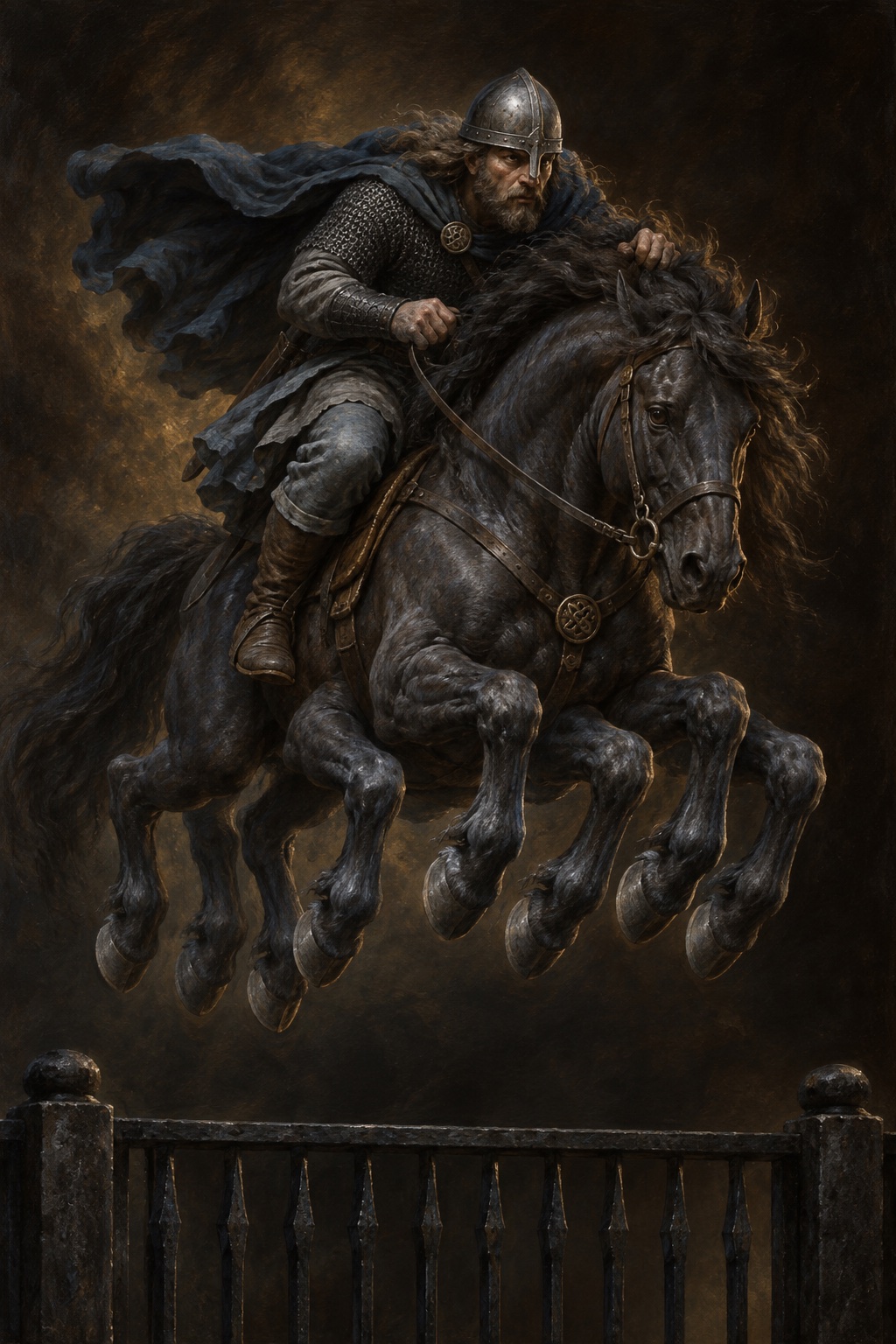
Þá reið Hermóðr, þar til er hann kom at helgrindum. Þá sté hann af hestinum ok gyrði hann fast, steig upp ok keyrði hann sporum, en hestrinn hljóp svá hart ok yfir grindina, at hann kom hvergi nær. Þá reið Hermóðr heim til hallarinnar ok steig af hesti, gekk inn í höllina, sá þar sitja í öndugi, Baldr bróður sinn, ok dvalðist Hermóðr þar um nóttina. En at morgni þá beiddist Hermóðr af Helju, at Baldr skyldi ríða heim með honum, ok sagði, hversu mikill grátr var með ásum. En Hel sagði, at þat skyldi svá reyna, hvárt Baldr var svá ástsæll - “sem sagt er. Ok ef allir hlutir í heiminum, kykvir ok dauðir, gráta hann, þá skal hann fara til ása aftr, en haldast með Helju, ef nakkvarr mælir við eða vill eigi gráta.”
“Then Hermódr rode on till he came to Hel-gate; he dismounted from his steed and made his girths fast, mounted and pricked him with his spurs; and the steed leaped so hard over the gate that he came nowise near to it. Then Hermódr rode home to the hall and dismounted from his steed, went into the hall, and saw sitting there in the high-seat Baldr, his brother; and Hermódr tarried there overnight. At morn Hermódr prayed Hel that Baldr might ride home with him, and told her how great weeping was among the Æsir. But Hel said that in this wise it should be put to the test, whether Baldr were so all-beloved as had been said: ‘If all things in the world, quick and dead, weep for him, then he shall go back to the Æsir; but he shall remain with Hel if any gainsay it or will not weep.’” — Snorri Sturluson, Gylfaginning 49, tr. A. G. Brodeur
The gate is the one obstacle in the whole journey, and nobody negotiates it. The text puts no keeper there to answer, and there is no knocking and no bargaining at the bars. Hermóðr gets down, pulls the girth tight, gets back up and puts in the spurs — the plain sequence of a man about to ask a horse for a very big jump — and the horse clears the gate with room to spare. Snorri does not name the horse in this passage at all; it is simply the steed, and the reader is left to remember that it is Odin’s. It is the one image in his story that could be painted straight from the text, and half of it belongs to a borrowed animal.
Inside, the scene is almost bare. He sees Baldr, his brother, sitting in the high seat, and he stays the night. Snorri gives no word between them. Baldr has no line of speech anywhere in the visit, and whatever the two brothers said to each other through that night is not recorded.
In the morning comes the embassy itself, and it is not quite the one Frigg sent. She sent him to offer Hel a ransom, útlausn. What the text has him do is ask — that Baldr may ride home with him — and tell Hel how great the weeping is among the Æsir. It names no price and reports no offer. Hel takes the thing he did bring, the report of grief, and makes a test of it: if everything in the world, living and dead, weeps for Baldr, he goes back to the Æsir, and if a single thing refuses, he stays. The word Hermóðr brought with him, grátr, weeping, comes back to him as her condition.
A ring instead of a brother
He leaves with things in his hands, and none of them is the thing he came for.
Þá stóð Hermóðr upp, en Baldr leiddi hann út ór höllinni ok tók hringinn Draupni ok sendi Óðni til minja
“Then Hermódr arose; but Baldr led him out of the hall, and took the ring Draupnir and sent it to Odin for a remembrance.” — Snorri Sturluson, Gylfaginning 49, tr. A. G. Brodeur
The ring is not given to him. Baldr sends it to Odin, til minja, for a remembrance, and Hermóðr is only the hand it travels in. It is the second of Odin’s things he has carried on this errand: he rode down on his father’s horse, and he rides back up with his father’s ring, which went onto the pyre in the part of the chapter where the rider was away. Nanna’s gifts for Frigg and for Fulla are sent up in the same breath, and they are hers to explain. For Hermóðr’s side of the story the point is simpler. He was sent to bring a person back, and he comes home as a courier.
The ride home gets even less room than the ride down.
Þá reið Hermóðr aftr leið sína ok kom í Ásgarð ok sagði öll tíðendi, þau er hann hafði séð ok heyrt.
“Then Hermódr rode his way back, and came into Ásgard, and told all those tidings which he had seen and heard.” — Snorri Sturluson, Gylfaginning 49, tr. A. G. Brodeur
Séð ok heyrt, seen and heard: his last act in Gylfaginning is testimony. He has been where the dead go and come back alive, and what he brings to Ásgard is an account of it — the bridge, the gate, his brother in the high seat, and Hel’s terms.
Then the story goes on without him. The next sentence has the Æsir send messengers over all the world to ask that Baldr be wept out of Hel. Snorri gives those messengers no names; they are erendreka, more than one of them, and Hermóðr is not said to be among them. The rider who heard the condition from Hel herself does not carry it round the world, and when a giantess in a cave refuses to weep, it is the messengers who find her. When Gangleri sums up the loss a few lines later, he blames Loki that Baldr was “not redeemed out of Hel”, and the man who was sent to redeem him goes unmentioned. Gylfaginning does not name Hermóðr again.
Other thresholds
Outside Gylfaginning a Hermóðr turns up twice in verse, both times in Odin’s service and neither time on the road to Hel. The first is in Hyndluljóð, where Freyja wakes the giantess Hyndla and starts to list what Odin gives to those who serve him.
Biðjum Herjaföðr í hugum sitja, hann geldr ok gefr gull verðungu; gaf hann Hermóði hjalm ok brynju, en Sigmundi sverð at þiggja.
“The favor of Heerfather seek we to find, / To his followers gold he gladly gives; / To Hermoth gave he helm and mail-coat, / And to Sigmund he gave a sword as gift.” — Hyndluljóð 2, tr. H. A. Bellows
The next stanza runs on through victory and treasure, wisdom and skill with words, fair winds and the singer’s art; this one names two who were given things. Hermóðr’s share is war-gear, a helm and a mail-coat, and the name beside his is Sigmund’s, whom Bellows’s note makes a son of Volsung. It is the only thing any source this corpus reaches gives him to wear. Whether this Hermóðr is the rider of Gylfaginning the stanza does not say. It never calls him Odin’s son; it sets him next to Sigmund as another favoured follower. Bellows’s note identifies him with the son of Odin whom the Prose Edda sends to Hel to ask for Baldr’s return. That is one translator’s reading, and this page records it without deciding it.
The second is Hákonarmál, the poem Eyvindr skáldaspillir made on the death of King Hákon and on how he was received in Valhalla. Skögul, one of Odin’s valkyries, rides home ahead of the king to tell the gods that he is coming, and Odin gives his orders.
Hermóðr ok Bragi, kvað Hroptatýr, gangið í gögn grami, alls konungr ferr, sás kappi þykkir, til hallar hinig
“To Her mod and to Braga then / Said Odin, ‘Here, the first of men, / Brave Hakon comes, the Norsemen’s king,— / Go forth, my welcome to him bring.’” — Eyvindr skáldaspillir, Hákonarmál 14, tr. Samuel Laing
Odin speaks here under the name Hroptatýr, and he sends Hermóðr and Bragi out to meet the king, gangið í gögn grami. If this is the same figure, it is the Baldr errand turned the other way round: in Gylfaginning he rides out from the gods to fetch a dead man back from the far side, and here he goes out from Odin’s hall to receive a dead man coming in. The poem does not call him Odin’s son either, and Laing’s page offers no note on him. Laing’s Victorian verse is loose, and it breaks the name in two, Her mod; the Old Norse keeps it whole.
Put the three sources side by side and the figure is steady in one respect only: he always goes somewhere on someone else’s word. Frigg asks, and he rides. Odin gives, and he is armed. Odin speaks, and he goes to the door. Nothing in any of them starts with him — the horse is borrowed, the ring is carried for another, the arms are a gift — and the only words of his own that survive are an errand and a request for directions. The domains on this page, travel, the underworld and death, are not three powers of his. They are the route.