The god who would not say his name
Okuninushi’s entry gives him half a clause — “with the dwarf deity Sukunabikona he lays out the land” — and moves on to the surrender of Izumo. The Kojiki gives him an entrance instead, and it is one of the strangest paragraphs in the book.
故大國主神坐出雲之御大之御前時,自波穗乘天之羅摩船而内剥鵝皮剥為衣服,有歸來神。尒雖問其名,不答。且雖問所從之諸神,皆白不知。尒多迩具久白言〈自多下四字以音〉 :「此者久延毗古必知之。」即召久延毗古問時,答白:「此者神産巢日神之御子,少名毗古那神。〈自毗下三字以音〉」故尒白上於神産巢日御祖命者,答告:「此者實我子也。於子之中,自我手俣久岐斯子也〈自久下三字以音〉。故与汝葦原色許男命,為兄弟而作堅其國
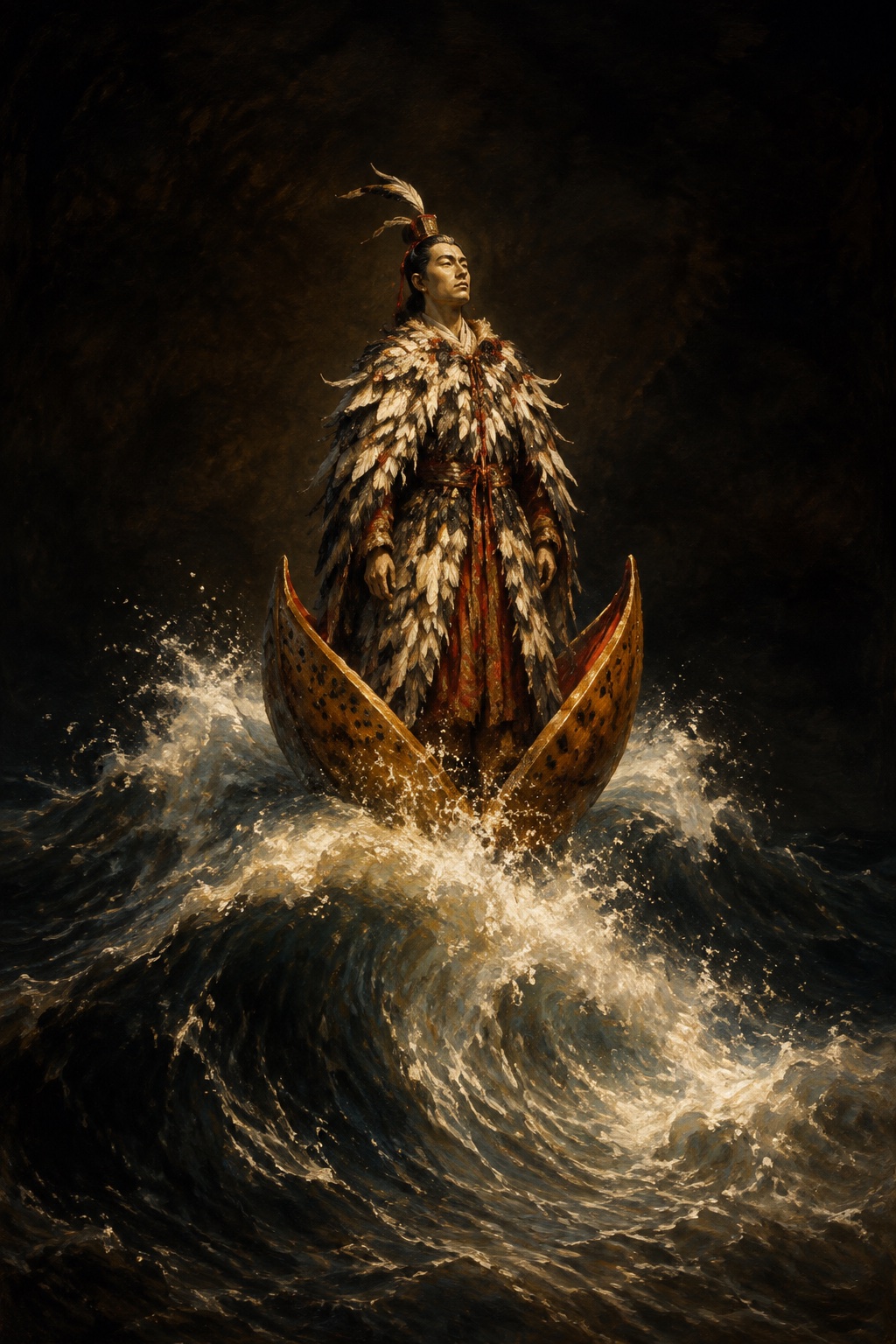
“So when the Deity Master-of-the-Great-Land dwelt at the august cape of Miho in Idzumo, there came riding on the crest of the waves in a boat of heavenly Kagami a Deity dressed in skins of geese flayed with a complete flaying, who, when asked his name, replied not; moreover the Deities who accompanied him, though asked, all said that they knew not. Then the toad spoke, saying: ‘As for this, the Crumbling Prince will surely know it.’ Thereupon the Deity Master-of-the-Great-Land summoned and asked the Crumbling-Prince, who replied, saying: ‘This is the Little-Prince-the-Renowned-Deity, the august child of the Deity-Producing-Wondrous-Deity.’ So on their then respectfully informing His Augustness the Deity-Producing-Wondrous-August-Ancestor, he replied, saying: ‘This is truly my child. He among my children is the child who dipped between the fork of my hand. So do he and thou become brethren, and make and consolidate this land.’” — Kojiki, Sect. XXVII, tr. Basil Hall Chamberlain (1882)
Everything about the arrival refuses the ordinary machinery. He comes 自波穗 — from the crest of the wave, riding it — in a boat of 天之羅摩, the pod of the kagami vine, which is to say a seed-case; he is wearing 鵝皮, goose skins flayed whole, with the feathers still on. Asked his name, 不答: he does not answer. Nobody in his own retinue can supply it either. In a chronicle whose main business is genealogy, where every deity arrives with a name and a parent already attached, a god turns up who has neither and declines to help.
The identification is then made by the two least likely witnesses in the corpus. A toad speaks first, to say that someone else will know; the someone else is Kuebiko, and the same passage tells us plainly what Kuebiko is — the scarecrow standing in the mountain fields, a deity who cannot walk and who knows everything under heaven. The scarecrow names him. Only then does his father confirm it, and even the confirmation is a physical oddity: 自我手俣久岐斯子 — the child who slipped through the fork of my fingers. He is so small that his own parent lost him.
作堅此國 — what the two of them did
The mandate is one line long and the Kojiki executes it in one more.
故自尒,大穴牟遲与少名毗古那二柱神相並,作堅此國。然後者,其少名毗古那神者,度于常世國也
“So from that time forward the two Deities the Great-Name-Possessor and the Little-Prince-the-Renowned-Deity made and consolidated this land conjointly. But afterwards the Little-Prince-the-Renowned-Deity crossed over to the Eternal Land.” — Kojiki, Sect. XXVII, tr. Basil Hall Chamberlain (1882)
相並 — side by side, in parallel. Not sent, not commanded, not serving: the Kojiki is careful that the two of them work as a pair, and the god who came in the seed-pod is the one Kamimusubi told Okuninushi to become brothers with, not the one told to obey. Then 然後者, and afterwards, he crosses to Tokoyo, the Eternal Land over the sea, and the sentence that reports it is shorter than the one that reports his clothes.
He is not killed, does not quarrel, and is not summoned home. He simply leaves, and everything Okuninushi does after this — the negotiation with heaven, the surrender of Izumo, the great shrine with its pillars in the bedrock — he does alone.
或有所成。或有不成 — the one thing he says
The Nihon Shoki tells the same partnership and adds the detail the Kojiki leaves out: what the two of them were actually for.
夫大己貴命與少彥名命。戮力一心。經營天下。復爲顯見蒼生及畜產。則定其療病之方。又爲攘鳥獸昆虫之災異。則定其禁厭之法。是以百姓至今咸蒙恩頼
“Now Oho-na-mochi no Mikoto and Sukuna-bikona no Mikoto, with united strength and one heart, constructed this sub-celestial world. Then, for the sake of the visible race of man as well as for beasts, they determined the method of healing diseases. They also, in order to do away with the calamities of birds, beasts, and creeping things, established means for their prevention and control.” — Nihongi, Book I, tr. W. G. Aston (1896)
戮力一心, joining strength with a single heart — and then two inventions, both of them practical and both of them for somebody else. 療病之方, the method of healing sickness, is for 顯見蒼生, the visible race of men, and for the livestock as well; 禁厭之法, the means of warding, is against the harm done by birds, beasts and insects. This is why he is a medicine god in every shrine that keeps him, and the reason is stated flatly here rather than inferred: 百姓至今咸蒙恩頼, the people to this day all receive the benefit.
Then the chronicle gives him a line of dialogue, the only one he has anywhere.
嘗大己貴命謂少彥名命曰。吾等所造之國。豈謂善成之乎。少彥名命對曰。或有所成。或有不成。是談也。蓋有幽深之致焉。其後少彥名命行至熊野之御碕。遂適於常世郷矣
“Before this Oho-na-mochi no Mikoto spake to Sukuna-bikona no Mikoto, and said: ‘May we not say that the country which we have made is well made?’ Sukuna-bikona no Mikoto answered and said: ‘In some parts it is complete and in others it is incomplete.’ This conversation had doubtless a mysterious purport. Thereafter Sukuna-bikona no Mikoto went to Cape Kumano, and eventually proceeded to the Everlasting Land.” — Nihongi, Book I, tr. W. G. Aston (1896)
或有所成。或有不成 — some of it is made; some of it is not. Eight characters, refusing a compliment, and then he leaves. The chronicler will not let it pass as small talk: 蓋有幽深之致焉, there is doubtless a deep and hidden import in it — a Chinese-trained historian’s way of admitting that a sentence in his own source is doing more work than he can account for. It is the only verdict on the creation of Japan delivered by anyone who helped make it, and it is a negative one.
The Nihon Shoki immediately adds the alternative departure, and it is worth having: 至淡嶋而緣粟莖者。則彈渡而至常世郷矣 — at the island of Awa he climbed a millet stalk, and was flicked off it, and so went to the Eternal Land. Both versions are in the same paragraph and the chronicle prefers neither. A god who arrived on a wave in a seed-pod leaves by being catapulted off a grain stem, and either way the last thing he does is go over the water.
What the two chronicles agree on
Put the accounts side by side and they disagree about almost every detail. The Kojiki dresses him in goose skins; the Nihon Shoki elsewhere makes them wren skins, and Aston’s own note observes that the wren was substituted as better suited to his dwarfish size — which is the chroniclers themselves reasoning about his height, not a modern gloss. The Kojiki has the toad and the scarecrow name him; the Nihon Shoki never asks. The Kojiki sends him straight from the land-making to Tokoyo; the Nihon Shoki gives him a conversation first, and then two ways of going.
What survives every retelling is a shape: he arrives from the sea, uninvited and unexplained; he works beside Okuninushi rather than under anyone; he leaves the work unfinished and says so; and he goes back over the sea. He is the only major figure in the Kojiki’s Izumo cycle who is neither born into the genealogy nor conquered by it. Two chronicles could not agree on his clothes, his boat, or his exit, and both of them kept the part where he says the country is not finished.
One textual note, since this atlas quotes the originals: the Kojiki on zh.wikisource writes his name 少名毗古那神, with 毗, and the Nihon Shoki writes it 少彥名命, with 彥. Modern editions standardise on 少名毘古那 and 少彦名, and this entry uses the standard form for the name and the source’s own characters inside the quotations.