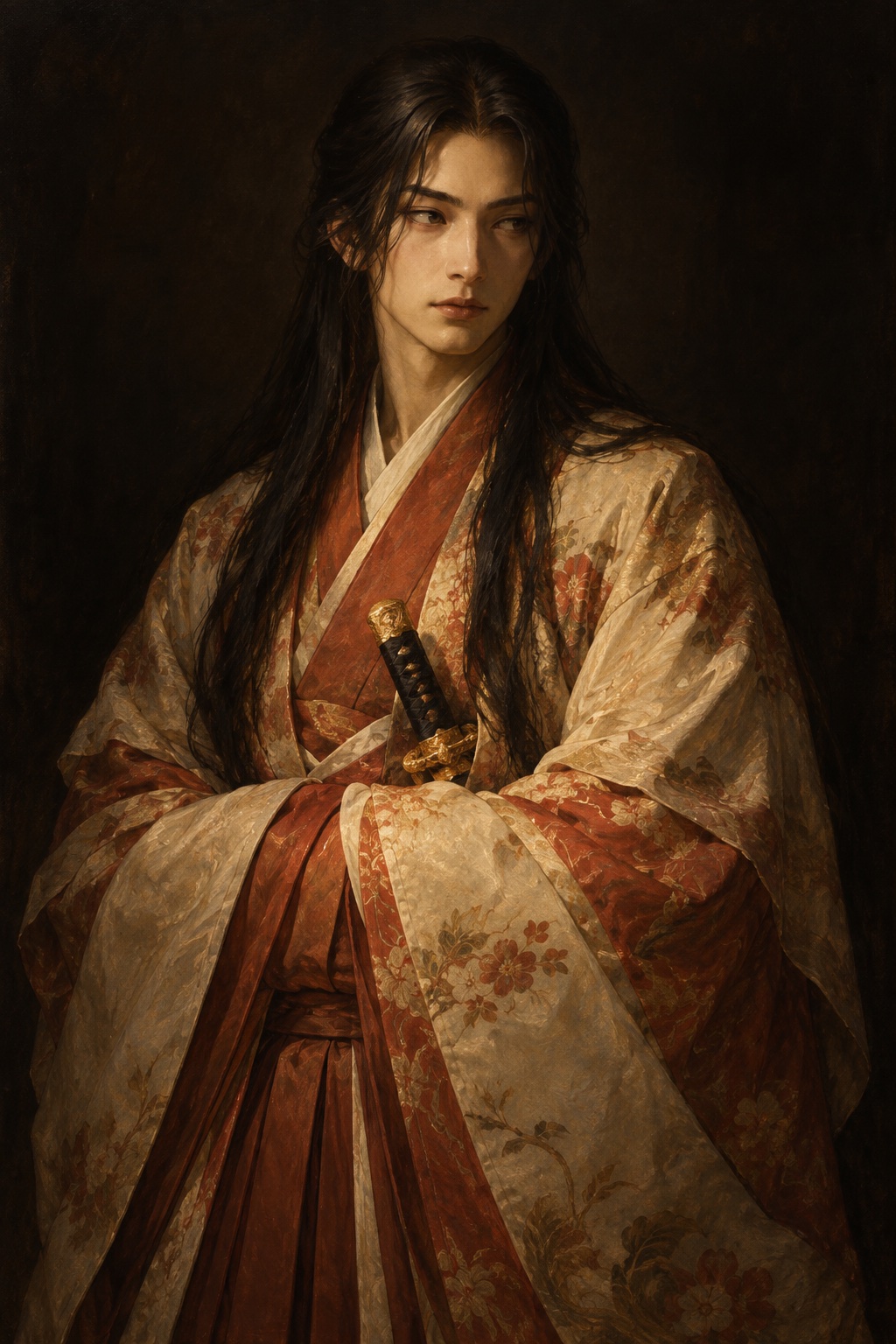
A name taken from the Kumaso
The Kojiki tells his story inside his father’s reign. The kanbun names the father 大帶日子淤斯呂和氣天皇, Chamberlain gives him as Oho-tarashi-hiko-oshiro-wake, and Chamberlain’s section headings file the whole run under Emperor Kei-kō, which this atlas writes Keikō. The headings number the son’s adventures as parts of the father’s reign — the white bird at the end is Part XV — but it is the son those parts follow.
The son begins with another name. The kanbun calls him 小碓命, which Chamberlain renders His Augustness Wo-usu. Chamberlain writes the name he ends with as Yamato-take; Aston’s English Nihon Shoki writes Yamato-dake; this atlas writes Yamato Takeru. The name is not given to him at birth, and it is not given by his father. He receives it from a man he is in the act of killing.
The Heavenly Sovereign, in Chamberlain’s words, was alarmed at the valour and ferocity of his august child’s disposition, and sent him west against two Kumaso bravoes, unsubmissive and disrespectful men, with the order to take them. The boy’s hair was still bound up at the brow, which Chamberlain notes was a youth’s style. His aunt, Yamato-hime (倭比賣命), gave him her upper garment and her skirt, and he set out with a small sword, 小劔, hidden in his bosom. At the Kumaso house he found a three-fold belt of warriors round a cave-dwelling, and the household noisily getting food ready for a feast to celebrate the cave. He waited in the neighbourhood for the day.
When it came, he combed his hair down after the manner of girls and put on his aunt’s clothes, and in Chamberlain’s phrase he looked quite like a young girl. He stood among the women and went inside. The two brothers, delighted at the sight of the maiden, set her between them. At the height of the feast he drew the sabre from his bosom, caught the elder brother by the collar of his garment and thrust the sabre through his chest. The younger brother ran. The prince caught him at the bottom of the steps of the cave, seized him by the back and thrust the sabre through his buttock.
The dying man asked him not to move the sword, because he had something to say, and then asked who he was. The prince named his father and the palace his father ruled from, and gave his own name as King Yamato-wo-guna, 倭男具那王. The answer that came back is the reason for the name this entry is filed under.
然於大倭國。益吾二人而。建男者坐祁理。是以。吾獻御名。自今以後。應稱倭建御子
“Yet in the Land of Great Yamato there is a man braver than we two,—there is. Therefore will I offer thee an august name. From this time forward it is right that thou be praised as the August Child Yamato-take.” — Kojiki, Sect. LXXX, tr. Basil Hall Chamberlain (1882)
The kanbun shows what the English cannot. It calls the brothers 熊曾建, the Kumaso Takeru, and Chamberlain turns 建 into “bravoes”. The braver man in Yamato is a 建男, and the name offered is 倭建御子: the brothers’ own title, the same character, moved from Kumaso to Yamato by the last man who bore it. As soon as he had finished speaking, the prince ripped him up like a ripe melon and killed him, and the section closes on the result. From that time he was praised by the name 倭建命. The text does not say whether the gift was a surrender, a compliment or a trick; it records only that the name was accepted, and kept.
The sword, the bag and the burning moor
The next gift also comes from his aunt. When he left her, departing in Chamberlain’s words with lamentations and tears, Yamato-hime gave him two things: a sword, which the kanbun names 草那藝劍 and Chamberlain the Herb-Quelling-Sabre, and an august bag, with the instruction that he should open the mouth of the bag if there should be an emergency. The kanbun adds a small gloss to the sword’s name, noting that the two characters 那藝 are used for their sound. Chamberlain’s note identifies the blade as the Kusa-nagi no tsurugi, and sends the reader back to the end of his Sect. XVIII, where Susanoo found it inside one of the tails of the eight-headed serpent he had slain. It is the sword this atlas calls Kusanagi, the one drawn from Yamata-no-Orochi.
On the road east he came to the land of Wohari and went into the house of Princess Miyadzu, 美夜受比賣, ancestress of the Rulers of that land. He thought of marrying her at once, thought again that he would marry her when he came back, plighted his troth and went on into the Eastern Lands, where he subdued the savage deities and unsubmissive people of the mountains and rivers. In the land of Sagamu the Ruler of the land lied to him. In the middle of this moor, he said, there was a great lagoon, and the deity who lived in it was very violent. The prince went into the moor to see the deity, and the Ruler set the moor on fire.
Knowing he had been deceived, he opened the bag his aunt had given him, and found a fire-striker, 火打, inside.
於是先以其御刀苅撥草。以其火打而。打出火。著向火而。燒退
“Hereupon he first mowed away the herbage with his august sword, took the fire-striker and struck out fire, and, kindling a counter-fire, burnt [the herbage] and drove back [the other fire]” — Kojiki, Sect. LXXXIII, tr. Basil Hall Chamberlain (1882)
Then he came out, killed all the Rulers of that land and burnt them, and the place took its name from the burning: the kanbun writes it 燒津, Chamberlain Yakidzu. What the passage does not do is name the sword at the moor. The name was spoken at the aunt’s house, before the journey; in the grass the kanbun says only 御刀, and Chamberlain only his august sword. The sword does not act by itself here. The prince mows with it, and what saves him is the bag, opened in the emergency his aunt had told him to keep it for.
The sword at the maiden’s bedside
By the end he no longer has the sword. Chamberlain’s note to Sect. LXXXVIII explains a phrase in the text as meaning that the prince went on without weapons, and specifically without the magic sword, which he had left behind in the house of Princess Miyadzu, the woman he had promised on the way east to marry when he came back. From that point the Kojiki follows him wearing out. At Mihe, he says his legs are like three-fold crooks, and very weary, and the place is named for it. On the moor of Nobo, which Chamberlain’s note puts in the province of Ise, he sings of Yamato, secluded behind the mountains that fold round it. Then the illness turns urgent.
此時御病甚急,爾御歌曰。袁登賣能。登許能辨爾。和賀淤岐斯。都流岐能多知。曾能多知波夜。歌竟即崩
“At this time, his august sickness was very urgent. Then, he sang augustly, saying: “The sabre-sword which I placed at the maiden’s bed-side alas! that sword!” As soon as he had finished singing, he died.” — Kojiki, Sect. LXXXIX, tr. Basil Hall Chamberlain (1882)
The last thing he sings of is not Yamato, not his father and not his aunt, but the sword, and where he left it. The song, unlike the prose around it, is written character by character, the way the text had marked 那藝 in the sword’s name, and the word Chamberlain renders “sword”, 多知, comes twice: once in the line that places it at the maiden’s bedside, and once as the song’s last word. Then a courier was sent. The Kojiki draws no lesson from the sequence. It sets down that the sword was left behind, that he went on without it, and that he died singing about it, and leaves the connection to the reader.
A white dotterel eight fathoms long
In Sect. XC his Empresses and his children, who lived in Yamato, came down and built a mausoleum, and crawled weeping through the rice-fields round it, singing. Chamberlain’s note on the word Empresses is dry: it means wives, and the historian habitually speaks of Yamato-take as if he had been Emperor. He never reigns, and the text mourns him as if he had.
於是化八尋白智鳥。翔天而向濱飛行
“Thereupon [the dead prince], turning into a white dotterel eight fathoms [long], and soaring up to Heaven, flew off towards the shore.” — Kojiki, Sect. XC, tr. Basil Hall Chamberlain (1882)
The kanbun calls the bird 八尋白智鳥, and like the crow eight feet long that guided Jimmu, it is measured before it is anything else: eight fathoms. What kind of bird it is, the text leaves open. Chamberlain renders it a white dotterel, and notes that, as usual with the word chidori, defined as any kind of dotterel, plover or sandpiper, it is doubtful what bird is really intended.
His wives and children went after it. They tore their feet on the stubble of the bamboo-grass, forgot the pain and followed with lamentations, singing that they were not going through the sky but on foot. The text adds that these songs were sung at his interment, and are still sung, to the present day, at the great interment of a Heavenly Sovereign. The bird flew off from that country and stopped at Shiki in the land of Kafuchi, which his note distinguishes from the Shiki in Yamato. They built a second mausoleum there and laid him to rest in it, and called it the August-Mausoleum of the White-Bird. The bird soared up to heaven again from there, and flew away. The Kojiki builds him two tombs, and has him leave both.