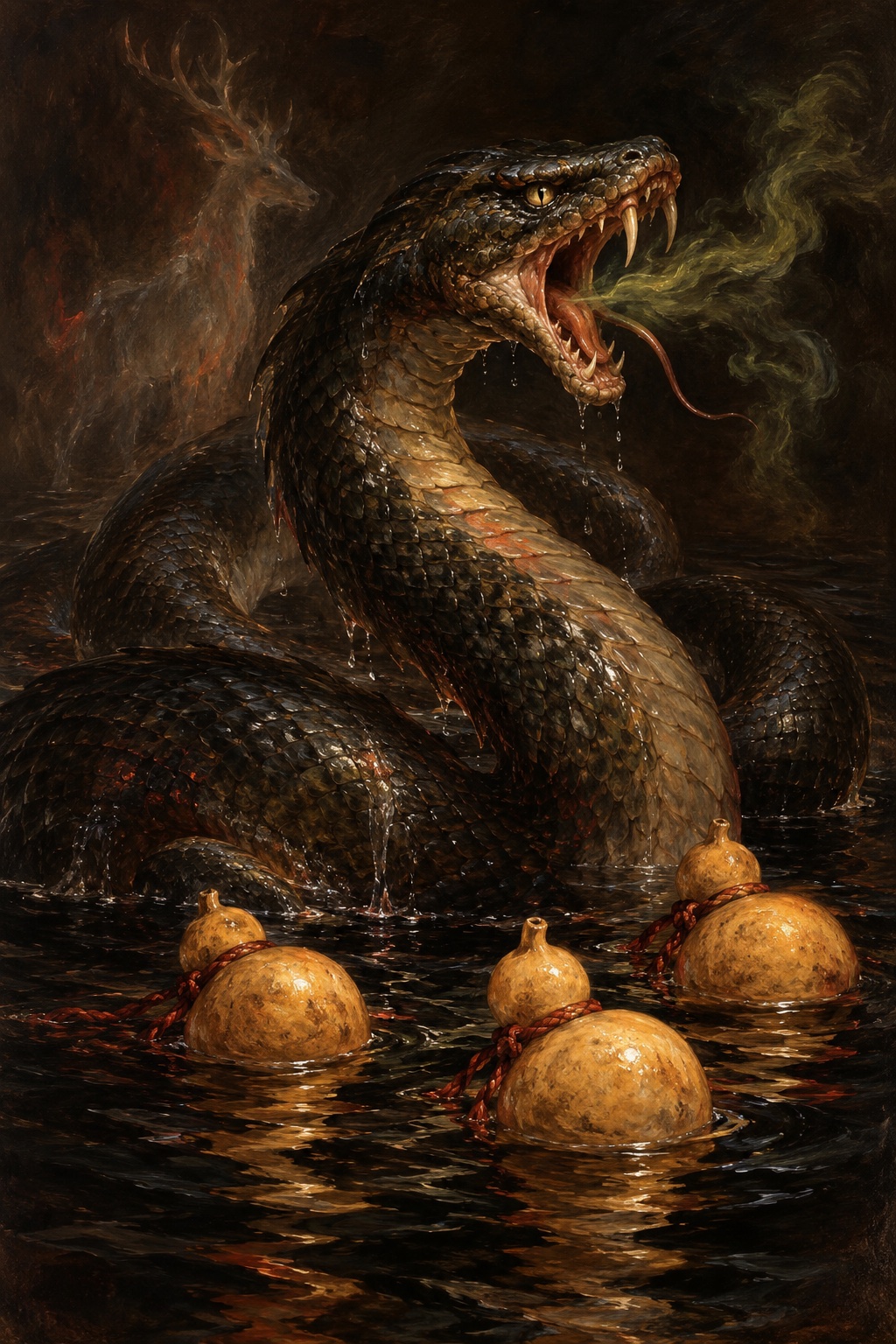
A fork of the Kawashima river
The Nihon Shoki gives this creature one paragraph. It stands in the eleventh book, the annals of the emperor known as Nintoku, under the sixty-seventh year of the reign, which Aston dates A.D. 379. That is two years after the paragraph on Ryōmen Sukuna in the same book. The paragraph gives no month or day, only the year, and it comes directly after another entry of the same year, in which a deer runs in among the labourers at the site of the emperor’s tomb, falls dead, and a shrike flies out of its ear. The chronicle does not connect the two entries.
The place comes first: a fork of a river in the central division of the province of Kibi. The chronicle writes the river 川嶋河, which this atlas romanizes as Kawashima; Aston spells it Kahashima. Then comes the creature, and in Aston’s English it has no name. It is a water-snake, the word he uses every time.
“there was a great water-snake which harassed the people. Now when travellers were passing that place on their journey, they were surely affected by its poison, so that many died.” — Nihongi, Book XI, tr. W. G. Aston (1896)
That is the whole description. The water-snake is great, it harasses the people, and it has poison. The text gives it no size beyond the one word great, no colour, no number of heads and no shape at all. It does not say that the creature ate anyone, or that it came out to attack anyone. The travellers died because they passed that place on their journey, and the poison met them there. Many of them died, and the chronicle does not give a single name.
Three calabashes
The man who ends it comes into the paragraph in the next sentence. He is Agata-mori, the ancestor of the Omi of Kasa, and the chronicle says two things about him: he was fierce, and he was very strong. It does not say that the emperor sent him, or that anyone did. He does not go into the water at first. He stands over the pool at the river fork and throws three whole calabashes into it, and he speaks to the creature. He accuses it of belching up poison again and again and plaguing travellers, and he tells it that he will kill it. Then he sets it a test.
汝沈是瓠則余避之。不能沈者仍斬汝身。
“If thou canst sink these calabashes, then will I take myself away, but if thou canst not sink them, then will I cut up thy body.” — Nihongi, Book XI, tr. W. G. Aston (1896)
The test has two halves of the same shape. 汝沈是瓠, if you sink these calabashes, 則余避之, then I will go away. 不能沈者, if you cannot sink them, 仍斬汝身, then I will cut your body. The creature is offered one way to make the man leave. The verb of the threat is 斬, to cut, and the kanbun uses it again twice before the paragraph ends, when he kills the creature and when he kills the rest of its kind.
The creature takes the test. In Aston’s English the water-snake changed itself into a deer and tried to draw the calabashes down, and the calabashes would not sink. That is the only time in the paragraph that the creature does anything except poison travellers, and the chronicle does not explain it. It does not say why the creature took the shape of a deer, or how a deer could pull a calabash under the water. It says only that the calabashes stayed on the surface. Agata-mori then raised his sword, went into the water and killed it.
He did not stop there. He looked for the water-snake’s fellows, and he found that the tribe of all the water-snakes filled a cave in the bottom of the pool. He killed every one of them. This is the only information the text gives about the creature’s kind. It calls the others its fellows and its tribe, not its children, and it does not say how many there were or that any of them had harmed anyone.
Book XI tells a calabash test once before, under the eleventh year of the reign, which Aston dates A.D. 323. A god tells the emperor in a dream that two men must be sacrificed to the River-God before the gaps in an embankment can be closed. One of them, Koromo no ko, throws two whole calabashes into the stream and challenges the River-God to sink them. A whirlwind tries to pull them under, they will not sink, and Koromo no ko does not die. In that story the test decides whether a man must give himself to the water; in this one it decides whether the creature must die. The chronicle draws no connection between the two.
The pool of Agata-mori
When the last of them was dead, the river changed, and the pool was given a name.
河水變血。故號其水曰縣守淵也。
“the water of the river became changed to blood. Therefore that water was called ‘The pool of Agata-mori.’” — Nihongi, Book XI, tr. W. G. Aston (1896)
河水變血: the water of the river became blood. 故號其水曰縣守淵也: for this reason that water was called 縣守淵, the pool of Agata-mori. The name of the place is 縣守, the man’s name, with the word for a pool after it. So at the end of the story the pool carries the name of the man who killed the creature, and the creature itself keeps no name in the text at all. Here the story ends. The chronicle does not say what became of the bodies, whether the blood cleared, or whether travellers could pass the place safely again.
The next sentence of the annal turns to the whole country. At this time, it says, pestilential vapours arose more and more, and there were one or two rebellions. The emperor rose early and went to bed late, lightened the taxes and the imposts, and was generous to the people. The chronicle does not say that the vapours or the rebellions had anything to do with the water-snake, and the annals of Nintoku do not mention the water-snake again.
Water-snake or water-god
The name that this atlas uses is not a name in the chronicle. Aston’s English calls the creature a water-snake every time it appears: the great water-snake of the first sentence, the water-snake whom Agata-mori addresses, the water-snake that becomes a deer, and the tribe of all the water-snakes in the cave. The kanbun has its own character for the creature, but that character is not legible in the available transcription. In every place where the creature is named, the online transcription of the chronicle shows a placeholder instead of the character, so this entry does not say which character the chronicle writes.
Aston gives the traditional reading of the character in a note.
“traditional kana rendering of the Chinese character translated “water-snake” is midzuchi. Midzu is waters and chi a honorific term meaning “elder.” Midzuchi means indifferently water-snake or water-god, the two ideas being intimately associated in the Japanese mind.” — W. G. Aston, Nihongi (1896), note to Book XI
Midzuchi is Aston’s spelling of that reading. This atlas writes it Mizuchi and joins it to the name of the river, as Mizuchi of Kawashima, because the word is the reading of the chronicle’s ordinary noun for the creature and not a name of its own. The river’s name tells this creature apart from any other that the same word could describe.
Aston’s note says that the word means a water-snake or a water-god without distinction. Aston’s English never calls this creature a god, and the paragraph tells of no worship and no offering. In his English it is a water-snake from beginning to end: it poisons the people who pass, it takes a test and fails it, it changes its shape once, and it dies with its tribe in the pool that is then named for its killer. That is all the chronicle tells of it.